|
My first impression of La Brasserie
was that it was like walking into Manet's painting
"Bar at the Folies-Bergere." There were
waitresses dressed in black uniforms with white collars
and white aprons, and French-speaking foreigners at
several of the tables. It was just like being in a
brasserie in France.
Brasseries play an
important role in everyday French life.
They are casual and informal places where
traditional French food is served.
Executive Chef Jean-Claude
Herchembert, a native of Vichy, was previously
in charge of the world-renowned Le Cordon
Bleu Cooking School.
|
 |
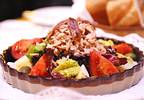
In their Salad Niciose (NT$320),
lemon is used to bring out the crispy freshness
of the lettuce. Another classic is the French
Onion Soup (NT$250) where a slow cooking method
brings forth the fragrance of onions. Alsace
Schweinehaxe with Sauerkraut (NT$650) has meat
so juicy and tender that it melts in your mouth.
Sauerkraut and mustard accompanies this dish.
 |
According to Jean-Claude,
good French cooking cannot exist without
cheese, good bread, and fine wine. Taiwanese
are not very much into wine, and they often
pick and choose what they want to eat out
of a platter. Such eating habits make it
difficult to fully enjoy the essence of
French cooking. One has to learn to savor
all the different foods on the same platter;
then you will understand that all the various
tastes compliment one another. That's the
philosophy of French cuisine. |
Looking around, I saw waitresses
moving around tables with their cheese board;
they patiently introduced and explained the
different kinds of cheese, and let diners make
their choices. It was indeed a nostalgic scene
that brought back sweet memories of my days
in Provence.
|


 Contributor's
Boards
Contributor's
Boards