Compass
Magazine, September 2003
| Sun
Li-tsui's "Shang Orientheatre"
By Selena Huang
Translated by Yvonne Chen |
Sun Li-tsui,
whose parents were fans of traditional theater, entered
the Art College (now Taiwan Art University) 25 years
ago to study cinema and theater, and to cultivate
her creativity. After graduating, she studied in Europe,
beginning in Germany, then England, and then going
onto France, then Italy. Finally, she chose to stay
in Paris.
|
During
her six years in Paris, she was in Jacques Lecoq
Performing School, and worked with Marcel Marceau,
Etienne Decroux Mime School, and Henryk Tomaszewski's
National Pantomime School of Poland. After working
with four theater masters, Sun Li-tsui says, "I
seem to have lost myself. When I see how obvious
my physical appearance differs from other Western
actors, I long for my mother, her round body calling
me from home." |
 |
Sun
Li-tsui returned to Taiwan in 1991. With the help
of her teacher Chang Shao-chuan, her taichi improved.
Omei Linchi Chi Kung master Fu Wei-chung passed on
to her the essence of chi kung and inspired her to
learn about humanism, geography, and the human body.
Tacheng Zen master Peng Jin-chuan taught her remarkable
techniques. The year she spent living behind Shaolin
Temple in China's Hunan province influenced her the
most: she embraced Chinese culture living in that
cave.
After
returning from Europe, she tried using her knowledge
to help Taiwanese groups. The results were not evident,
but she gained valuable experience. "The truth
is, it is difficult to fully attain ideal performance
arts in Taiwan. At times, I feel that all the hard
work is a waste of time. But, I know the yearning
to bring in Eastern and Western elements cannot be
weakened by external factors. The deeper you dig into
Chinese culture, the more it affects you."
 |
With
that, she continues to work, motivated by the
support of family members, and encouraged by friends
and students. Theater training has become life's
pursuit: she believes that theater can convey
"real person philosophy." |
"Shang
Orientheatre" was founded the fall of 2001 on
Yangmingshan. For the past year, the members studied
and lived like spirits, practicing their stands and
voices in the deep woods. The spiritual lifestyle
is backed with training in theater and Chinese philosophy
to help the young people of a materialistic world
to open up and find a path back to life.
Breathing,
voice, and the body are used to create taichi, chi
kung, drumming, calligraphy, yoga, and pantomime training
courses that revolve around Chinese philosophy. Solid
guidance allows students to form proper postures,
to think, and to be real and self-aware so they become
"real" on stage as well as in life.
|
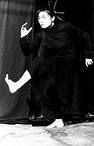
As
tachi and meditation practices proceed, the pantomime
performances become philosophical with a Chinese
feel. Pantomiming itself is universal; any mime
actors know to exaggerate body movements to convey
emotions and the importance of timing during time,
character, and facial changes on stage. Pantomime
performance is elusive: on stage, flowers, jungles,
and animals are possible with a snap of the finger,
the portrait of a dream as told by the body; the
actors are in state of Zen. |
 |
The
use of Chinese architecture on stage, the movements
of Chinese characters, and the shapes, capabilities,
and forces of the actors, life seems complete if interchangeable
with career. It is quite fascinating: the figures
in old Chinese paintings are relaxed and minute against
the immense mountains.

