|
HOME
> TAIPEI
> ARTICLES >
TAIWAN FUN
MAGAZINE, November 2007.
The Hidden Wanhua around Longshan Temple
By Shanzi Chen Translated by Ann
Apart from Longshan temple and the bustling night market, the Wanhua district is full of diversion-worthy scenic tourist spots and historical relics. In this month's cover story, we'll explore Wanhua in-depth and try and discover some new old places to explore. |
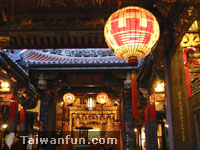 
In the old days, Wanhua was called Mankah (Menjia). In 1920, the Japanese government renamed it Wanhua, in Chinese meaning, "1,000 years of prosperity". If there is one thing that this area has a lot of, it's temples. In the early days of the city, many of the religious followers believed that placing temples at the beginning of streets and other strategic places would help protect their neighborhood and keep spirits at bay, so there are a lot of large and small places of worship here. Today, one street is even called MiaoJie (Shih-Jie), which means "Temple Street".
Many people have heard of Longshan Temple, but not too many visit two affiliated temples--one dedicated to "Dizang" and one to "Dajhong". These buildings, along with two more area temples, "Cing Shan Palace" and "Cingshuei Yan's Temple" are classified as third-grade historical landmarks in Taiwan. The main Buddhist god that the Wanhua locals pray to is Avalokiteshvara, also called Guanyin, the Mercy Buddha, who is an example of compassion. Another god, Dizang, forgives people's sins; Dajhong, the commonalty god, is the judge between the two worlds of ying and yang. The buildings, erected in 1760, are close together on purpose--the townspeople wanted to keep these three gods in a common area.
Today, the main temple is located on 245, SiChang Street. As far as architecture goes, the Dizang Temple is a simple establishment, inspired by the building style of the Qing dynasty. All of the wood inside the temple came from Cyuanjhou; although time has warped the boards to gray and blue, they are still somehow radiant. The Dajhong Temple is smaller than Dizang's; it's simple, consisting mainly of an altar on which people can place offerings to Dajhong. There are also some wonderfully carved panels and decor elements, created by the some of Cyuanjhou's master craftsmen. Although these two temples might be less ornate than others, they're certainly worth checking out.
Located north of Longshan Temple is Cing Shan Palace (GueiYang St., Sec 2). Built in 1856, it serves the Ling-An god, who is also called Cing-Shan. He is in charge of law and justice in the underworld; his devotion is believed to remove pestilence. It is said that hundreds of years ago, when a terrible plague struck the people of Mengjia, a messenger returned to Cyuanjhou's Huian in China to implore Cing-Shan to cure the people in Taiwan. Even just a few years ago, when SARS came to Taiwan, Wanhua was severely infected by the disease; some local residents again called on Cing-Shan to heal the area.
Because Cing-Shan plays such an important part in Wanhua, Menjia celebrates the deity's birthday every October 23. During this large religious event, many ceremonies, re-enactments and performances take place, including appearances by Taiwan's only religious performing group "Bajiang". The festival is one of Wanhua's most important religious events each year, and this year's ceremony will be held from the lunar calendar's November 29 to December 1. |
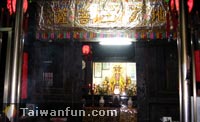 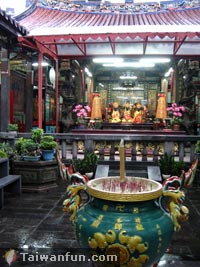 
Cing Shan Palace is long and resembles the Chinese character "川". The temple, which is devoted to Cing-Shan and his wife, includes several rooms and three stories. What makes this temple stand out are the courtyards--they span both sides of the palace. All of the beams, doors, and windows are wooden, which means they are full of exquisitely crafted carvings and sculptures.
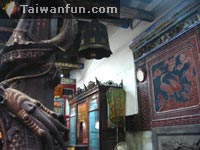
If you go straight from Cing Shan Palace and walk towards KangDing Road, you'll end up at Menjia Cingshuei Yan's Temple, which was built in 1787. Cingsheui Yan is the god of protection and safety for Cyuanjhou's Anxi people. He is believed to have the ability to predict natural disasters. If his nose points downwards, a natural disaster is expected--this nasal communication has also earned him the nickname, "Nose Dropping Master."
Other noteworthy items in the temple include two dragon poles and an iron incisor imported from Cyuanjhou long ago, which is quite precious. The walls are filled up with sculptures and paintings done right on the bricks--a rare sight in Taiwan. The courtyards within the temple and the sides surrounding it are brimming with restaurants and snack food vendors who have been in business for about 50 years, making this location a great place for tourists and locals alike.
|
Special Sightseening Spots |
 |
Bo-Pi-Liao
Besides the temples, there are plenty of other interesting sightseeing spots in Wanhua. One of these spots, Bo-Pi-Liao, is a street preserved and restored to keep with architecture of the Qing dynasty. Located at the intersection of KangDing Road, GuangZhou Street and KunMing Street, this corner is full of two-story houses, Japanese colonial architecture, and traditional stores.
During the Qing dynasty, Bo-Pi-Liao was called Fu-Pi-Liao or Fu-Di-Liao and functioned as a military base; while Japan was in charge, officials renamed the area Bei-Bi-Liao. Today, as Bo-Pi-Liao, the historic area is mainly comprised of homes and business. It wasn't until 1988 that the Taipei government approved a restoration project for the old street. Since then, it has become a place full of culture that acts as a testament to the passing of time and as a witness to Taiwan's history. And, indeed, while walking through the buildings and the archways in Bo-Pi-Liao and looking over the remaining cultural artifacts in Menjia, you can't help but feel a little moved.
For more information, check out:
http://59.120.8.196/
|

|
Wanhua History Exhibition Center
171, ChangSha St, Sec 2, 2F (Tue-Sat 9 am-5 pm), (02) 2371-3557
If you would like to find out more about the Wanhua area, then visit the Wanhua History Exhibition Center, Taipei's first proper "musem". Inside, you can find ancient relics and information about Menjia, as well as admire some of the local residents' family heirlooms that have been handed down for centuries. Documentaries about Menjia and Taiwanese history are shown on a regular basis and the center has a variety of free, informational brochures and pamphlets about the area. |
| Themed Shopping |
When the city streets started developing in Menjia, the same type of businesses stuck together, believing that a central location would increase morale and promote more business for everyone. As a result, the shopping streets on Menjia are basically divided into themed districts. Here's what you can explore in the streets around Longshan Temple:
|

|
The Buddhist Street
SiYuan Rd, Sec 1
On this street, there are about 20 stores selling Buddhist statues and accessories and, in between, you can find a few shops selling trendy, embroidered goods. All the statues and goods sold in the stores are religious crafts--one store, called "Longshan" has been there since 1895! Sometimes, you can even see craftsmen and women embroidering their merchandise, right on the spot. Even if you are not looking to buy anything here, the shops are definitely "browse worthy". |

|
Cing Cao Alley
near Alley 224 on SiChang St
In this area, you can find hundreds of different herbs and medicinal ingredients. Practically all the stores on this alley are well-known for their quality greens. In the early days, it wasn't easy for the residents of Menjia to find doctors of any kind, so these pharmaceutical stores provided the best available medical advice. Even today, in an age full of Chinese and Western medicine and doctors, you can still visit these stores to buy herbal remedies and inquire about ingredients and properties. |


|
Clothing Boutiques
from Wanhua Train Station to Dali St. area
The first wholesale clothing market in Taipei City, the Clothing Boutique Street, has been in existence for close to 50 years. In total, there are about 500 stores selling clothes and underwear. Consumers can find anything from children's garments to fancy dresses, even stores that sell funeral shrouds! The clothing styles you find here are not quite the same as the ones you will find in Wufenpu, but it is still worth the trip. At the corner of Menjia Boulevard and SiYuan Road, there's also a place called the "Taipei Costume Cultural Center", an establishment dedicated to research and education about garment culture. |

|
The Clock & Watch Street
Lane 159, Dali St. (inside and around the Shi-Feng Building)
There are about 36 stores selling clocks and watches on this street. The shops sell timepieces at mid-to-low prices. They also sell watch accessories, like bands, straps, and clocks, to other markets around Taiwan, especially to other big night markets. |

|
The Bird Street
both sides of HePing W Rd, Sec 3
There are about 20 stores on this street that sell all kinds of birds, cages, stands, food, and other bird accessories. The street, which was built on a land bridge, is about 30 years old. Other stores in the area sell more unusual pets like lizards, rats and rabbits. |
|
Today, the Wanhua district is like a lot of Taiwan, full of contrasts between ancient traditions and modern innovations. Although the street scenes here may not be as beautiful as some parts of the island, Wanhua makes for a great lesson in history and local culture. Between the temples, the markets, and the interestingly themed shopping streets, you're time in Wanhua is sure to be unforgettable.
More information about the Wanhua district can be found at:
http://www.waha.taipei.gov.tw/cgi-bin/SM_theme?page=437d7071 |
|

