|
HOME
> CENTRAL TAIWAN
> TAICHUNG CITY > ARTS
& LEISURE >
COMPASS
MAGAZINE, November2004
The
Beauty of Taichung's Ancient Temples
Information
provided by Taichung city government Compiled
by Compass Magazine
|
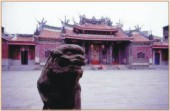 |
Lin Shi Ancestral Shrine
Address:
55, GuoGuang Rd. (southern section Min Zhu Village)
Tel:
(04) 2224-6928
Getting
there: Take Ren You (orange) bus 105 or 125
and get off at Lin-Zu-Cu.
Open
hours: 9 am-5 pm Mon-Fri (open 9 am-12 pm
on first, third, fifth Saturdays)
The influential, important Lin Shi ancestral shrine
has moved many times, reaching its current location
in 1930. The building was constructed with traditional
"Min-Nan" Fujian-style architecture.
The most prominent decorations include carvings,
paintings, Chinese characters, auspicious inscriptions
and clay sculptures. Wooden sculptures are very
important, and the Zhong Shan Door and Main Hall
feature highly detailed alto-relief, circular
sculptures and transparent sculptures. Flowers,
birds, beasts and humans make up most of the artistic
subject matter. The fine artwork of the master
craftsmen can be seen everywhere here.
|
 |
Wen
Chang Temple
Address
: 41, Chang Ping 2nd Rd.
Tel:
(04) 2422-5845
Getting
there : Take Ren You bus 105 and get off
at Si Zhang Li village
Open
hours: 6:30 am-8 pm
Wen Chang Temple was built during the fifth
year of Dao Guang's reign during the Qing dynasty.
Around 1825, official Zeng Yu Yin and his friends
established two clubs, named Wen She and Wen
Bing, which raised money to build the temple.
The total temple area is 1,900 pings and its
purpose is to worship the "Scholar god".
Students often worship this god prior to an
exam in hopes of getting good grades. There
are two Wen Chang temples in Taichung, one in
Beitun district and the other in Nantun. The
main entrances of both temples face south, in
accordance with basic Feng Shui principles.
The temples are primarily constructed of granite,
which was also formed into stone tablets, sometimes
in shape of a drum, for the purpose of engraving
records of important events. The two bottle-shaped
side doors, which both lead into the main hall,
are worth looking at. Perhaps the finest feature
of the temple are the many cute animal figurines
that surround Wu Qu Pond and bring a lively
atmosphere to this ancient temple.
|
 |
Le
Cheng Temple
Address: 48, HanXi St., HanXi Village,
East District
Tel: (04) 2211-1928
Getting there: (By car) Go from the Taichung
train station to Xi-You Rd. and turn right.
Go to the HanXi River, turn right onto HanXi
West Rd. and continue until you see HanXi St.,
where you turn left.
(By bus) Take the city "High Bus"
yellow line from either Chao-Ma, Liming Xin-Cun,
or Le-Cheng Park stops. Get off at the Le-Ye
Rd stop.
Open hours: 6:30 am-10 pm
Le Cheng Temple is more commoly known as the
HanXi Mazu Temple and is located on the eastern
side of the city next to a tributary of Dali
River. The ancestors of Lin Da-Fa invited the
spint of Mazu to come to Taiwan through Mei-Zhou
of China's Fujian province. The spirit of Mazu
went to HanXi village and chose that site for
the temple. The temple is over 200 years old
and, as is its incense cauldron. The well-crafted
holy table, stone-made artifacts, and sapphirine
stone lions are all witness to Le Cheng Temple's
many years of history.
|
 |
Wan-He
Temple
Address: 51, WanHe Rd., sec. 1, Nantun
Village, Nantun District
Tel: (04) 2389-3285
Getting there: (By car) Get off the Rt.
1 Freeway at the TaichungGang Rd. exit and stay
on TaichungGang Rd. until you reach Li Ming Rd.
Turn right onto Li Ming Rd. Go straight until
Nantun Rd. and turn right again. The temple is
at the intersection of WanHe and Nantun roads.
(By bus) Taichung Bus Co. bus 3 or 26 or you can
take Ren You Bus 9, 10, 30 or 40.
Open hours: 6 am-10 pm
Wan-He Temple is also named Li Tou Dian Sheng
Mu Temple. One of its features--consistent through
out all of Taiwan's temples--are complex, exquisitely
designed carvings. Construction was completed
during the fifth year of the reign of Yong Zheng
during the Qing dynasty. During the reign of Emperor
Kang Xi of the same dynasty, a military officer
named Zhang Guo and some of his subordinates quit
their posts in Ding Hai, Zhe Jiang province, in
order to plough and cultivate the lands of MaoWu
LueShe. Later, Zhang Guo went to Mei Han in Fujian
province to deferentially bring the holy sculpture
of the goddess Mazu back to MaoWu LueShe, in order
to bring peace to the land. He then helped built
Wan-He Temple in thanks to Mazu.
|
 |
Ji
Shan Lou
Address: 163, XingAn Rd., sec. 1, Beitun
District
Getting there: By car, get off the Rt.
1 Freeway at the ZhongQing Rd. exit. Head downtown
WenXin Rd. and turn left. Continue to XingAn
Rd. and turn right
Open 24 hours/day.
Information: Taichung City Tourism Office:
(04) 2228-9111, ext. 1651~1652
Ji Shan Lou was built during the late Qing dynasty
period in 1897. Lai Chang Rong moved from Tou
Zhang to what is known today as Er Fen Pu, into
a mud-brick house. In 1924, Lai's descendant,
Lai Chong Ren, built another home south of the
original dwelling upon advice from a Feng Shui
master. The new home helped his business prosper
and he named it "Ji Shan Lou". Ji
Shan Lou was built by a famous construction
company from Tang Shan and no expense was spared.
Its structure is extremely sturdy and, today,
it is easy to see the care and effort put into
the construction. The columns and posts were
made with Chinese fir from Fujian province.
The roof eaves are "dove-tailed" and
use convex-shaped shingles. Murals of grass
and flowers, mirrors, and beautifully-sculpted
columns fill Ji Shan Lou. Behind the house are
also five old banyan trees, whose roots are
entangled and keep the house well shaded. Sitting
quietly here is a peaceful experience for visitors.
|
|
|

