|
|
What
is the relationship between traditional
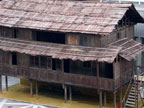
Miao "dangling leg" houses
and the Chinese word "gaichi",
which literally means "must eat"?
As it turns out, Gaichi is the name of
an area in Chang Hua hamlet, in Ping
Lue township, Jin Bing County, Guizhou
Province, China. Over the past 30-plus
years, this unique house has taken a
meandering journey from its original
Gaichi home in China to its present location
at Taichung's National Museum of Natural
Science, where it will be on display
until June 13.
This
building's less-than-remarkable appearance
is misleading, as the structure is an
excellent example of how traditional
Miao architecture is a response to the
surrounding environment. In an embodiment
of traditional wisdom in wood-working,
every room of the house is crafted of
wood and open for display to the public,
giving visitors a chance to enjoy the
acclaimed architecture.
The
building itself is constructed from about
1,300 individual pieces of timber. Renovation
project director Mr. Hu said that each
piece is hand-crafted and assembled to
match the original configuration and
style. The building even creaked and
groaned with every little movement as
a foundation was laid and the building's
framework took shape. By the first month
of the reconstruction, the building became
a labor of love for the 14 to 18 people
involved in the construction process.
The assembly of all the original materials
became a challenge that tested the skills
of these master craftsmen. The final
product, though, is a charming structure
which everyone can enjoy.
As
noted above, the exterior of this 30-year-old
building appears dark and unimpressive
on the outside. But, upon closer inspection,
its construction resembles XieShan architecture,
a style characterized by a distinct roof
ridge and wooden framework construction.
But, why is it called a "dangling
leg" house? The majority of the
Miao people live in the mountainous regions
of Guizhou province, which is hilly and
impoverished. As they depend heavily
on agriculture for subsistence, the Miao
utilize every piece of arable land--meaning
the flattest--for cultivation. This leaves
hillsides and mountainsides the only
available spaces on which the Miao build
their houses. Sometimes, they even build
on slopes with inclines of 30 to 70 degrees.
To
overcome the problem of building on an
incline, the Miao build their houses
on stilts and, to maximize space, they
build upwards. The first floor is actually
an area under a raised platform built
on columns, with the other floors added
to this, giving the building the appearance
of a modern urban parking tower. As they
hold up the building, the stilts have
the appearance of "legs" dangling
from the main platform, hence the name.
The
simple appearance of the building belies
its functional design. The lowest level
is used for raising livestock and for
storage of firewood and manure. The middle
floor serves as the living area for the
family, with a central area for the ancestral
tablets and a guest area. The remaining
space is divided according to each family's
needs, for sleeping areas, a kitchen
and a cooking and storage area. The third
floor contains a children's room, a granary
and an area to hang and dry clothing.
The building is square in shape with
a total floor area of 85 pings and a
height of eight meters. At the top, the
roof ridge and eaves culminate in a fascinating
curved shape, giving it an ancient charm,
similar to Han dynasty architecture,
which is different from Chinese Tang
Dynasty or Tang-inspired Japanese architecture.
The
craftsmen assembled a building that appears
seamless in design, so that a discerning
eye is needed to find the joins between
each piece of wood. The structure itself
is painstakingly crafted and assembled,
making it a testament to the skills of
the workmen. In addition to this, it
possesses a number of surprisingly detailed
and accurate wooden carvings, especially
gourds, which appear as if they were
just gathered after a harvest. The window
frames, too, have a number of intricate,
carved decorations.
Thanks
to effort and detail that has gone into
this extraordinary exhibition, modern-day
visitors can appreciate the intricacies
of Miao "dangling leg" houses,
without every having to travel to far-away
Gaichi.
National
Museum of Natural Science
1,
GuanChien Rd; (04) 2322-6940, ext.596
Hours:
9 am-5 pm (closed Mondays)
|