Compass
Magazine, May 2003
 |
Taichung
artists bring environmental art to Matsu
By
Cheryl Robbins
|
Sustainable development
is the hot topic of this century. Thus, it is no wonder
that the concepts of environmental protection have entered
all facets of life, from the home to the factory to the
office and even to the arts. This has led to the creation
of a distinct field called environmental art. Although there
is as yet no definitive categorization of environmental
art, it can be thought of as art that helps to call attention
to environmental issues or proposes new ways for people
to get along with nature.
Taichung
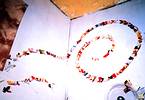
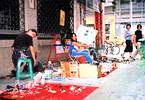
is home to a number of environmental artists known--as
the saying goes--for using "one man's junk to
create another man's treasure". For example,
Huang Chyi-wen (黃圻文) uses posters, newspapers,
magazines and even shopping bags as backgrounds for
his paintings and modern calligraphy works, while
David Wang (王振瑋) utilizes various discarded items
to create sculptures and Li Chao-tsang (李朝倉) develops
elaborate art pieces from egg shells.
These
artists hope to challenge society to change its views
on waste. They believe that almost everything that
we throw away has a use, if only it is looked at creatively.
With a change in value systems, the amount of garbage
and waste will naturally decrease, leading to the
benefits of a better environment and a society that
is not solely focused on cash logic.
|
 |
From
May 1 to 6, these and other Taichung artists will be on
the offshore island of Matzu to host an environmental arts
festival. Matzu is rich in natural beauty, including sand
and pebble beaches, sand dunes, atolls and precipitous cliffs,
and is also rich in culture. Niujiau, of the Matzu township
of Nangan, where this environmental arts festival will be
centered, has been named a model "green" community
by the central government's Environmental Protection Administration.
Thus, Nangan is the perfect backdrop to this festival.
 |
Over
the six days, there will be a number of DIY environmental
arts and crafts classes. Participants will be able to
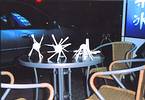
learn hands-on how everyday items such as metal milk
powder cans, plastic bottles and candles can be turned
into play things. Other DIY projects will include creating
paper sculptures from magazines, and unique boxes from
fruit peels. There will also be an aluminum can and
plastic bottle innovation camp. A special event will
make use of used (and cleaned) plastic spoons from a
fruit slush shop in Taichung and brought to Matzu to
form sculptures. The festival will also feature an exhibit
of works by participating artists. |
These
artists will also be on hand to give lectures about environmental
art and the unique field of art therapy. The events are
expected to inspire the public to find new uses for things
once considered waste or junk, increase awareness of environmental
art and promote tourism to Taiwan's offshore islands.
This festival is organized by Rebeca Yu (俞瑞玲), founder
of Taichung’s 616 Art Collective, a combination art exhibition
and art education center. It is hoped that this will be
just the beginning of an art relationship between Taichung
and Matzu as the collective is working to convert abandoned
buildings on that island into a flourishing art village.
For
more information about this event or the 616 Art Collective,
call Rebeca Yu at (0953) 355549 or (0927) 218477.



 投稿佈告欄
投稿佈告欄