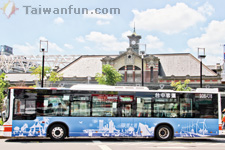
New blue buses running on
the optimized bus route will
be designed to showcase the
major attractions on
the
Taiwan Blvd. |
BRT Lane becomes dedicated bus lane to
accommodate the public's needs
Words and photos by Huang Yu Qing Translated by S. Ying
Photos provided by the Transportation Bureau Taichung City Government
For the last six months, the Taichung BRT (Bus Rapid Transit) has generated a significant amount of controversy related to supporting policies, design, inconvenience to motorists, and several highlighted traffic problems. Consequently, Taichung Mayor Lin Chia-lung solicited feedback and proposed solutions from a panel of academics, experts and community members, resulting in the decision to transform previous BRT lanes into "Optimized Bus Lanes" to be launched on July 8.
Safest, most convenient solution
Wang Yichuan, of the Taichung City Government Transportation Bureau, publicly announced that opening current BRT lanes to other buses would be the optimal solution for all parties concerned--drivers, motorcyclists, bus commuters and pedestrians. Taiwan Boulevard is one of Taichung's busiest roadways, used by about 40,000 motorists daily. This means that during rush hours, traffic jams and buses competing for lane space are often a common occurrence.
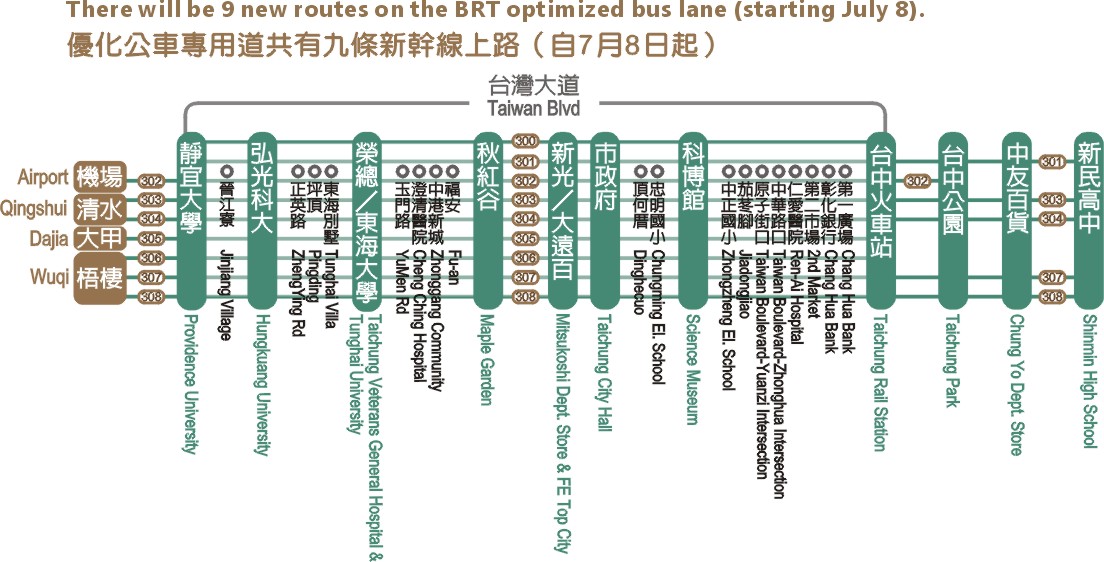
Optimizing the BRT lanes means close coordination between the Transportation Bureau and local city bus companies which together have formed a Taichung City Committee to review and monitor the situation. The decision was made to change the entire original BRT route to incorporate both BRT and city buses traveling between Taichung Railway Station and Providence University. It is hoped that this will reduce bus traffic in the slow lanes and increase traffic flow for motorcyclists, making it a safer commute with less car traffic.
This plan to optimize the entire BRT bus route also includes increasing bus frequency from the original 426 to 855, thereby shortening bus waiting times. Six more additional stops will also be added to the current BRT route and riders will resume swiping stored-value cards when they board buses rather than at the BRT station terminals.
Routes distinguished by bus colors
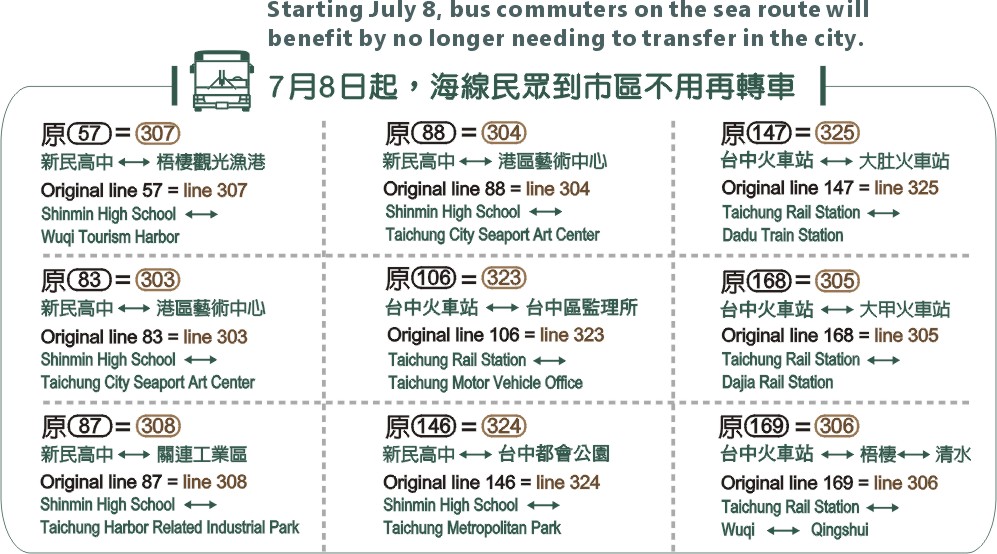
Bureau official Wang, noting public criticism that not enough people used the city's mass transportation system, said that the city would take responsibility for changes that will boost public usage and address public needs. To enhance the convenience of buses for commuters, bus colors will be updated to a standardized, easy-to-understand scheme that all commuters can understand regardless of age and nationality. This new plan will also help increase the number of buses and minimize necessary bus transfers for "sea route" commuters, as the previous BRT system had caused them major inconveniences by decreasing bus frequencies.
In order to facilitate tourism in Taichung and increase public transportation access for foreigners and local expats, the Transportation Bureau will use the color blue for all buses running along Taiwan Boulevard, marking it as the "Blue Route" and using "3" as the starting number for those buses to minimize the public's need to ask about available stops on buses traveling this route.
In addition to the "Blue Route", the Transportation Bureau will also further enhance colors and appearance on other routes over upcoming months, starting in August and continuing to January 1, 2016. Buses running on the mountain route and sea route will also have new pictures or symbols of tourism attractions emblazoned on them, making it easier for visitors to figure out the city bus system with these intuitive designs. All such changes aim to move our city closer to Mayor Lin's vision of making buses a symbol of mobility in Taichung.
Plans for eight major transportation centers to minimize transfer time
For decades, Taichung's original bus network has been centered on original downtown areas and bus stops have not been updated much since the merger of Taichung county and city.
Mr. Wang added that, as public transportation is a fundamental right of citizens, rural area residents should not be at a disadvantage for bus usage compared to those living in more densely-populated metropolitan areas. Comprehensive planning is needed to incorporate buses, trains and the new iBike system in order to satisfy the commuting needs of all communities in rural and urban areas. Therefore, the Taichung Transportation Bureau will take action to plan out eight major transportation centers in the city and create proposals to improve access by significantly decreasing bus travel times between these centers, including Fengyuan Railway Station, Taichung Railway Station, and Shuinan, Wufeng, Wuri, Shalu, Dajia and Chaoma stations. The bureau is also planning to roll out "Health Promotion Buses" offering direct transfers to local hospitals, such as the Taichung Veterans General Hospital, Feng Yuan Hospital and China Medical University Hospital, and give communities better access to medical care. Further plans will include increasing access to Dajia routes and the Fengyuan area, and using the Rt. 74 Expressway for genuinely convenient mass public transportation system commutes.
|

 July 2015
