
In order to enhance English-
teaching quality, the city
government has
assigned native-
English teachers to serve at junior
high and
elementary schools.

Ming Dao High School students
participate the first ENO Pacific Asia
Conference in Malaysia.
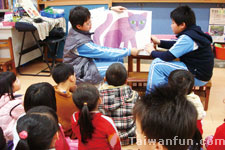
Da Tung Elementary School's
English club holds
reading activities
for children.

Storytelling activities with picture
books are a student favorite.

|
Eliminating the post city-county merger education
gap: Taichung takes big steps forward in the
2014 national education survey
Words by Chen Yu-xiu
Photos by Education Bureau, Taichung City Government
Translated by Angela Cheng
CommonWealth Parenting Magazine published the results of a 2014 national education survey covering
all of Taiwan's cities and counties, which saw Taichung take the third-place ranking overall, a top progress
rate, and second and third place rankings, respectively, for reading ability and teaching ability in the nation.
In 2010, prior to the merger of Taichung city and county, the same publication held its first education-related survey for the island's 25 cities and counties. While the former Taichung city received a fourth-place ranking, the former Taichung county came in at 24th place! Therefore, following the city-county consolidation, Mayor Jason Hu made reducing the education gap between city and county a specific goal, designating 38% of Taichung City's NT$100 billion annual budget towards education for the highest education-related spending in the country. These efforts appear to have paid off, according to 2014 CommonWealth Parenting Magazine survey results which, as noted above, not only gave the city a third-place national ranking but the top ranking for rate of progress.
Since 2010, CommonWealth Parenting has conducted its Taiwan city-county educational survey every two years, making this year the third time it has been held. The standard survey score was determined by scoring in four categories--"government investment and leadership satisfaction", "reading ability", "teaching ability" and "fair and multifaceted"--with 42 different indicators designed to examine educational efforts and outcomes in each city and county, and judge educational competitiveness in each location. Over 10,000 surveys are sent out to mayors, teachers, principals and parents all over the country, and public city/county statistics are also collected. Judgments based on the results from the 42 above indicators are supplemented with indicators regarding care for the socially vulnerable and experts' qualitative comparisons.
Great efforts to promote and examine each facet
In 2012, Taichung received a 19th-place ranking in the education survey. Mayor Hu found these results unacceptable, given the fact that Taichung's education funding was the the highest in the country. Given the city's great efforts, why was its ranking still so low?, he wondered. With this in mind, he immediately asked all relevant bureaus to establish a special task force, headed by Deputy Mayor Tsai Bing-kun in order to examine each indicator and see where improvements were needed. Less than two years later, the city achieved the above-noted 2014 results. Although Mayor Hu has expressed great appreciation for the hard work of all education-related city personnel, he believes that third place is still not sufficient, meaning that efforts toward improvements and promotion will continue.
Deputy Mayor Tsai, invited as Taichung's representative at a press conference for the 2014 education survey results, spoke of Taichung's investment and achievements in education, noting that the results of these were obvious in the survey results. He said that in order to achieve Taichung's vision of "happy education" and providing children with "fun learning in Taichung", the city raised education funding on its own and boosted the number of elementary school teachers to 1.7 per class in 2014 in order to ease educators' teaching burdens and allow them time to also focus on educational research. An unprecedented "safety lunch voucher" was also promoted to give kids a more secure learning environment, and the city invested NT$300 million towards the enrichment of library resources and reading environments, encouraging children to enjoy reading more. Other efforts have included the planning of multiple, innovative educational activities, expansion of an international perspective to achieve a "five-star level" educational blueprint and create school learning that is fun, high-quality, dynamic and innovative.
To date, the education gap between urban and rural areas has been gradually reduced after the merger of Taichung city and county, which helped Taichung get its third-place national ranking, making the city government very pleased and using educational progress to boost the quality of overall governance.
Reading: A key to future competitiveness
In this most recent survey, Taichung's "reading ability" was ranked second in the country and Deputy Mayor Tsai stressed that "reading is the key ability for children as they face future learning" and expressed hope that kids would make it into a fun habit. To promote reading, the number of books owned by residents needed to be boosted, so the city government launched its "333 reading plan"--within three years (2013-2015) at least NT$300 million will be funded to purchase books and raise the number of books students and the public owns, in order to reach at least a third-place ranking. However, this goal has already been exceeded with Taichung's second place in this category.
In addition, Taichung teachers developed a "Taichung online reading system" by themselves. This very successful effort, which began in 2007, provides sharing access to resources all over the country, providing nearly 20,000 additional books and over 26,000 accumulated certified subjects. The number of participants has exceeded 20 million, encouraged via honors rankings based on eight different birds, meaning that children can enjoy a better reading environment as many students motivate themselves to progress from a "sparrow" to a "Taiwan blue magpie".
Native English teaching enhances learning quality in remote areas
In order to expand students' horizons and international connections via an "international innovation--promoting international education" initiative, the city government invested about NT$20 million into international education exchanges in 2013. This saw the number of participating students reach up to 3,425 people and subsidies to schools to promote international educational activities. To promote the quality of English teaching, Taichung set up a provisional fund totaling NT$220 million in 2013 to hire 10 native-English teachers and 10 native-English assistant teaching staff assigned to 23 junior high and elementary schools and holding a total of 44 English camp sessions at schools in remote areas. To solve a lack of English teachers in rural small schools, the city government has since 2013 annually invested about NT$300 million to recruit 30 official elementary English teachers to teach in these remote areas to boost English learning quality.
Education is a solid foundation for national competitiveness and fountain of vitality for city culture. Taichung will continue to care for its disadvantaged students and promote multifaceted, student-focused educational policies that provide kids with fun learning in the most creative and dynamic educational environments, thereby achieving a happy education and brighter future for the city's children.
|

 September 2014
