The ups and downs of a
brush maker's life: Chen Jing-cong's writing brushes
compress 5,000 years of history
Words by Ye Jia-hui
Translated by Angel Pu
Photography by You Jia-huan
Narrowing his eyes, Chen Jing-cong has the intense gaze of a surgeon as he studies the
writing brush that he's holding up against the light for a better look. Brush-making
requires elegant, meticulous techniques that Chen--who once planned to work as a
mechanic--never thought he would be associated with.
After demonstrating the creation of a goat-hair writing brush, Chen dips it into some water and begins writing on a piece of practice paper, once again looking very concentrated. Although he says he's simply a writing brush maker, not a calligraphy artist, his passion for calligraphy art is clearly evident and his writing skills are fairly professional.
"I'm just trying to kill time," Chen says although, contrary to his words, he stares at his work and begins discussing it with his in-store calligraphy artist Gu Yuan-ci.
Motorcycle repairman destined to become a writing brush maker
"It seems that everything in your life is destined; God has decided what you will become and what you will achieve," says the writing brush maker who didn't believe in fate until it played out in his own life.
In the 1970s when Taiwan's economy was booming, Chen, like many young Taiwanese men his age, stopped going to school in the hope of learning a practical skill that allowed him to feed himself. At the invitation of a friend, he traveled from Taichung to a Tainan Kawasaki motorcycle shop with the intention of becoming a mechanic. However, the shop only needed one trainee and naturally chose Chen's friend, as he was a relative of the owner. This left Chen clueless about what to do next, as he didn't even have a ticket back to Taichung.
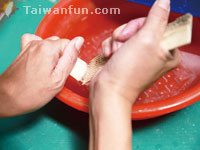 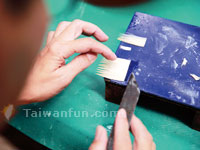 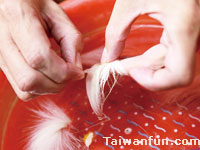
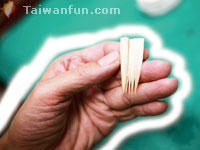
Left: Brushing the hair with a horn comb is a process that dates back to
ancient times.
Medium: Because the hair is so light, it needs to be dampened during brush
making.
Right: Chen categorizes the length of each hair strand and removes
hair buds and impurities.
Studying a skill with all his heart and time
The next day, after Chen finally got home, a cousin in Tainan asked what he had planned for his career after graduation. This once again took Chen back to Tainan, where he started learning how to make writing brushes with his cousin.
Seeming like he had been born with such skills, he became a quicker, better learner than his fellow students despite a lack of any previous training and, after four months of study, Chen had acquired almost all of the brush making skills. As he found the work very interesting and didn't have any other career directions, he decided to stay at the writing brush company to improve his skills. After relocating with the writing brush shop to Taipei and Taichung, Chen eventually decided to remain in Taichung and took over the "Zheng Da" writing brush shop where he was a staff member. Among over a hundred students who studied brush making with him, Chen was among a handful that chose to stay in the business and promote the disappearing art of ink writing.
Chen takes out some wool materials that he just brought back from China the previous night. To the eyes of a non-professional, wool, wolf hair and rabbit hair may look all the same but, according to Chen, he can even tell if the goat was healthy simply by looking at the hair. Holding a bunch of the hair, Chen looks at it closely, holding it up to the sunlight. "The hair for a writing brush has to be baby [animal] hair that hasn't been cut or shaved, so that it has a 'peak' that's very important for a good writing brush," he explains.
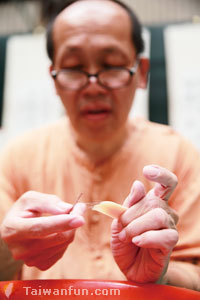 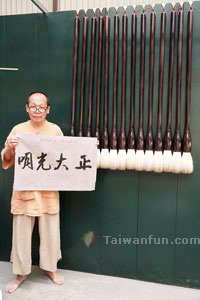
Left: 如The ability to pick out damaged hairs depends
on the maker's experience and skill, which is
among the reasons Taiwan's writing brushes
are of superior quality.
Right: The name of Chen's shop—"Zheng Da"—means"open and honest" in Chinese, which is also
Chen's motto.
Every strand of hair is essential for making a great writing brush
A writing brush can be separated into two parts--the head (brush head) and shaft. Brushes vary according to different animal hairs in terms of softness and the proportion of different kinds of hair, and can be divided into soft brushes, hard brushes and mixed brushes. There are four parts of a brush head between its thick part to the point--the brush root, brush waist, brush belly and brush peak. When writing, only the peak, belly and waist will normally touch the paper. The length of the peak can also divide brushes into long-peak and short-peak varieties. According to Chen, if you look closely at a brush, you will find out that every strand of hair is complete and has the four above-mentioned parts. The longer the peak, the more time it takes to make and more expensive the brush costs.
Chen skillfully separates the hair from the hide, removing any remaining skin by hand, categorizes the hairs according to thickness, and then removes the hair buds, impurities and fluff. He uses a corn comb to repeatedly organize the hair until it finally starts to look neat. To arrange the hairs at the same level, he holds a small piece of board with his left hand with the hairs in the other hand, and carefully presses the hairs along the board, strand by strand, step by step, until all strands are arranged in order. This has to be done carefully and repeatedly in order to categorize the varying lengths.
There are four elements for a good writing brush: a) pointy--the brush needs to have a significant point peak; b) even--after the first use, the peak should be evenly spread; c) round--the middle, or waist, of the brush should have a rounded shape; d) well-conditioned--the brush must have a certain level of flexibility, or it will influence continuity and comfort when writing.
Chen explains these four criteria while arranging the hairs, sweat dripping from his forehead, adding that "it's not easy to do this". He then uses cotton thread to tie up the hairs that have been brushed countless times. With a technique that combines tying and pressing, the brush is now secured. For brushes that lose hairs after a period of usage, those secured with cotton thread are fixable and can be used for a long time. However, if the brush maker only uses glue, the brush cannot be repaired and can only be thrown away if it loses hair.
 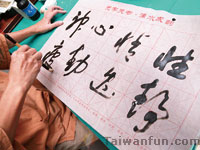
Left: Wrapping the hair in the center of the brush
needs to be done without any mistakes and an
experienced maker can do it perfectly.
Right: Chen is not only is good at making writing brushes but
also creates beautiful calligraphy work
Chen continues to devotedly operate his shop and focuses on passing along his techniques
"Making a writing brush can be very easy, with only six or seven steps, but it can also be very complicated, with over dozens of steps. It all depends on what the maker is aiming for," notes Chen as he discusses Taiwan's writing brush industry and how the art of ink writing has started to disappear over the years.
From his time as a trainee to becoming a master, Chen has been in this industry for nearly 40 years, with this being his sole career. While he understands this traditional Chinese art is disappearing, the only thing he can do is to continue running his shop properly, making it a platform for communicating with others who also love this art and passing down his techniques to younger talents if possible. These are his greatest contributions to the traditional Chinese writing art.
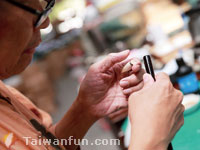 
Right: To make a brush even, the maker first needs to select hairs of a similar length.
Left: Tying up the hair tests the maker's strength
and is also criticial to determining whether a
brush head is tough or will easily lose hair.
Zheng Da Writing Brush and Ink Shop
Address:
65, WuQuan W Rd, West Dist., Taichung City
Tel:(04) 2372-0657 |

 November 2013
