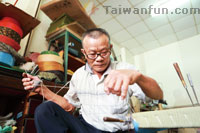
Wei Shan-chu has worked in
the tatami industry for 53
years.
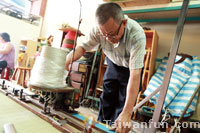
A tatami sewing machine is 10
times faster than human
hands.
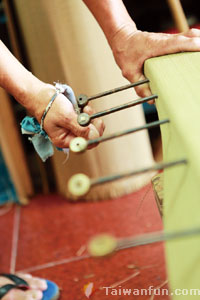
Special nails are used to fix the
position
of the mat cover.
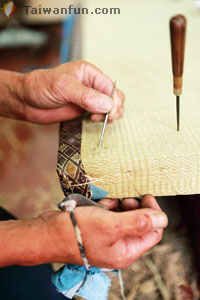
The thickness and density of
tatami makes it difficult and
time-consuming to sew.
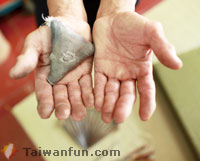
Wei Shan-chu puts a special
pad in his palm so that he can
work
more easily.
|
Japanese culture and spirit take root in
Taiwan: Tatami
Words by Ye Jia-hui
Translated by Angel Pu
Photography by You Jia-huan
"It's really nice that you chose today to do the interview, because tomorrow there are some Japanese journalists coming," says Wei Shan-chu
as he uses a stainless steel knife to neatly cut tatami matting. A veteran in this industry with over 50 years of experience, Wei is undoubtedly
one of the top tatami makers, to the point that even visitors from Japan, where tatami originated, want to interview him.
Along busy Fengshi Road in Dongshi district is a small, low-profile sign hanging on a concrete wall. Very easy to miss, this blue-and-white placard marks the Sanyou Tatami Shop, where 66-year-old owner Wei Shan-chu is also its only tatami maker.
Japanese culture deeply rooted in Taiwan
When Taiwan was governed by the Japanese, everything was deeply influenced by Japanese culture, including education, social manners and, of course, daily life. Tatami, a type of matting made with rice straw, is used as a flooring material in traditional Japanese-style rooms. In light of the many Japanese living on the island at that time, Japanese tatami makers came to Taiwan to find business opportunities. In doing so, they not only successfully made a living here, but also passed down original tatami-making techniques to the Taiwanese.
One of their original Taiwanese students was actually responsible for teaching Wei how to make tatami. When he finished 6th grade, the 13-year-old boy moved in with his relatives--who happened to run a tatami shop--in Dongshi town in order to make a living for his family. Although he was related to the shop owner, he did not receive any special attention over other trainees as the owner didn't want to create any conflicts. Wei himself also didn't want to be favored, either. He woke up earlier, stayed up later, and never complained, because that was what trainees were supposed to do. "There was no such thing as overtime pay," he recalls. "I already felt grateful that they'd let me stay."
A hard-working trainee finally gets his chance
After working diligently for three years and four months, Wei Shan-chu finally became a professional tatami maker. The tatami shop was very busy because most government offices, including the power company, police stations and schools, used tatami as a flooring material. When the shop received such major orders, the employees needed to work day and night despite the fact it had dozens of tatami makers. Obviously, tatami-making was a thriving business.
The first and foremost task when making tatami is choosing the right materials. Tatami shops usually had one farmer that they purchased rice straw from. The makers would clean the straw, compress it to compact it, and tie it closely together with thick thread. The result was a straw mat. Because dust was flying everywhere, causing dry skin and itchy noses during the straw-cleaning process, this was usually the work of the trainees. Today, tatami shops use machines to clean the straw because machine-made mats are more neatly tightened and durable than manmade ones. Due to the fact that straw absorbs humidity, makers will use a plastic film to prevent this. Modern-day tatami makers even use special foam material and MDF (medium-density fibreboard) as a straw replacement in order to eliminate humidity problems.
Valuable and expensive tatami-making tools
Wei places a straw mat on a wooden stand that has been passed down over three generations, holds up a Japanese-made steel knife, cuts the straw a couple of times against an aluminum bar and, suddenly, a five-centimeter-thick mat is perfectly split open. "The most difficult part of making tatami is cutting the mats," Wei says. "It may seem like nothing to the others, but it takes endless practice to cut straight and neat like this." Wei now uses another knife as heavy as the previous one, but with a more slender handle.
Explaining why he is using a different knife, Wei explains, "They are actually the same kind of knife, but this one is the oldest and the handle is so worn-down that it gets thinner and more slender." According to Wei, the knife is the most important tool when making tatami, so every one of his knives is imported from Japan in order to perfectly split his mats. Unlike cheaper ones, these tools are all made of steel and each cost over NT$10,000. This is why tatami makers usually collect their knives after they finish working, as they are all very expensive.
Machines make better tatami
The price of tatami is determined by a mat's density and weight, with mat patterns and edging usually chosen by customers. According to Wei, Dajia straw was used for tatami covers when the straw business was thriving, but now most mat covers use machine-made straw mats. Moreover, machines are also used to sew the mats. Wei bought his sewing machine seven or eight years ago from Japan and found that it not only makes neat and firm edges, but was also 10 times faster than doing it by hand. However, the machine can only sew in straight lines, meaning that sewing the corners of mats still requires the skillful hands of experienced tatami makers. Although there is a machine to do the hard work, Wei still likes to hand-make mat covers and edging and his big knuckles are proof of his hard labors.
Internet marketing a fresh channel for tatami industry
Although most people consider tatami-making a sunset industry, Wei has continued his trade. Moved by his spirit, Wei's daughter began promoting the trade via the Internet, allowing many more people to appreciate this traditional craft. Thanks to excellent online exposure, Sanyou Tatami Shop's business is once again growing, with its owner currently working to produce over 100 tatami mats per month for clients around Taiwan. The 66-year-old never thought that his traditional trade would get such a second chance at life with the help of modern technology.
Holding a piece of tatami that he has just made, Wei expresses his undying affection for these products: "Although people sleep on mattresses nowadays, I still like to sleep on tatami because nothing is better for falling asleep than its cool feeling and natural smell."
San You Tatami Shop: Wei Shan-chu
Tel:(04) 2587-0215、0911-870215、0960-715332
150, Fengshi Rd., Dongshi Dist., Taichung City (opposite Pxmart)
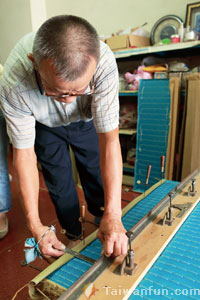 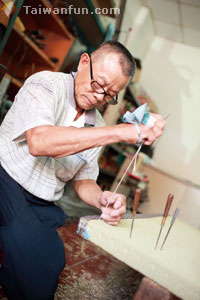
Left: The mat cover size must be very correct
to ensure the appearance of the finished
tatami.
Right: Tatami corners cannot be sewn by
machines, so it can only be done with
human hands.
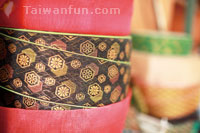 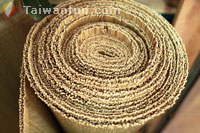
Left: The edging of a tatami mats reveals the tastes of different people.
Right: Triangular Dajia rushes makes aromatic and slightly flexible tatami mats
|

 October 2012

