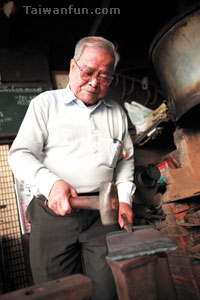
Although he's in his 80s,
retired Cai
Qing-long is still the
best consultant
for his son and
grandson.
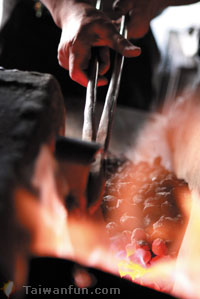
Flames and heat are the
biggest factors
contributing to
the blacksmith's challenging
work environment.
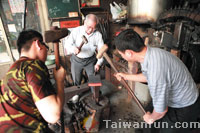
Cai Jing-yong, Cai Qing-long,
and Cai Tian-shun
(pictured,
left-right) represent three
generations of
the Cai family,
working to pass along the
heritage of
Litoudian Street.
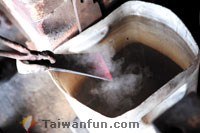
The process of putting the iron
under heat and then
into cold
water makes it tougher and
more durable.
|
Hard knocks:
The Traditional Smithing
Business in Taichung
Qing Long Blacksmith Shop owners use steel-like
willpower to stay in business for over 60 years
Words by Ye Jia-hui
Photography by You Jia-huan
Translated by Angel Pu
It's 9 a.m. and you can already hear the sound of hammering on Wanhe Road,
once known as Litoudian Street. For over a century, these metallic banging
sounds have been one of this location's famous features.
Many years ago, central Taiwan's most flourishing city was Changhua. However, Taichung's rise to become one of the busiest cities on the island certainly has something to do with Litoudian Street in Nantun District.
Located along the way between Changhua and Fengyuan, Nantun was the connection between Dadun Street (former Dadun Road), Qizhangli, Shalu and Wuqi. This geographical advantage is one of the main reasons it developed into a local trading center for agricultural and daily-use products, and became Taichung's first developed area.
In the early days, most Taiwanese were farmers. Since most agricultural implements were made of iron, it made perfect sense for there to be an abundance of blacksmith shops, to the point that on Wanhe Road alone there were 29 blacksmith businesses. Litoudian Street got its name because that the most common product made by blacksmith shops was the plow, known in Chinese as "litou", and shops producing these items were called "litou dian" (plow shops). During this era, the iron industry flourished. However, as humans began to be replaced by machines, cast iron also became a "sunset industry", leaving the Qinglong Blacksmith Shop---now open for over six decades--as the only remaining "litou dian" left on Wanhe Street.
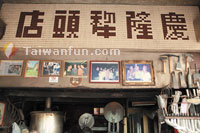 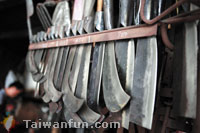
Left:Qinglong Blacksmith Shop is the only business of its
kind left on Wanhe Road, the former Litoudian Street.
Right:The handcrafted knives are much more usable
and durable than mass-produced ones.
Fighting for life by fighting the heat
Over 80 years old, Cai Qing-long was Qinglong Blacksmith Shop's original owner. He became a blacksmith because his 24-year-senior older brother led him into the industry when he was a teenager. From Qingshui to Nantun, Cai and his brother slowly but surely succeeded in their calling.
Their business boomed because there were many farms near their shops, and there were often customers standing outside the shop, waiting for them to open. Busy as they were, the Cai brothers always insisted on making the best-quality products. Although the making of every kind of cutting and farm tool had a different process and standard, the difficult working environment was always the same. According to Cai Qing-long, the heat of the forge could rise up to 1,200 degrees Celsius, and in summer the situation only got worse. When he would remove the iron from the forge, sparks and iron chippings were always everywhere, burning his shirts and pants full of holes. Because living conditions were not that good, Cai only threw clothes away only if the holes had been patched more than three times. Watching the blacksmiths doing hard labor, covered in soot and wearing patchy clothes, many people also looked down on this profession.
Customized products help business thrive
However, Cai never cared about how others looked at him, focusing only on how to produce better products. He started to study farmers' various needs when they were doing different tasks. For example, when bean farmers were preparing the soil, they dug deeper rows on each side of shallower rows. After discussing different needs with the farmers, he began creating customized farm implements that helped them to work more efficiently.
His reputation for continually improving his techniques and willingness to listen to his customers helped the Qinglong Blacksmith Shop do increasingly good business, so that the sounds of metal striking metal echoed all day long. However, as Taiwan gradually became industrialized, Litoudian Street's heyday finally ended, leaving Qinglong Blacksmith Shop as the last of its kind on the street.
As a member of the second generation at the shop, Cai Tian-shuan--who has worked with his father since leaving the army--never imagined that his son, 26-year-old Cai Jing-yong, would embrace the hard work of this profession and be willing to pick up the hammers used by both his father and grandfather to become the third-generation owner of Qinglong Blacksmith Shop.
Passing down heritage and culture via Facebook
Growing up in the Internet age, Cai Jing-yong knew how the web could help business. He used a blog to promote news about their shop and local events, created a page on Facebook, and sold kitchen knives on the Internet. For the youngest Cai, being traditional does not mean being out of touch, as good products will always be loved by customers. For example, there are still many patrons who are willing to come all the way to the shop to purchase kitchen knives that are four times more expensive than mass-produced ones because they know that Qinglong's knives are tough, sharp and durable. It is said that the shop's knives are the favorites of many butchers in central Taichung.
Today, Qinglong Blacksmith Shop not only sells knives and farm implements, but also sharpens knives, does electric welding and produces construction tools. According to Cai Tian-tuan and Cai Jing-yuan, they are even willing to try their hand at producing movie props and machine components, and Cai Qing-long remains their top consultant. Although now might not be the best era for the traditional smithing industry, it remains one of the most culturally-valuable businesses, and continues to serve as a very important historical reminder of how Taichung became such a vibrant metropolis.
Qinglong Blacksmith Shop
Address: 529, NanTun Rd, Sec 2, Nantun District, Taichung
Tel:(04) 2389-3199
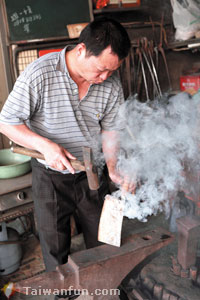 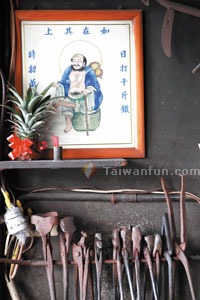
Left: Cai Tian-shun is now the main blacksmith at
the shop.
Right: Many old customers' beyond-repair tools are
still showcased at the Qinglong Blacksmith
Shop.
|

 April 2012
