
Xinshe can sometimes seem
like a mythical land of flower
fairies, thanks to magical-
looking meadows of flowers.
(photo provided by Xinshe
Agricultural Tourism Development Association)

Xinshe has many unique
structures that attract tourists
seeking a romantic European-
style atmosphere.

Most people love the carefree,
relaxing ambiance at Xinshe's
bed-and-breakfast places and
restaurants.

Most old local houses in the
area were destroyed by the
921 Earthquake. Those that remain stand as witnesses to
the lives of previous
generations. Pictured is the Xu
Family Home.
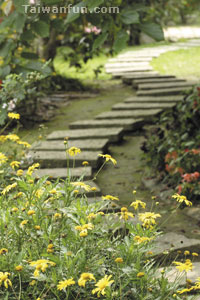
To slow down and enjoy a
more relaxing pace of life, head
to Xinshe and enjoy the
natural, tranquil and
rejuvenating environment.

Pipelines are very important to
the locals, who are committed
to protecting these waterways.
The ecological park by Shi Shui
Ke River teaches the next
generation how to protect the
environment.
|
Green mountains, clear water, dancing butterflies and fields of flowers: Enjoying Xinshe's truly romantic atmosphere
Words and photos by Taichung City Government
Translated by Angel Pu
"Romantic" is one of the simplest, best adjectives for describing Xinshe, which offers an abundance of romantic settings that capture the hearts and imaginations of visitors. Perhaps it's the pastures filled with red, white, yellow and purple flowers. Maybe it's the dreamy, charming variety of local bed-and-breakfasts places. Or, complementing the beautiful natural scenery, the sweet, juicy fruit. All of these are facets that make Xinshe so attractive and lead visitors to fall in love with it.
In recent years, Xinshe's vast fields of flowers have helped it gain fame as a top romantic spot, popular with local lovebirds that flock to the area. Highlighting this are the annual Flower Festival and Kite Festival, which both are ideal for family outings. Such events can be combined with a discovery of Xinshe's charming, uniquely-themed and designed bed-and-breakfast residences, from a distinctive castle to refined-looking country manor.
Taiwan's first seven-color tour routes
Romantic pastimes that you can enjoy in Xinshe include mountain-gazing during the day or night, watching the clouds, or locating constellations and looking for shooting stars. Together with this beautiful natural setting, there are a good number of accommodations, including the above-mentioned European-style castles and manors and country-style bed-and-breakfasts (complete with evening fireflies), plus coffee shops with herbal gardens, and restaurants offering great mountain vistas. With so many places to go and things to do in Xinshe, the natural question is how it got to be this way in the first place.
According to Xinshe Agricultural Tourism Development Association Director Du Wen-hao, many of the locals are highly-cultivated individuals and there are many fruit farmers, manor house owners and businesspeople who have joined the association in a collaboration to jointly promote Xinshe's development projects. For example, its recent "Purple Windmill Plan", designed to promote healthy foods, has received a good response from the public.
In another example, tourism farms have been spreading in Xinshe due to its long, narrow geographical lay-out . For tourists, it's almost like entering a maze. Thus, after receiving a budget from the Ministry of Economic Affairs, the assoication organized seven different color-coded tour routes that highlight every local area's own special attributes. Each route is indicated on roadside utility poles, with each area's business owners together deciding on their representative color and painting it on the poles. Such pioneering efforts are an unprecedented example for all of Taiwan's commercial/business areas.
Xinshe's natural beauty, combined with such comprehensive development and promotion plans and ideas are major factors for making it such a multi-faceted attraction.
A multi-cultural community from many different origins
The name "Xinshe" is rooted in the Chinese phrase for "new indigenous society". This area has long supported new immigrants with the original local residents being Atayal indigenous tribe members. The earliest new arrivals were the Varutto community from Pazeh tribe (of the Pingpu tribe), which came from what is today Dongshi. Given the fact that this made it a "new indigenous society", the name "Xinshe" appeared.
Local aborigine residents then had conflicts with Hakka people who wanted to farm in the area, which in turn disrupted local cultivation. It was not until 1826, when a Hakka representative surnamed Chang made an agreement with the aborigines, that both sides stopped interfering with each other. However, conflicts with Han Chinese immigrants and the hunting convenience pushed the indigenous tribes deeper into the mountains, with these peoples finally leaving Xinshe completely to settle down in present-day Nantou county's Puli town and Taichung's Heping district. Today, Xinshe boasts the second-largest Hakka population in central Taiwan. A combination of Hakka, Minan and later-arriving mainland Chinese peoples have truly resulted in a cultural melting pot in this region.
Hakka religious variety
There are two religious centers in Xinshe. One is Zhen An Temple, built in 1893 and worshipping the god Nezha, the goddess Mazu, the Kings of Three Mountains, the fertility goddess Zhusheng Niangniang, the earth god Tu Di Gong, and the honest and upright official Bao Gong.
The other religious center is Xinshe's very unique "Jiu Zhuang Ma (Mazu)". Unusually, there is no temple for this Mazu goddess, who has rotated beween nine houses in different villages for over 200 years, as devotees toss divination blocks to decide which home the goddess will stay in. Legend has it that over two centuries ago, a Xinshe resident found the Mazu statue in a wrecked house while he was sheltering from the rain. The villagers then built a thatched hut to worship Mazu in, and she protected them from aboriginal attacks. As people from different villages came to worship the goddess, she no longer stayed in one temple, but took turns staying in nine different villages. This story and heritage has been passed down from generation to generation since the earliest cultivation of the area. One more unusual aspect of the Jiu Zhuang Ma is the fact that her pilgrimage date differs from that commonly practiced by other Mazu worshippers. Instead, local residents will decide a date between third and seventh days of the first lunar month for this pilgrimage, which is Xinshe's most important religious event and sees pilgrims prepare plentiful items for the goddess. Thus, Xinshe is the only place that holds a Mazu pilgrimage festival during the lunar new year holiday.
Building the famous Pai Leng Pipeline with natural construction methods
According to local Xinshe records, Xinshe contains nine branches of the Da Jia River. These intricately-woven pipelines across the Xinshe tableland nurture over a thousand hectares of farmland, leading local people to develop a unique attachment to these waterways. The most famous pipeline in Xinshe is the Pai Leng Pipeline. People refer to it as the "Spring of Life in Xinshe", but other than that, it's also Far East Asia's largest example of Inverse Siphon hydraulic engineering. Being built completely according to a natural terrain elevation drop, and it doesn't need any power to provide water for irrigation. Pai Leng Pipeline was severely damaged in the 921 Earthquake in 1999, but was rebuilt by both the local and central governments. To continue their mission of protecting the pipeline, locals set up the Pai Leng Pipeline Protection Community Association in 2003 and the association secretary Chen Shou-xian notes that a Pai Leng Pipeline Cultural Festival is held every October. This consists of a evening thanksgiving festivities, as residents clean the canal together to show their determination to protect it.
Pai Leng Pipeline was built in 1932. When Japanese colonial prospectors arrived in Xinshe, they discovered that the weather and soil were suitable for growing sugar cane. However, the biggest problem was a lack of water resources. Therefore, the Japanese governor general of Taiwan sent a Mr. Isoda to measure out a watercourse route and design the pipeline. Isoda decided to draw water from Dajia River's upstream in the Pai Leng highlands. The main line is a 16.6-kilometer-long conduit. When builders encountered a mountain, they dug a tunnel; if there was a valley, they set up an inverse siphon. Along the way there were a total of 22 tunnels and three inverse siphons. Inverse siphon No. 2 went through the riverbed of Chou Teng Keng River, and the total difference between the lowest and highest spots is 90 meters. This tremendous feat of hydraulic engineering and construction required no shortage of wisdom and intelligence, making Pai Leng Pipeline a must-see when you visit Xinshe.
Pai Leng Pipeline's main line has stairs and, if you're in decent physical condition, you can climb up to the observation via the stairs and look out over the beautiful river terrace. Every night between 6:30 and 8 o'clock, the siphon will light up creating a breathtaking night view.
Local delicious fruit
Next to Dajia River's middle section, you'll see many thriving Xinshe orchards and vegetable farms. According to local elder Chen Jin-rong, the Bai Mao Tai Grapes produced around the Tian Leng area are sweet and juicy. Most of them will be exported to Japan, to the point that even friends of local farmers may only get one or two grapes for a taste, showing how valuable they are. Local farmers also produce pears or loquat fruit which generate signficant economic benefits and are also very delicious.
Spread some salt and pepper on the fresh, fried Xinshe oyster mushrooms and king trumpet mushrooms for a truly tasty, invigorating flavor. Local mushroom-growers are well-equipped for their job and developed unique techniques that allow visitors to take mushrooms home to grow themselves. Chen Jin-rong emphasizes that the mushrooms you buy in Xinshe are 100% grown in Taiwan.
Some Bai Mao Tai history
The original name for Bai Mao Tai was "Mao Ping" and aborigine residents lived there. There's a story behind its change of names: According to records, an aboriginal couple had twins; however, one of boys had white hair and the other had red hair. The parents were frightened, thinking that perhaps they had given birth to monsters, and reported the situation to the police immediately. Unexpectedly, the Japanese police ordered them to bury the babies alive, and then changed the name "Mao Ping" into "Bai Mao Tai"(white hair in Chinese). The opposite mountain was also named Bai Mao Mountain. Soon after that, a big plaque occurred and took hundreds of lives. Believing the area was cursed, local aborigines applied to move to Heping district, leaving the land vacant. However, Han Chinese thought this land was fertile and moved there for cultivation. In the end, the fruit they grew was so sweet and juicy that it has become popular near and far.
 
Left: The "Jiu Zhuang Ma" Mazu stays at different villages, where villagers show deep respect and devotion to her.
Right: Pai Leng Pipeline was constructed with hydraulic engineering techniques and is known as the "spring of life in Xinshe".
 
Left: Loquals are important produce from Xinshe and their high-quality richness make them a favorite fruit.
Right: Xinshe is Taiwan's largest producers of mushrooms, which are fresh and tasty.
|

 May 2011
