Previously,
Taiwanese interested in Egyptian civilization have
only been able to catch glimpses of this fascinating
culture through the mass media, or by taking an
expensive trip abroad. Now, after four years of
preparation, "Ancient Egyptian Art from The
Louvre" is here.
The
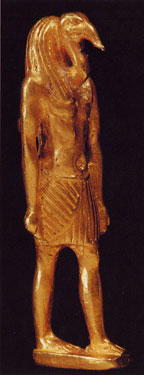
exhibition consists of more than 600 major items
from the collection of the Louvre in Paris, and
lasts one year from November 2003 to November 2004.
Come and see what the excitement is all about;
if you are not already an admirer of ancient Egyptian
art, you will likely become one.
The
Louvre's Egyptian Galleries contain over 60,000
Egyptian relics, a hoard second only to the Cairo
Museum. Some of the pieces now in Taiwan have never
left France since they were acquired by The Louvre,
including a mummy of cat, and the Carved Granite
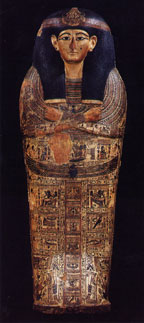
Statue of Pharaoh Thutmose IV. A girl mummy is
also showcased for the first time; while in Taiwan
it will also be sent through a CAT scanner to gather
data.
Ancient
Egyptian Art from The Louvre is divided into four
main subjects: Ancient Egypt Revealed--Archeology
and France; The Rise of Egypt--The Nile and Its
Ecology; Egypt and Pharaohs--4000 Years of The
History and Culture of Ancient Egypt; and finally
Mysteries of Millenniums--Life and Death of The
Ancient Egyptian.
1.
Ancient Egypt Revealed--Archeology and France
Napoleon
attacked Egypt at the end of the 18th century,
and France has enjoyed close ties with Egypt ever
since. In modern times, three French scholars have
been of great importance in the field of Egyptology.
They are former Louvre Museum Director Vivant Denon,
First Egyptian Gallery Director Jean Francois Champollion--the
first man to decipher Egyptian hieroglyphics--and
Auguste Mariette, who promoted the Egyptian Antiquity
Hall in Egypt.
2.
The Rise of Egypt--The Nile and Its Ecology
The
Nile brings fertility to the land by flooding each
year. It nurtured the ancient Egyptian civilization,
which revered the Nile as the Mother God of Earth.
Small creatures and riverbank implements are introduced
in this section.
The
Nile brings fertility to the land by flooding each
year. It nurtured the ancient Egyptian civilization,
which revered the Nile as the Mother God of Earth.
Small creatures and riverbank implements are introduced
in this section.
3.
Egypt and Pharaohs--4000 Years of The History and
Culture of Ancient Egypt
In
this section, the antiquities are arranged by year
into a chronicle, revealing changes in art and
civilization with actual objects. The major periods
are: Pre-dynastic Period (4000-3000 B.C); Thinite
(first dynasty), Old Kingdom and First Intermediate
Period (3000-2000 B.C); Middle Kingdom (2000-1500
B.C); New Kingdom (1500-1000 B.C); and Late Period
(1000-30 B.C).
4.
Mysteries of Millenniums--Life and Death of The
Ancient Egyptian
Ancient
Egypt's unique burial ceremonies are fascinating.
This section introduces the Egyptian concepts of
life and death, ceremonial procedures, mummification
procedures, barriers the dead must overcome to
reach the afterworld, guardian gods and charms,
colored tombs, and the reconstruction of Sennedjem
(tombs).
When
and Where:
*
July 30, 2004 to November 7, 2004
National Science & Technology Museum, Kaohsiung
City
Information: (07) 384-6471 |