|
SanMin-KaoHsiung
County's Mountain Paradise
Texts
and Phots by Richard Matheson Translated by Mallory
Chen
The
Sanmin Valley has
all the makings of an outdoor tourist paradise.
Blessed with lush green vegetation and crystal
clear waters, the valley is located in Kaohsiung
County, south of Alishan, north of Jiasian.
Central
to the area's geography is the Nantzuhsien
River (also known as the Chishan River)
and its 11 tributaries. Tumbling down
the southwest face of Yushan, Taiwan's
highest mountain, the Nantzuhsien enters
Sanmin at the Danayiku gorge. Of the
45 kilometers of the river that pass
through Sanmin, 28 kilometers have
been declared a wildlife refuge. Rafting
on the Nantzuhsien River is exciting,
but you need to bring your own raft,
as there are no outfits running the
river yet. During the wet summer months
the river is dangerous, and locals
say that outsiders have died while
attempting to run it.
The
lowest point in the valley, the river,
is 430 meters above sea level; the
highest is the peak of Mount HsinWangLing,
at 2,481 meters. The four main settlements
one comes across while traveling upriver
are Minzu (Nangisalu, in the local
aboriginal language), Minchuan (Mangchu)
and Minsheng First and Second villages
(Takanua).
Until
recently, there was very little in
the way of tourist traffic in this
area, with the exception of Holy Mount
Zion (a Christian community that began
by squatting on aboriginal lands, and
is now a self-governing enclave). Recently,
however, Sanmin's local government
has been working to get more tourist
revenue into the area. District Chief
Ke Ming-de says that developing tourism
is the current highest priority, with
an emphasis on "natural resources" (river,
fish, mountains, wildlife), "culture" (aboriginal
arts and dances), and "farming" (seasonal
fruits and vegetables).
One
of the new projects is the NaTzuLan
River Protected Area. Following the
signs up the mountain from Minchuan
brings one to a protected area where
aboriginal crafts are sold and dances
are held. In this writer's opinion,
the real attraction of the area is
the trail network that has been built
along the river. Some paths guide visitors
through camphor forest, cherry and
plum blossoms; some have signboards
with information about the local flora;
but the best simply follow the river
and lead to gorgeous waterfalls, river-sculpted
rocks, and a long forgotten camphor-oil
camp, complete with overgrown but intact
ovens for making the oil.
WHO LIVES IN SANMIN?
One
of Sanmin's attractions is that it
is spacious (250 square kilometers)
yet thinly populated, with just 3,400
inhabitants. The area is uniquely multicultural.
While most aboriginal areas are inhabited
by a single tribe, Sanmin has the distinction
of having representatives of almost
all of Taiwan's 11 mountain tribes.
Historically,
Sanmin has been Tsou territory. Bunun
families migrated into the area from
Nantou County after the Tsou population
was reduced by disease. Next came Atayal
from the Hsinchu area. Most of the
other aborigines living here arrived
through marriage or migration.
The
Bunun are the majority, accounting
for 2,330 people, and Bunun is the
major language hereabouts. Tsou number
around 500, and can mostly be found
in the village of Minsheng. There is
also a smattering of non-aboriginals--about
400 people, or 12 percent of the population.
Adding to the ethnic mosaic, there
is a picturesque Pingpu (lowland aborigine)
village called Siaolin, located between
Jiasian and Sanmin.
WHAT LIVES IN SANMIN?
The
wildlife in the Sanmin Valley is plentiful:
Twenty-nine different mammals, 97 bird
species, 30 types of reptile, 16 amphibians,
18 kinds of fish, and an amazing variety
of plant life. The fauna is rarely
seen from the roadside. According to
locals, 15 or more years ago there
were monkeys beside the road, deer
and boar were often seen, and the butterflies
were thick in the sky. Sadly, the butterflies
are disappearing because of the pesticides
used by farmers, and animal numbers
have dropped due to poor hunting practices.
SIGHTS TO SEE
Excellent
hiking awaits those who have the time
and patience to explore. However, if
you are used to well-maintained national
park trails, take special care--the
trails are hunting paths without signposts,
and the jungle is thick. Having said
that, there are fairly well established
routes to the bamboo-covered peak of
Second River Mountain (this takes half
an hour), and to Mount Hsingwangling.
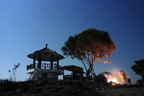
San
Ming Huo is an interesting anomaly,
with fire rising out of the hillside
in a similar fashion to the fire at
Guantzling. Firefly and butterfly watching
is also popular; there being 89 species
of butterfly in the valley.
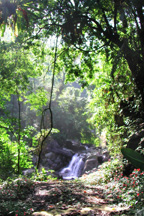
Phoenix
Waterfall is the most popular of Sanmin's
many waterfalls, and with good reason.
A ten-minute hike from the parking
lot (where cold drinks and local products
are sold), the waterfall is especially
impressive in the summer. The trail
continues up the hill to some delightful
swimming holes.
ABORIGINAL COOKING
Aboriginal
cuisine is similar to Chinese cooking,
but as much of the meat is shot or
trapped, it often has a gamier taste.
At festivals and large gatherings,
the tables are filled with flying squirrel,
mountain boar, deer, rats and mountain
birds. This writer has sampled raw
pickled flying-squirrel intestines,
and a dish called "stinky meat." The
latter is meat that has been left in
the trap for too long, and has started
to rot. It is surprisingly delicious.
Vegetables
and leaves are foraged as they grow
abundantly, and are often tastier than
supermarket vegetables.
Unfortunately,
few restaurants serve authentic aboriginal
fare. An exception is Ba Li Shiang
(reported in the What's New section
of this month's FYI SOUTH) in Minchuan.
Also of note in Minchuan is the tea
shop across from Ba Li Hsiang. While
is doesn't serve aboriginal cuisine,
it is beautifully decorated with bamboo
and aboriginal motifs.
Coffee fans will enjoy Cafe Angisalu in the village of Minzu, where Mr.
Huang has planted around a thousand coffee trees, and opened a lovely
establishment with striking views of the river and mountains.
SHOPPING FOR SOUVENIRS
There
are several places to buy local arts.
In Minsheng, the recently opened MaYa
Workshop (tel: (07) 670-1971) sells
bags, belts and other leather crafts
in a nicely designed shop that is well
worth checking out. In Minchuan, RiBuLuo
Workshop (tel: (07) 670-1483) has a
large selection of handmade clothing
and crafts, while the Ba Li Shiang
Restaurant also has some arts and crafts.
Also
in Minchuan is a local pottery workshop
where local artists and their teacher,
Hai Sul, work clay. At first glance,
Hai Sul looks more at home in the role
of policeman than artist. A dark stocky
man with muscular hands ideal for working
clay, he is thoughtfully articulate,
interesting and has a strong sense
of culture. In 1993, as a policeman
in Tainan, he studied pottery. Later
returning to his birthplace in the
mountains, he was re-inspired by his
Bunun culture, which he has worked
into his pottery to great effect. At
his workshop you can see the large
brick kiln that he uses.
Hai
Sul has been exhibiting nationally
since 1997, and is becoming well known.
He says he is fortunate in that he
doesn't depend on pottery for a living,
so he can work when inspired instead
of churning out items to sell. While
not really a shop, people can drop
in and see pieces made by Hai Sul and
other local artisans.
FESTIVALS
Several
festivals are held in Sanmin each year.
The largest is the DaEr ("hit
the ear") Festival, usually held
in May. This features local youths
showing off their archery skills by
trying to hit a hanging pig's ear--hence
the name. Other festivals include a
millet festival in August, and a river
celebration in September--both Tsou
tribal events.
Most aborigines are Christians, so Christmas is also celebrated. At midnight
on Christmas Eve the population walks through the streets, holding candles
and singing carols. The procession culminates with a church service;
a day of games and a feast follow.
PLACES TO STAY
There
are homestays and hostels in and around
the villages. Especially notable is
the HuSong Relaxation Farm, located
high above Minchuan, with deluxe air-conditioned
cabins, a barbeque area, and a tent
area; and the Falas Campground (tel:
0928-156-034), just beyond Phoenix
Waterfall. This is a large field, impossibly
perched on a very steep hillside. where
you can pitch a tent or stay in a room.
Dances and other activities are put
on when there are a lot of guests.
The boss will drive hikers to the trailhead
for Mount HsinWangLing and other places.
GETTING THERE
There
are two major routes to Sanmin. The
best road is up Highway No. 21 from
Jiasian, a town on the Southern Cross-Island
Highway. The alternative route takes
considerably smaller roads via Chashan,
coming from the Zengwun Reservoir or
the Alishan area. Consult maps before
attempting this route.
For
information, call the local government
at (07) 670-1001. For English-language
information, call Ba Li Shiang Restaurant
at (07) 670-1387, and ask for Ebu. |