|
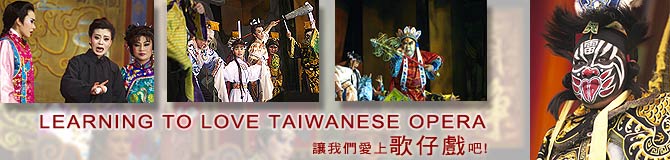
LEARNING TO LOVE TAIWANESE OPERA
--- Written and Photos
by Richard Matheson Translated by Annie Liu
For the first-timer, Taiwanese Opera
can be a bit much: An involved story, elaborately costumed
and painted characters, pulsing lights, a cacophony
of instruments, ear-piercing shrieks...
Fortunately, there are various stage conventions. A
rudimentary understanding of roles, stage gestures,
props, and storylines can lead to a deeper appreciation
and enjoyment of this indigenous art form.
The roles. There are typically four
major roles in Taiwanese opera: The male lead ("sheng"),
the female lead ("dan"), the supporting male
lead ("jing"), and the jester ("chou").
These can be further divided into many sub-roles, for
example when the female lead is a sad female ("ku
dan," easily spotted as a woman who's always crying).
Costumes and makeup are often good indicators of roles.
Gender, however, is not. Simply being a woman does not
necessarily mean the actress is portraying a woman.
Gestures and props. Simply knowing
that most gestures have a meaning opens up a new facet
of the opera. Hands clasped behind the back indicate
bravery; wringing one's hands expresses worry; walking
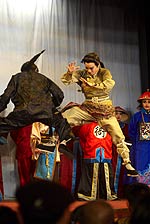
in circles represents a long journey; and acrobatics
indicate battle. Props are simple-carrying a whip means
the actor is riding a horse.
Story. Obviously, knowing the story
makes understanding easier. Most troupes perform well-known
stories, and asking enthusiasts is a good way of finding
out the key points.
Taiwan's leading Taiwanese opera troupe is Ming Hwa
Yuan, who have performed overseas many times. Details
of upcoming performances can be found on their website,
www.twopera.com
|