|
|
A
place often visited by tourists when coming to Tainan
is the historic neighborhood of Anping. Anping Fort,
which remains the signature destination of the area,
was the first castle built in Taiwan by the Dutch.
The Dutch first built a small castle by the name of Orange
on this site. Later it was expanded, and renamed Fort
Zeelandia. It became an administrative and trading center,
and although the name has been changed more than ten
times, the building has earned itself a permanent place
in history.
It was not until 1983, with the enactment of the Cultural
Preservation Law, that the fort was officially recognized
as an historical monument of national importance. The
castle once again changed its name--from Zeelandia to
the Anping Fort Taiwan Cultural Heritage Site.
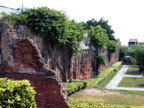
All that is left of the castle is the outer wall of the
north-facing side, the outer wall facing southwest, and
the half-circle of the inner castle. Other remaining
parts of the castle walls are hidden within private property.
No blueprints of the castle have survived, and to better
understand the history of the building, an archeological
team was brought together. This team included people
from Tainan City Government, professional archeologists,
civil engineers, art historians, and educationalists.
Ground Penetrating Radar (GPR) was used from August 2003
onward, allowing the walls to be studied without causing
further damage.
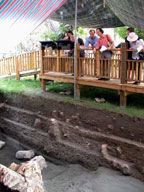
The results of all this work are being made public, and
integrated to create Taiwan's first-ever public display
of live archeological work. The team is going about its
work in an exceptionally thorough manner, and hopes to
gather enough artifacts and information to produce a
complete archeological plan for the castle.
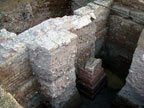
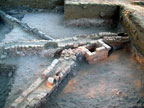
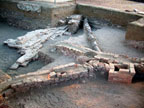
After initial analyses, it was decided to approach the
castle from three points--Test Pits 1, 2, and 3 (TP1,
TP2, and TP3). The team is examining porcelain, tools,
and documents which the Dutch left behind more than 300
years ago. One kind of teapot--now dubbed the Anping
Teapot--has been found dispersed throughout the site.
Another artifact unearthed was a blue-and-white porcelain
piece, made from imported Kraak Porcelain, and originally
from the Chinese mainland. Nearly a hundred fragments
of artifacts were uncovered in each of the three spots.
Two Majolica items (from seventeenth-century Delft in
the Netherlands) were uncovered in TP1 and TP2. In TP2,
archeologists unearthed a wine pot that may have been
a 17th century salt-glaze ceramic model from Rhineland,
Germany. It is believed that a German man by the name
of Bartmannskrug might have owned the pot.
All
of these pieces reveal the complexity of trade during
the "Age Of Sail." Though the actual fort is
in ruins, the artifacts reveal much about the Dutch colonization
era. During four months of archeological work, the site
has had around 180,000 visitors. Through guided tours
and a monthly publication, the public has learned from
the work done by the archeologists. The team is seeking
government assistance to fund further excavations and
investigations.
|