|
|
Each
spring, Taichung county's Dajia (Tachia) town becomes
a busy hive of religious and tourist activity as
preparations for the goddess Matsu's birthday celebrations
take place. Matsu, who came to Taiwan with 17th-century
immigrants from Fujian province, is the most worshipped
deity in Taiwan with hundreds of temples around
the island devoted to her.
There
are a number of stories about the origins of Matsu.
One of the most popular is that her earthly incarnation
was born into a Sung Dynasty fishing family in
Fujian. She was highly intelligent and, by the
age of 10, was chanting Buddhist scriptures day
and night. By the age of 16, she caught the attention
of the gods, who gave her a special amulet, used
to communicate with the gods, drive off evil spirits,
avert disasters, cure the sick and rescue ships
from disaster. Instead of dying, she is said to
have ended her life on Earth by climbing a mountain.
When she reached the peak, the clouds suddenly
parted and she was spirited upward. Following her
ascension, her spirit frequently appeared to save
shipwreck victims and, thus, became known as the
guardian deity of sailors and fishermen.
Matsu's
birthday falls on the 23rd day of the third lunar
month, but is usually celebrated earlier with a pilgrimage
to sister Matsu temples. The pilgrimage procession
starts from the Chenlan Temple in Dajia and goes
hundreds of kilometers through Taichung, Changhua,
Yunlin and Chiayi counties before returning to Dajia
eight days later.
Matsu
takes part in the journey in the form of a statue,
respectfully carried by her followers in a sedan
chair. A number of companions in the form of large
puppets create a colorful parade. These include
her "bodyguards", who also serve as her
eyes and ears. At the front of the procession is
a person who acts as a messenger, striking a handheld
gong to announce Matsu's arrival.
The
start of this procession is the highlight of what
has become a month-long international festival
designed to help more people to learn about Matsu's
history and culture, and to boost local tourism.
This year, the festival starts in early March and
continues until April 24. The procession will begin
around 10 p.m. on April 17, with thousands of well
wishers crowding the streets of Dajia to see Matsu
off, and a parade featuring lion dances, floats,
a variety of performing artists, the lighting of
piles of firecrackers and the sounds of gongs and
drums. Preparation festivities begin in the afternoon
at about 3 p.m. This is one of Taiwan's largest
folk religion rituals and is extremely colorful,
loud and lively. During the month-long festival,
there are exhibitions related to Matsu and folk
cultural performances in and around the Chenlan
Temple. To emphasize that this is an international
festival, organizers have invited musical groups
from around the world to perform.
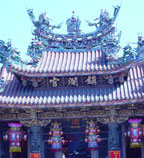
The
Chenlan Temple itself is worth a visit. It was
established in 1732 as a shrine for an image of
Matsu brought from Fujian Province two years earlier.
The shrine was rebuilt as a small temple in 1770,
and expanded to its present impressive size over
the past 200-plus years.
For
more information about the 2004 Dajia Matsu International
Culture Festival, go online to http://mazu.taichung.gov.tw
or call the Taichung County Cultural Bureau at
(04) 2526-0136. |