|
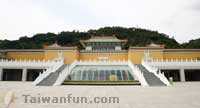
National Palace Museum: A confluence of the modern and traditional
Written and translated by Diva Photos by Andy Lin
(02) 2881-2021
221, ChiShan Rd, Sec 2, ShihLin District
Hours:
Main Building 9 am-5 pm daily; free admission on Saturday from 5 pm-8:30 pm
Admission: General admission NT$160; group admission NT$120
(10 people or more; including audio unit rental); student admission NT$80
www.npm.gov.tw
Transportation:
Take MRT Danshui Line to Shin-lin Station and transfer bus R30 (Red 30) to the National Palace Museum. Also bus 255, 304, Minibus 18 and Minibus 19 can stop in front of the museum plaza.
When I was little, the National Palace Museum (NPM) seemed like a mysterious and distant place. On a school trip, my fellow students and I would spend a whole day at the NPM without ever really appreciating, or even knowing how to appreciate, the beauty of the ancient Chinese artifacts on display. Also, at the time, it seemed like the NPM was far away from anything resembling downtown Taipei; the bus ride was grueling and, after one trip, all of us students knew we had a day of sore-footed ennui in store. More than once I thought about faking a stomachache and calling in sick to get out of our principal's puzzling field trip choice.
When the MRT Danshui line in was completed in Taipei, going from downtown to the NPM seemed easier than ever before. As an adult, I realized that its location was not as tucked away as I had imagined. Thanks to the speedy MRT service, the total number of annual NPM visitors has been growing rapidly, bringing Taiwan nationals as well as foreign tourists to this magnificent museum. The NPM, well known as one of the top four museums in the world, aims to revamp its image in the 21st century and reach out to locals and foreigners who have never visited its well-stocked corridors and low-lit exhibition rooms. It is also reaching out to children more as well. Hopefully, visitors to this museum will talk about what they've seen after they come home, and spread the word about its scintillating collection.
Children's Gallery: A miniature collection, just for kids
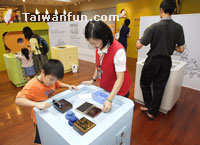
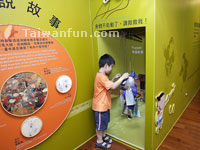
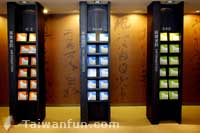
Opened in May this year, the Children's Gallery is aimed at children between the ages of 7 and 12. The gallery's main purpose is to provide advanced tour guidance, which can help students understand the historical background and cultural significance of the artifacts on display in the main building.
Since its opening, the number of visitors has exceeded the museum's original expectations. Though the Children's Gallery takes up only about 4,320 square feet, it hosts as many as 400 visitors in one day. Over this summer, the number of students visiting children's gallery increased steadily. Located in the west wing of the main building's basement, the museum is convenient to get to and free of charge. However, parents or teachers must accompany children inside the gallery.
As far as access goes, the children's area is open during normal NPM business hours, except for Wednesday afternoons. Each tour is about 50 minutes long. There are set schedules for individual tours and group tours. It is advised to make a reservation seven days in advance (02 2881-2021, ext. 2851) for a group of 10 or more. No more than 60 people are allowed at one time and there are no group tours during the weekends.
Since Children's Gallery has been opened, kids like me who once loathed a visit to the NPM now have a chance to enjoy the experience and really understand what these ancient artifacts are all about. In Taiwan's mandatory nine-year schooling system, part of the curriculum is art, humanity and culture. The purpose of such classes is to encourage students to form a lasting appreciation and understanding of art, which is exactly what the Children's Gallery aims to do--in a fun, exciting, and hands-on way.
3D technology brings ancient artifacts to the silver screen
A circular, multi-purpose theater inside the Children's Gallery is home to live stage performances and a short, 3D animated film, "Adventures in the NPM". The movie, which is dubbed in Mandarin, English and Japanese, is an engaging look into the national treasures housed in the museum. After watching it, children often race through the exhibition halls, looking for the Chinese masterpieces that appeared in the film. Sought-after pieces include the legendary jadeite cabbage with insects, the jade duck, and the pillow shaped like a child.
To make "Adventures in the NPM", the museum collaborated with internationally renowned animation artists and spent one year producing the project. All of their efforts paid off earlier this year when the short film received the first place award in the Tokyo International Animation Film Festival. It goes to show that matching age-old artifacts with state-of-the-art technology is the best way to integrate computer-generation kids into a high-art environment. Lately, the NPM has been working with the Taiwan Public Television Service. The second season of "Journey through the Palace Museum" recently premiered by introducing cultural artifacts with animation and splendid visuals. All eyes were on the famous hand scroll "Along the River during the Ch'ing-ming Festival" because it took nearly three years to complete the 4D animation, which shows what everyday life was like in ancient China. This absolutely fascinating project will draw attention from everybody--from school children to working adults.
Free admission on Saturday nights
Beginning in March 2008, the NPM extended business hours to 8:30 p.m. and opened Saturday night up to the public--free of charge. Since extending their hours, the positive feedback has been overwhelming. Before, all of the museum's various outdoor activities and special exhibitions took place during the extended evening hours on Saturdays; the NPM was closed at 5 p.m. on most days and you could hardly see anyone walking around the grounds. Now that the NPM is open on Saturday night, it has immediately become the hottest nightspot in town. Strolling through the NPM plaza is the newest favorite pastime among students, three-generational families, and couples in Taipei.
NPM collaborates with international design house ALESSI
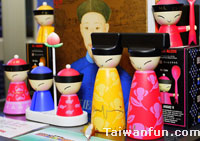
Three years ago, the NPM started a search for a mascot. By fate, Italian design brand ALESSI came along and the two hit it off. In May 2007, the launch of "The Chin Family" became a sensation overnight and was quickly sold out at most retail outlets. The main reason is that Eastern cultural icons were given a new life and transformed by the international design house into adorable, accessible characters. The inspiration originated from a portrait of Emperor Chien-Lung from his younger days. The Chin Family has a series of merchandise items, including key chains (NT$990), which are among the more affordable things you can buy here. Salt and pepper shakers in the form of Mr. & Mrs. Chin (NT$2,600, limited edition) are the best-liked items among the line of luxurious household goods.
Thanks to ALESSI, there are now 5,000 NPM merchandise distributors worldwide and "The Chin Family" is becoming a recognizable collectible. In each product's package you'll find the NPM logo and a brief brochure with information about museum. The success of "The Chin Family" accelerated the next collection series, "Orientales". This new collection of decor and household merchandise is based on the intersection of East and West and Western ideology to interpret Eastern culture. ALESSI's top designer, Stefano Giovannoni, took Asian monkeys with their traditional favorite fruit--the peach, and incorporated them into Western cartoons and fairy tales. The outcome is extraordinary.
So, the next time you visit the NPM, be sure to make a trip to the gift shop in the basement of the main building. As soon as you enter the shop you'll find "The Chin Family" and "Orientales" collections. Along with the merchandise, there are also two wooden full-sized figures of Mr. Chin standing by the entrance of the gift shop. These icons have become the newest hot spot for picture taking inside of the NPM.
A cultural meeting place
While writing this article and once again visiting what my child-like brain perceived to be a dull destination, I've come to realize what the saying "old is new" really means. The NPM has gone through a series of major renovations in recent years and the new NPM is bright and chic. The floor plan is designed with a human touch and the exhibitions are easily accessible. Some may have noticed that the official website of NPM is available in nine different languages, an obvious invitation to foreign guests.
On the website, there is also a section called NPM e-Learning, which offers online art courses and information on all kinds of subjects like Chinese ancient bronze work, ceramics, painting, and calligraphy. This year, a new course on Chinese jade will be added to NPM's online learning center. NPM e-Learning is extremely helpful for those who, like me, wish to know more about ancient Chinese artifacts but don't really know where to get started. Last but not least, if you would like to stroll through the exhibitions at the NPM without ever stepping into the building, the digital museum is only one click away.
All of these technological advances, in a shrine to the old, ancient and established, is a testament to the Eastern ideal of preserving the old while embracing the new and of Taiwan itself; on our beautiful island, we're in a constant struggle to rectify the old and the new, the traditional with the modern, the past with the future. The National Place Museum is a well-cast example of a place where these conflicting values can exist in complete harmony and truly represent the true spirit of Chinese culture.
|

 October 2008
