|
HOME
> TAIPEI
> ARTICLES >
TAIWAN FUN
MAGAZINE, October 2006.
 |
| |
Its
Jazz Baby!
---
By Courtney Donovan Smith and Douglas Habecker
Translated by Iva Huang and Picker Chen
From Whence It
Came
Jazz, along with the gramophone, was introduced
to Taiwan during the Japanese colonial period.
Inspired by recordings and Japanese performances,
the first Taiwanese jazz musicians began to
try out this new musical form. In 1949, new
arrivals from mainland China added some of the
juice from the influential Shanghai scene.
The next wave of influence came from the America
militaryn bases located in Taiwan from the 1950s
through the 1970s. During the Vietnam War in
particluar, jazz greats like Louis Armstrong
even came to Taiwan to entertain the troops.
Embodying these influences, local jazz aficionado
Tsai Ba (??) opened the now legendary Blue Note
bar in 1974 and is still a main fixture on the
scene. Armies of musicians have passed through
his doors, and countless careers launched with
the Blue Note's encouragement.
Another milestone in Taiwan's jazz history
is 1981, when the Dizzy Jazz Band was formed.
Today, this is more of a community than a band--there
are currently five 'Dizzy' bands and they maintain
their own offices. These bands consist of the
big band they are famous for , a Latin band,
a youth band, a 'small' seven person combo band
and yet another youth band. Other bands have
grown out of the Dizzy community, like Metamorphosis
which, naturally enough, plays at the Blue Note
regularly.
Two developments have played out in recent
years. The first is the growing number of establishments
that have live jazz bands performing (see sidebar).
The second is the number of festivals and events
cropping up, including the Taichung International
Jazz Festival (see page four of this article),
the Taipei International Jazz Festival and the
Chrysler and ICRT Jazz Competition.
|
 |
| |
So
Where's the Scene At Now?
Asked to comment on the scene, those involved
with it all seem to disagree. While Blue Note's
owner Tsai Ba frets about the future, jazz musician
Ashley Hines (who has been on the scene since
the 1980s), is much more positive--especially
when comparing the Taiwan scene to others in
Asia.
He notes "Taipei alone, I would estimate,
has about four to five times the numbers of
musicians as Beijing. Those in Shanghai are
all imported and leave when their contracts
are up. By comparison, in Asia, Taiwan is really
happening. Only Japan really outshines Taiwan.
And Taipei is important for the Taichung scene,
too, because many Taipei musicians make the
trip down for regular gigs, often commuting
between the two cities--cross-fertilising the
two scenes."
Grooveyard owner and jazz musician Patrick
Byrne has another take on the scene: "The
scene grew really quickly for awhile, but has
leveled out a bit. It's all the same bands now.
The quality has been getting better, though.
As for the listeners, there is a growing interest
in what is perceived as 'jazz', and some of
that is percolating down."
|
 |
| |
Jazz
Not Defined
So what is jazz, then?
Asking a jazz musician or anyone passionate
about music to define jazz is risky. Some are
upset by the question. Others take you on a
long historical journey that doesn't seem to
answer the question so much as document it.
Yet others take the question as an opportunity
to rant about how much they hate Kenny G.
Over time it has become a melange of different
styles. Originally it drew from classical and
the blues. Now it's drawing heavily from hip
hop and funk. Many note the heavy use of improvisation,
a more complicated harmonic structure and chord
progressions, and the heavier use of wind instruments
as defining features--though none of these features
are uniformly present. Complicating matters
further are bands like Bearbabes, wich in one
song plays pure jazz, the next a fusion of jazz
and rock, and then follows that with pure rock.
All that being said, there is frequently consensus
on what constitutes 'jazz' when people hear
it.
Challenges
The jazz scene does have some challenges to
overcome to continue growing, both locally and
internationally. Booking agents hire bands to
play what they perceive as audience demand.
In practice, this means bands that play either
the classics ('Girl from Ipanema', 'Take Five')
or soft background music that often is a live
version of elevator music.
This isn't necessarily bad, at least as a start.
The listening public doesn't have a feel or
understanding for jazz, so starting with the
easily accessible classics and unchallenging
background music can act a starting point or
'first lesson' in the music genre. This start,
hopefully, leads some listeners to delve deeper.
Another problem or challenge that keeps many
potential listeners away is the perception that
the music is staid. Patrick Byrne notes, "People
take it too seriously. Traditionally, jazz was
party music--people jumping up and dancing on
the tables. Classical went through the same
thing; originally people would be getting drunk
and heckling the bands, but then it became so
serious. Take someone like Miles Davis; you
don't want to see him at the concert hall--you
want to see him at a smoky bar."
|
 |
| |
Taichung
Jazz Festival' 06
2006 Taichung Jazz Festival showcases top foreign,
local jazz talent
Taiwan music fans regularly pencil an October
trip to Taichung into their calendars, as that's
when the Taichung Jazz Festival rolls around
each year. This year's festival--on the weekends
of Oct. 21-22 and 27-29--provides more outstanding
live jazz from a spectrum of styles and local
and international artists. Highlights include
the following (performance times noted):
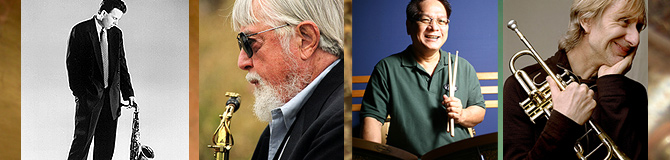
Incredibly, alto sax player Bud Shank (Oct.
21, 7-10 p.m.) has played a big role in the
U.S. jazz scene for 60 years as a player, composer
and arranger from the "West Coast"
jazz movement. Since the '40s, he has performed
and worked with dozens of jazz greats--from
Ray Brown and Phil Woods to Jackie McLean--in
over 50 albums and countless performances. Now
in his 80s, he still welcomed by jazz fans the
world over.
The Erik Truffaz Quartet (Oct. 21, 7-10 p.m.)
is led by French trumpeter Truffaz. Often compared
to Miles Davis, Truffaz has won acclaim for
his own brand of new jazz that features modern
dance rhythms, from drums and bass to hip hop,
in a jazz-pop-rock fusion. This Blue Note Records
artist has released a number of albums, including
1998's European hit "The Dawn". A
Japanese household name and leading jazz pianist
Yosuke Yamashita (Oct. 21, 7-10 p.m.) has released
over 40 albums and toured widely the past 30
years. He and his New Quartet will Taichung
to his unique brand of contemporary jazz.
Acclaimed, world-class tenor sax player and
BMG recording artist Harry Allen (Oct. 29, 7-10
p.m.) has over 20 recordings and has worked
with jazz musicans worldwide, including Rosemary
Clooney, Ray Brown and Hank Jones. Trio da Paz
(Oct. 29, 7-10 p.m.) consists of three top Brazilian
jazz musicians--guitarist Romeo Lubambo, jazz
drummer Duduka Fonseca and string bassist Nilson
Matt. Formed in 1990, they have ganed fame for
their live performances and collaborated with
artists from Charlie Byrd to Herbie Mann.
Other Festival artists/bands include Taiwan's
Japanese-born UNO Jazz Trio, the Dizzy Jazz
Big Band, JEG Jazz Band, Montunos Lartin Band,
Japanese/Taiwanese acid jazz quintet Hip Swing,
Taipei Jazz Ensemble, Mosquito Latin Band, and
Taichung's own popular bands 'Round Midnight
and Jazzaholics.
Performances start at 3 p.m. on Oct. 21, 22,
28 and 29, and at 6 p.m. Oct. 27 on the two
smaller J1 and J2 stages along the JingGuo Boulevard
parkway, where dozens of food and drink vendors
will also be present. Big-stage performances
on Peoples' Square are on Oct. 21 and 29 from
7 to 10 p.m. For more information, go the Festival
website at http://www.jazzfestival.com.tw
|
|

