|
Foot
Massage
By Josie Wu Translated
by Cara Steenstra
Even though the traditional folk therapy of
"foot massage has been around Taiwan for
over 20 years, my first experience of it was
only a very recent event. A Swedish friend of
mine, Peter, was visiting Taiwan for the first
time and was curious about everything. As we
were strolling around the streets of Taipei,
Peter stopped suddenly and would not stop staring
at a foot massage center that had caught his
attention. Then came a flood of questions from
Peter. "What are they doing?" "Interesting!
Does it really work?" "Does it cure
diseases?" "Does it hurt? It must
hurt!" "What kind of theory is this?
How does it feel?"
My curious friend, who wanted to try stinky tofu
the first day he arrived in Taiwan, immediately
rolled up his trousers to have a go at it. As
for me, I simply went along for the ride but realized
just how great it felt and that it was not really
painful after all. While I watched my friend's
face contort and his eyes bulge during the massage,
I kept imagining him going home to tell his friends
about this "horrific" experience. Surprisingly,
he not only finished the entire therapy, he also
kept exclaiming about how "cool" it
was! The next day, he continued to exalt the wonders
of its effects, telling me about the wonderful
nights' sleep he had enjoyed and how energized
he felt. It was entirely beyond what I had imagined!
Foot massage can be traced back to ancient China
where, thousands of years ago, Chinese people
had already used foot massages to treat ailments
and to stay healthy. The theories are similar
to acupuncture, and were introduced to Japan during
the Tang dynasty, evolving into what is known
nowadays as "harikyu" and "sokushindo".
There is an old saying that goes, "When trees
age, their roots age first; when people age, their
feet age first." Some people claim the feet
are a human being's "second heart",
and are intimately connected to the body and its
organs, also taking on the entire weight of the
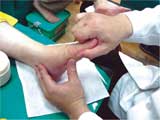
body. Foot massage stimulates the reflex areas
in the foot to adjust bodily functions, improve
blood circulation and metabolism.
Well known for the development and progress of
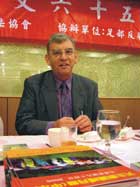
foot massage in Taiwan is Rev. Josef Euguster.
Last month (December 2004) was Rev. Euguster's
65th birthday. He is friendly, full of energy
and speaks fluent Mandarin and Taiwanese. As a
missionary in Taitung, apart from his religious
work, he also promotes the new methods in reflexology
enthusiastically. He stresses that real foot massages
are unlike those painful scenes seen on certain
TV prank shows, but should be done according to
the individual's physical needs, applying necessary
pressure, making one feel refreshed afterwards.
Rev. Euguster aims only to help others, and has
never opened a single shop. Yet his name has almost
become a brand name for foot massage businesses
because of the effects of his methods. Forty minutes
of foot massage plus 10 minutes for a medicinal
foot bath usually costs around NT$500-NT$600.
These therapies are popular among tourists, businessmen
and those in the entertainment business. Even
though many places use the name of Rev. Euguster,
the quality of massage therapists may differ,
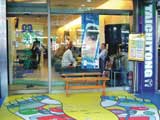
so one must take care when choosing. The Tai-Chi-Tong
Traditional Therapy Research Center has five branches
in Taipei and one in Hsinchu, and is a member
of the Chinese Foot Reflexology Association. They
wish to differentiate themselves from other massage
businesses claiming to use his methods, and work
hard at passing on their professionalism and training
talents.
An experienced technical consultant, Mr. Chen
Bi-Hsiung, said that a truly qualified therapist
should be able, by simply touching the client's
foot, to professionally judge the level of strength
needed in order to achieve the best results without
causing any harm. Health problems are often caused
by lack of exercise. Foot reflexology therapy,
which means foot massage, aims to stimulate reflex
areas to improve blood circulation, expel toxins
that have accumulated in the body, stimulate metabolism
in order to achieve the effects of good health.
Mr. Chen also added that a regular lifestyle,
a balanced diet, moderate exercise and good moods
are the actual basis of maintaining good health.
Zi-Zu-Chang-Le Traditional Therapy Research Center
is also a member of the Chinese Foot Reflexology
Association. The premises are not large, with
nine therapists. The difference is that since
their opening three years ago, they have received
numerous reports from Japanese travel magazines.
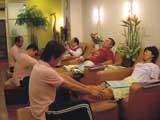
The bonsai trees and indoor plants create a very
relaxed environment. The manager, Mr. Chen, who
was once invited to lecture in Japan, insists
upon certain concepts he learned from the Japanese
such as patience, friendliness and attention to
service. He also wants to break away from the
old image of the ZhongShang area. Even with an
all-male therapist team, their client base is
mainly female. Mr. Chen remarked that many tourists
from Japan come here as if on a pilgrimage to
enjoy foot massage and, due to their proximity
to the Far Eastern Plaza Hotel and Le Petite Sherwood
Taipei, many business travelers visit them, too.
Originated from central and southesn Taiwan is
the Teacher Deng Health Center, with 10 branches
across the country. They just opened a flagship
store in the Carrefour Hypermarket in HsinTien.
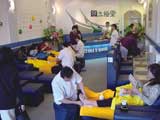
The place is bright and spacious, with luxurious
seating and audio-visual entertainment. Their
motto being "economical, healthy and recreational,"
they welcome the entire family and stay open 24
hours. So you can enjoy a massage anytime to improve
your circulation and immune system. They also
have a "Shanghai Foot Bath" that contains
10 medicinal herbs.
If you wish to gain further understanding of the
benefits of foot massage, a lot of information
and books are readily available. Those who suffer
from ailments should consult their doctors before
beginning any form of treatment. Overall, foot
massage is a very practical method for maintaining
good health.
Tai-Chi-Tong
Traditional Therapy Research Center
Tel: (02) 3343-3926
Address: 72, ZhongXiao E. Road, Sec. 2
Hours: 9:30 a.m.-10:30 p.m.
Zi-Zu-Chang-Le Traditional Therapy Research
Center
Tel: (02) 2700-8817
Address: 109-2, XinYi Road, Sec. 4
Hours: 11a.m. -12 a.m.
Teacher Deng Health Center
Tel: (02) 2541-2700
Address: 136, MinChuan E. Road, Sec. 2
Hours: open 24 hours
|