|
Dining
healthy in Taiwan

By
Mark Payne Translated by Iva Huang
Did
you know that in the some lunch boxes contain
900 calories bursting in between those two little
rubber bands?
Dieting
is all the rage in Taiwan; topics like weight,
calories, exercise and dining out are now as common
as eating moon cakes during Mid-Autumn Festival.
Chang Chin-jen, president of the Taiwan Medical
Association for the Study of Obesity, estimates
that there are 1.1 million people in the country
who have weight problems, according to a September,
2004 article in the Taipei Times. Although that
number seems surprisingly high, it is true that
most residents of Taiwan aren't getting any
skinnier.
Unfortunately, many diet plans propose buying
into the over-the-counter "miracle pills"
that supposedly reduce your weight by several
kilograms a week. But losing weight permanently
takes more than a diet pill. Some people need
a complete food and diet makeover.
The Devil is in the Details
Taiwan has an abundance of fresh, healthy foods
that lend themselves to a low-calorie lifestyle.
Moreover, the general diet is still relatively
free from processed foods. But the cooking method
is usually where the calorie count soars, as the
majority of restaurant food is prepared in a frying
pan or a wok.
Bernard Lee, who teaches Western cooking at Shih
Jian University, thinks that most Taiwanese food
is too oily. An accomplished chef, Professor Lee
rarely eats out, preferring to cook his own meals.
Since fried foods contain a generous amount of
oil or lard, these entrees are full of fat and
calories. Just one tablespoon of vegetable oil
has 120 calories and 12 grams of fat. Besides
being highly caloric, a diet high in vegetable
oil and other saturated fats may clog your arteries
and significantly increases your risk of heart
disease.
Additives like MSG and salt are also dangerous
to your health. The latest recommended intake
of sodium (set by the National Academy of Sciences)
is only 1,500 mg a day. One tablespoon of soy
sauce contains almost 1,000 mg of sodium, so you've
consumed
your daily limit in just two tablespoons! Eating
too much sodium raises blood pressure, which increases
the risk of heart attack and stroke.
He Who Eats Many Calories Will Have Big Belly
Additives aside, some Taiwanese foods should be
avoided simply because they're downright fattening.
And the majority of those foods are fried. Fried
dumplings (jaudzi), although delicious and traditional,
are calorie traps. These small, pork-filled bundles
pack anywhere from 50 to 150 calories each. If
you're like most people, you can put away a minimum
of 10 dumplings at a meal. Before you know it,
you've eaten 1,000 calories, and that's not including
the dipping sauce! If you do enjoy jaudzi, order
it steamed and limit yourself to only a few. And
forget about those all-you-can-eat dim sum restaurants.
Fried dim sum is the evil twin to fried jaudzi.
Hot pot can also be a caloric nightmare, contrary
to popular thought. Oil is added to the broth,
and many of the tofu selections are deep-fried
and full of fat. Certain varieties of hot pot
combined with dipping sauces can pack up to 2,000
calories! Then there's the ever-popular "bien
dang" lunch box that is quick, cheap, and
tasty. But did you know that in the some lunch
boxes contain 900 calories bursting in between
those two little rubber bands?
Although Professor Lee might shun bien dangs,
the vast majority of college students won't. "Sure,
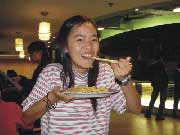
I am concerned about calories," a petite
Chinese girl informed me. "But I really like
fried food." As I observed Shih Jian students
downing plates of fried noodles and fried rice
during lunchtime, I asked them about their daily
food choices. All of the students admitted to
enjoying greasy food on a regular basis. And since
college students are on a tight budget, few of
them will opt for a pricey salad or fresh sushi.
.
So, what's a dieter to do? Well, if you don't
have the metabolism of a teenager anymore, you
need some practical advice about staying trim
and fit in a country that thrives on fried food.
Instead of swearing off fast food forever, here
are some suggestions from professional chefs,
nutritionists, a registered nurse, and expats
who have lived in Taiwan for years.
Tips from the Pros:
1. Avoid fried foods.
Obvious, but many people overlook the fact that
fried vegetables contain unnecessary calories.
Ask to have your vegetables boiled in water instead
of fried. The chef may look at you a little funny,
but he'll get over it. Ask the chef to prepare
your dishes with less oil. If your vegetables
look like they're
sitting
in an oil slick, blot them with a napkin. It's
amazing how many calories you can wipe away when
no one's looking! Finally, scour the menu to find
food that is boiled, steamed or grilled, instead
of fried.
2. Find healthy dining spots.
Try the food courts in department stores or at
the Taipei 101 mall. From sushi to sub sandwiches
to smoothies, healthy food abounds. If you do
frequent a "lunchbox" restaurant, choose
one that offers a variety of vegetable and lean
protein options. Stay away from fast food chains
and try a vegetarian restaurant instead.
3.
Watch your portion sizes.
Most people feel ripped off if they pay a lot
of money for food and then walk away hungry. Because
of this, Western portion sizes are huge, making
it easier to overeat. Although portion sizes of
Taiwanese food tend to be smaller, all-you-can-eat
buffets create a dieting dilemma; hungry patrons
get to pig-out on all kinds of fattening foods.
Eating buffet-style on a regular basis will likely
result in weight gain, not loss.
4. Avoid highly-caloric beverages.
Although fruit smoothies are arguably healthy,
most of the sweetened teas and beverages won't
help you lose weight. A Strawberries & Cream
Frappuccino at Starbucks has 580 calories and
17 grams of fat; that's more calories than you'lll
find in a Big Mac! Sweetened teas are no better.
A pearl milk tea packs upwards of 600 calories;
those little tapioca balls are pure starch. Unless
you have a very high metabolism, you probably
can't afford to drink hundreds of extra calories
every day. Stick to unsweetened teas or small
amounts of pure fruit juice, and ask for skim
milk when ordering flavored coffee drinks. (As
a rule of thumb, always assume that the milk used
in teas or coffee is whole milk).
5. Make dining out the exception, not the rule.
"There's so much fabulous food here,"
says well-known food writer and stylist, Shirlee
Posner. "It's not one meal that's going to
make you fat." But eating out every day will
likely widen your waistband and put a dent in
your wallet. If you do have to eat out, keep it
simple; order a few dishes and share them with
others. Eat until you're 70 percent full, Professor
Lee recommends.
Do your own shopping and cooking! I know, I know,
you're too tired to cook when you get home from
work. But if you're concerned about your health
and diet, you can probably save yourself hundreds
of calories by simply preparing the food yourself.
Between Jason's Market, Tesco, Costco, RT Mart,
Carrefour, and several organic grocery stores,
you can find almost anything! Stock up on chicken
breast, fresh fish, fruits and vegetables, whole
grains, and low-fat dairy products. Cooking meals
at home may take extra time, but there's something
satisfying about creating food that is both healthy
and delicious. If you lack culinary skills, take
a class from the Community Center or buy a good
cookbook from the Page One bookstore.
|