Kenting:
A true all-things-to-all-people resort
By
Steven Crook
Kenting offers a great deal more than sandy beaches
and sparkling ocean. Energetic visitors can happily
spend days here without ever getting their feet wet.
Kenting
National Park--which now covers 20,000 hectares of
land, and almost as much sea--has 15 species of wild
mammals (though you're more likely to see buffalo
than macaques), 59 kinds of reptiles and amphibians,
216 species of butterflies, and more than 300 different
birds.
Offshore,
reefs of soft and stony coral attract scuba divers.
Sixty percent of the world's coral species can be
found around Kenting; these reefs nurture 1,500 kinds
of fish. For those visitors who want to enjoy all
this sub-aqua color, diving outfitters abound.
The
Hengchuen Peninsula has more than a dozen prehistoric
sites, some of which were inhabited by humans 4,000
years ago. More recent cultural attractions include
the 120-year-old lighthouse at Eluanbi, Hengchuen's
South Gate, and the tiny aboriginal communities that
dot the area.
Popular
with tourists since the 1970s, Kenting Road--the resort's
main strip--now hosts well over a hundred businesses
run by locals, outsiders, and foreigners. On weekend
evenings it resembles a night market, with food vendors,
souvenir hawkers, and even tattoo artists plying their
trades.
Dawan
Road, quieter and closer to the beach, is home to
two of Kenting's most popular eateries--Warung Didi
and the Cactus Cafe.
Unless
you're here for the gastronomy or the nightlife, you
shouldn't restrict yourself to "urban Kenting"
and the nearby beaches.
Scooters
can be hired at almost any time of day or night. I
arrived just after 5 am, and had the paperwork completed
within 10 minutes.
The
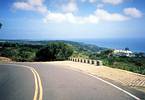
roads that criss-cross the eastern half of the peninsula
make for dream riding: Smooth tarmac, extremely light
traffic, and pleasing scenery at every turn.
Some
of the places I saw in the hour after dawn, like the
crumbling cliffs near Lungpan, looked very different
when I returned mid-afternoon.
At
one point further up the coast, I had to stop because
torpid cows blocked the road. Then a man with a two-meter-plus
tuna fish strapped to the back of his motorcycle overtook
me at great speed.
Taiwan
is a well-watered, fecund island. The shifting sand
dunes at Gangtz are therefore especially intriguing,
and it's no surprise that at least two companies offer
Jeep tours of the "desert." A circuit costs
NT$300 or so per person, and takes 25-30 minutes.
I
was enjoying my foray through the less-visited, thinly
populated eastern half of the peninsula so much that
it seemed a pity to turn around and head into the
uplands visible from the tourist beaches.
These
hills are largely uplifted coral reefs. It is strange,
hundreds of meters above sea level, to find house-sized
chunks of brownish coral. It's also a vivid illustration
of the power and time-scale of geological processes.
Kenting
Forest Park is a formal but worthwhile introduction
to the area's plants and trees. Exploring the nearby
roads--many are dead-ends, others are rock-strewn
farm trails, a few are alarmingly steep--can be equally
rewarding. The surrounding open pastureland, and the
cattle grates on the road, make for several this-cannot-be-Taiwan
moments.
Mountain
biking is certainly an option hereabouts, and rock
climbers will find plenty to occupy them. In fact,
the list of non-water activities is almost endless.
There are hot springs elsewhere on the peninsula if
the sea is too cold for you (unlikely in this season),
not to mention the superb National Museum of Marine
Biology and Aquarium.
In
and around Kenting, you can be sure: You'll run out
of time before you run out of things to do.
|