|
HOME
> NORTH
TAIWAN > TAIPEI > ARTICLES
>
TAIWAN FUN MAGAZINE,
February 2002.
Cross-Cultural
Dating and Marriage
Translated by Sharon Yang
| With Taiwan's focus
on internationalization, including its recent entry into
the WTO, foreigners are arriving and staying on the island
in larger numbers. In addition, an increasing percentage
of the local population has spent some time abroad for
work and study, and has been exposed to other cultures.
Thus, it is inevitable that foreigners and locals will
have more and more opportunities to mix and, perhaps,
even fall in love. |
 |
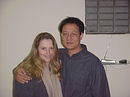
For the "Love Edition", we interviewed several
cross-cultural couples and asked them about the advantages
and drawbacks of dating or marrying someone from another culture.
Most of the couples we interviewed met in Taiwan. Karl Smith
and his wife, Cynthia Chang, met when they taught together
in a kindergarten. Andy Town and his fiance, Michelle Wu,
also met while working together in a language school. But,
two of our couples met outside of Taiwan. Chi Lu met his wife,
Lynda, a member of the aboriginal Maori culture, at a church
in New Zealand. Janine and Damao Chu met in Janine's native
South Africa.
 |
For most of our couples, falling in love was a slow process.
Justin Richardson and Naomi Chen, a Canadian-born Chinese,
met at her 27th birthday party. Says Naomi: "I didn't
really notice him until later, when a mutual friend set
up a dinner. We were thrown together a couple times so
I finally decided to take fate into my own hands." |
Michael Blayden and Jessie Lee fell in love
when Michael had a health scare. After taking care of Michael
in the hospital for a week, the relationship between them
gradually developed. For Donna Campbell and Yowie Chen, it
definitely was not love at first sight. Donna says that one
of the first things Yowie said to her was, "You smoke too
much". At first she thought he was rude but, after chatting
a bit, they decided to start a language exchange. But, when
Janine and Damao Chu met, after Damao had been working in
South Africa for six months, they immediately became interested
in each other.
During the interview, these seven couples were
asked about the most rewarding and most difficult cross-cultural
aspects of their relationship. Justin Richardson mentioned
that learning more about Chinese culture is a real benefit.
In addition, having a girlfriend that speaks Chinese helps
a lot.
| Chi and Lynda Lu share this opinion, saying that "cross-cultural
relationships give you the opportunity to get a taste
of one another's cultures". Michelle Wu says that having
a foreign boyfriend has given her insight into another
culture. She adds that "having different ideas and views
makes life more interesting". |
 |
Admits Michelle's fiance Andy: "Before I met
Michelle, I didn't feel particularly comfortable living in
Taiwan. Unable to read Chinese characters, I felt frustrated
and had the feeling I was missing out on so much. I also often
found myself criticizing the Taiwanese and their lifestyle
largely due to a lack of understanding on my part of their
culture. Being with Michelle, though, has opened my eyes.
I feel a lot more comfortable living here now."
As far as the drawbacks, Janine Chu says that
it has been very difficult to adjust to living in a foreign
country. For many cross-cultural couples, the uncertainty
of future plans, like which country they will live in, can
be difficult. Michael Blayden says, "I really love living
in Taiwan. Jessie and I plan to make our home here. We might
go back to the United States someday but, for now, we are
both very happy here."
Andy Town adds that, "At the beginning, Michelle didn't think
I would stay in Taiwan on a long-term basis, and there was
no way that she'd leave her family and move to England with
me."
 |
Another drawback can be misunderstandings influenced
by differences in cultural backgrounds. As Donna Campbell
mentioned, these can be even more serious if the misunderstandings
extend to your partner's family. Or, as Karl Smith explains,
"There are some issues about obligations--family versus
job, job versus friends. But, I believe the same issues
occur in most marriages, even when both partners are from
the same culture." |
Another question we asked was, "Have your friends
and family supported or objected to this relationship? If
they objected, how have you coped?" On the foreign side, most
families were quite open and supportive. Lynda Lu answered,
"My family really didn't care as long as he looked after me.
In fact, they liked the idea that he was Chinese as the Chinese
culture, like the Maori culture, is family-oriented." Karl
Smith says that his family "adores my wife, even taking her
side on various disagreements".
On the Chinese side, there have been more concerns
about whether a cross-cultural relationship would last. Andy
Town says, "Michelle's family was initially a little concerned
that she was dating a Western man. I think they thought the
relationship wouldn't last and I'd eventually return to England.
They now trust me and I have a very good relationship with
all of the members of her family."
| Cynthia Chang's parents were very skeptical about her
marriage to Karl. They believed that foreign men were
all womanizers and placed little importance on the sanctity
of marriage. But, they were finally won over by Karl's
polite and respectful attitude toward them. Michael Blayden
recalls, "Jessie's parents were a bit shocked to meet
me the first time, but we get along together very well
now. Jessie's dad and I enjoy drinking a bit of wine together
at dinner time." |
 |
Damao and Janine Chu, on the other hand, had
to work hard to win over both families, as there was much
doubt among their parents that their marriage would work.
But, it was this doubt that pushed them to work hard at their
relationship and now, after 10 years, they have everyone's
support and blessing. They say that it was the support of
their friends, rather than their families, that helped them
through the tough times.
Finally, we asked, "What advice do you have
for other cross-cultural couples?" Justin Richardson replies,
"Be prepared to take time and make an effort to join in with
family life. Always try to be understanding towards your partner's
culture. Learn about the good differences you see, not the
things you think are bad. Remember, every culture is different."
Damao Chu notes that "it is difficult for an Eastern man to
marry outside of his culture. You have to compromise a lot.
You have to really get to know her, and her background and
culture". Damao's wife, Janine, adds, "Definitely learn all
about each other's cultures and accept it; don't try to change
it. It won't be an easy road but, if you hang in there, it
will prove to be very rewarding."
Michelle Wu advises that "you should take the
opportunity to visit your partner's home country to meet his
friends and family. That will build understanding between
you". Chi and Lynda Lu encourage couples to "go for it" while
at the same time admitting that there are major differences.
They maintain that it is important to be open-minded. Donna
Campbell admits that marrying outside of her culture is harder
than she ever imagined. She feels that "the only way the relationship
will work is if you're willing to accept and understand each
other's inevitably different viewpoints".
|

