|
HOME
> INFORMATION
COMPASS
MAGAZINE, MAY. 1999. VOL. 6 ISSUE 5
The Eastern Way of Healing
By Barbara Healy
|
|
With
a known history of over 2500 years, Chinese herbal medicine
is an organized system of medical knowledge containing more
than 7000 remedies proven through centuries of use, pharmacological
research, and modern clinical experimentation.
In both written and unwritten form, this holistic practice
has evolved over the centuries using primarily plant extracts
and some other natural substances to treat diseases. The Chinese
have developed a complex diagnosis and treatment system, tailored
to an individual's patterns of disharmony, which, it is claimed,
if left unchecked, can lead to illness. The theory of yin
and yang, where opposite poles need to work together within
a person for good health to occur, is a primary theory in
Chinese herbal medicine.
|
The
western science approach has focused on isolating active chemicals
in a particular herbal substance. The Chinese believe that actives
evolved side by side for a particular reason. It is believed
that separating them disturbs their natural balance. An eastern
doctor fights infection by prompting the body's natural defenses
to combat a disease while the western doctor isolates the organ
or a specific condition and either remove the organ or sets
a target to attack.
In the
West three factors have contributed to a revival in the use
of herbal medicine. First, there is public concern about the
cost of drugs that produce unacceptable side effects (for instance
penicillin, which can cause serious allergic reactions). Second,
in Europe, it has been proven that natural substances can address
may modern health concerns with minimal side effects. Thirdly,
China and Japan have successfully integrated modern medicine
with traditional herbal remedies.
|
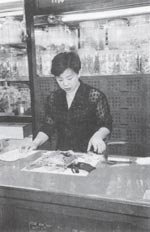
Locally
in Taiwan, herbal medicine shops (zhong yao fong) continue to
serve loyal customers much as they have done throughout Asia
for centuries. Effects of herbal medicine are gradual and cumulative,
rather than sudden and dramatic. The natural products are sold
in the form of pills, tablets, medicate oils, plasters, and
water-soluble granules. If sold in their raw state, they are
taken home and boiled, often in clay pots, to create a thick
broth. Doctors practicing herbal medicine in Taiwan have four
tools to diagnose a problem and determine what mix of herbs
best suit a patient's condition. They listen to a description
of symptoms; observe the patient; check pulse rate, tongue color
and texture, and other body parts for signs of illness; and
then delve for specifics.
Overall, the belief that good health is mintained through proper
nutrition, ample activity and quiescence is universal today
and herbal medicine is a primary advocate to facilitate a healthy
and well-balanced state of being. |
|
Well-proven
herbal remedies include:
- Bark
of cinchona tree for antimalarial drug, quinine
- Qing
haosu for antimalarial drug
- Dried
seed of papaya for dysentery
- For
scurvy (caused by vitamin C deficiency): rosehips
- Beriberi
and rickets can be cured with a mix of herbs
- Ginger
root in soup helps as decongestant
- Mint
and menthol sooth sore throats
- Oil
of cloves is used to numb aching tooth
- Wild
nuts from a jungle near Guangxi for rheumatism
- Ganoderma
mushrooms for chronic intestinal problems
|
|
Find
Chinese Herbal Medicine in Taichung
|