Depicting the essence of zen
via architecture: Dharma Drum Mountain Buddhist Temple
Words and photos by Xie Wen Tai
Translated by S. Ying
Where does one find zen? Is it found deep in the woods or up in the mountains? Do you look at the lakes, or in the flowing waterfalls? How about among the clouds, in the chiming of temple bells or within dying tree branches and fallen leaves?
Could it be found by looking through a feather, some ferns, moss and even a fancy stained glass window or cigarette smoke patterns?
When a Buddhist temple is not located in the mountains, amidst the clouds or near flowing waters, how does an architect connect to spiritual concepts using a basic building structure? Dharma Drum Mountain Buddhist Temple, built by Architect Huang Ming-Jie, is one such structure, providing new insights into how one can rationally depict the essence of zen through architecture.
Taichung's 7th Redevelopment Zone is a busy competition ground for architects, with tall high-rises on both sides of Taiwan Boulevard, each building boasting designs that showcase the extravagance of the luxurious lifestyle in this area, whether it be through the grandness of the homes or the magnificent use of abundant space in these structures.
However, the architectural designs of these grand buildings are also limited in scope because the area lacks a natural landscape for incorporating design elements, with no rivers or ancient old trees or grass fields. This mandates that the design focus be entirely within the building structure itself; therefore, each structure in this area resembles a beautiful, yet lonely, peacock, standing in its own glory within its clearly defined area.
  
Left: Top-floor Buddha
Medium: Third "three doors" see from the Guan Yin Dian
Right:
Classroom
Blending with its environment
Dharma Drum Mountain Buddhist Temple sits on a narrow strip of land with drastically different architectural designs on both sides. The north side is next to a 60-meter stretch of ShiZheng Road, facing the central diameter of the large city center, while the south side is next to 10 meters of ZhengHe Road's quiet residential area. The architect took note of the different structures on each side and designed the Buddhist temple to blend in naturally with the two areas by placing the higher buildings of the temple grounds on the north side and leaving open space on the south side, which also expresses the essence of zen as it blends in within the urban landscape and showcases the ideology of adhering to an "original state".
Stairs and open space
The simple outward appearance of the Buddhist temple allows it to stand on its own amidst the colorful mosaic of buildings in the 7th Redevelopment Zone; the setting resembles a Buddhist monk dressed in simple off-white cloak with no expressions of joy, placed among a crowd of lavishly-dressed men and women, which creates a "pause" for the onlookers and passers-by.
 
Left: Lobby and backyard from the south side
Right: Sloping hallway and light-shadow effects
The huge slanted windows of the temple stand at a height of eight stories with a backdrop formed by the many slanted surfaces so that there are hints of a traditional rooftop in the design while decreasing the complexities of its appearance. Thus, it has clear lines and a simple visual effect, symbolizing the need to respond to the environment while drawing out the significance of self-reflection within the busy world as the building structure represents a non-traditional Buddhist temple and, more so, a different form of architecture in the urban environment.
Within the interior space, the architect has situated the service area (such as bathrooms and elevators) in a most economical and efficient manner by placing them on two sides of the main building structure so that the two columns on the sides form a high pillar for viewers as they look at the building from the outside. There is a 15-meter-long pillar-free space on the inside that can be used for meetings, studies and gatherings, forming a special ambiance that generates a feeling of empty space with the 15-meter distance and the center of the building that resembles a glass center with its window design.
The huge lobby for rituals and the Buddha are all contained in this large space, separated into three zones of emptiness-- "large empty", "medium empty" and "small empty" zones--all three zones also depicting the natural hierarchy that is respected by standard ethic where the large empty contains the small empty zone and medium empty zone as if it sits in a box, with the large empty being the most respected zone, represented by the vast emptiness that is formed between the area on the balcony and patio, drawing in air and light to flow through the space and generating the "large empty" zone via a new design concept that utilizes the stairs on each side and open space in the center.
Three doors: Repeating melodies
Stepping into the Dharma Drum Mountain Buddhist Temple does not feel like visiting the usual Buddhist temple--the Buddhist statues are positioned inside like artworks and the temple does not resemble a usual gathering place for Buddhist meetings. The design showcases a deeper and more subtle spirit of Buddhism, allowing you to define Buddhism and derive its meaning on your own as you seek your own path to enlightenment.
When the architect was designing the temple, Dharma Drum Mountain specifically requested that the design incorporate the "three doors" core concept to depict the theology of the three stages and to encourage visitors to reflect on ways to return to the original state of "no door" as the third door. The "first door" of the three doors starts with the major entrance, which welcomes with a spacious greeter area and service center with service counters on both sides and a long wooden bench. In the corner is a small book area for visitors to relax and rejuvenate.
Walking along the western side of the service center brings you to the huge lobby and at the end of the long corridor there is a side window that lets in natural light, which also resembles a purifying ritual. If you look back as you enter the huge lobby, you will discover a frame that is four stories high, forming the "second door". After you enter, you look up to the Buddha and the frame disappears from sight, signifying the "third door", which is also the "no door" state, and symbolizing the importance of returning to the original state with the environment.
 
Left: Exterior view of the temple from the north
Right: Staircase
The architect uses natural light and shadows to create different moods and ambiances in the various spaces with less need for indoor lighting; the dim lobby can filter in light from the side walls and roof windows, bringing in a long beam of illumination from the north via the third door of the large window pane, generating a space that is soft, gentle and perfect for reflecting on the light that embodies the message of a pure soul, clear mind and clean heart.
The three doors design and path through the doors creates a space for one to take some time to examine the environment and reflect on one's heart while pausing and walking through the doors.
Forgetting self while navigating between what's there and what isn't
The use of natural wood tones of white and grey creates a comforting visual effect without the burden of extra colors, as if taking you inside a box that is cut off from the material world, without cigarette smoke or heated arguments. It is simply a place for you to relax in and to be, to let go, to quietly savor and take in the simplicity of this world.
In the corner of the temple stands a triangular ladder that is formed by dark grey metal rails and steel rods spiraling upwards along a path that is neither round nor square, forming a special visual line between the imaginary and reality.
There are no traditional Buddhist temple decorations or a traditional Buddhist courtyard design here, and yet this place depicts a state of purity that is even closer to zen. There are no religious labels and the essence of Buddhism is realized through the building design and structure shapes that generate a space between reality and virtual realms. The seemingly-contradicting space is also symbolic of the pursuit of enlightenment.
If we are to refer to this place as a Buddhist temple, we can also call it a school, a gathering place, a resting ground from the mosaic of buildings in the 7th Redevelopment Zone. When walking past Dharma Drum Mountain Buddhist Temple, why not pause and enter, find a quiet corner as you walk through, allow yourself to self-reflect and gaze upon the visual array of light and shadows, emptying out your mind and forgetting about worldly woes to seek the forgotten zen.
Terminology
Three Doors: The entrance into the temple, representative of the three doors of no desires or three phases in Buddhism that stand for wisdom, compassion and relief which are also the three doors to escaping from worldly worries and the three phases to enlightenment of faith, understanding and actualization.
Dharma Drum Mountain Buddhist Temple
Location: 37, ShiZheng Rd, Xitun Dist, Taichung
Built: March, 2015
Designer: StudioBase Architects
Architecture Specialty: Does not use traditional emphasis of Buddhist buildings or traditional architectural elements of a Buddhist temple, instead using a spacious interior area and various naturally-illuminated arrangements to create an ideal space for visitors to empty their minds and self-reflect in the heart of this urban setting.
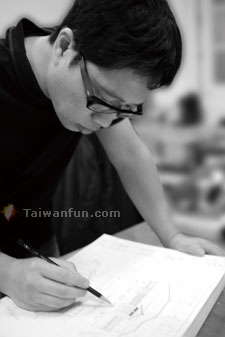 Writer's profile:Xie Wen Tai Writer's profile:Xie Wen Tai
A long-time resident of Taichung, this romantic architect believes that wonderful stories will emerge from beautifully-designed spaces. Although his foolish love for the old parts of Taichung compel him to do what others view as stupid, some of his silly deeds somehow have slowly become wonderful stories, one by one.
He holds a master's degree from the Department of Architecture at National Chengchi University, and now is a lecturer there in addition to Tunghai University and Chaoyang University of Technology's Department of Landscape and Urban Design. Mr. Xie has dedicated himself to projects related to community building, school landscape improvement, revival and preservation of cultural assets in the city, and renewal of city spaces.
|

 October 2015
