Art in numerous
dimensions: National Taiwan Museum
of Fine Arts
Words and photos by Chen Chia Yun
Translated by S. Ying
Claims by institutions of being the biggest, or newest, or most magnificent will slowly fall by the wayside with the passage of time. However, the associated memories, embodied spirit and cultural value will withstand the test of time because the true essence of architecture cannot be replaced.
It is not easy for a large building to blend in naturally with its surroundings, as some may find it too enormous or bulky while others will consider it
too eye-catching or grand. Thus, it is commendable that National Taiwan Museum of Fine Arts can convey a quiet, peaceful and humble spirit to
visitors despite its size.
Originally built in 1988, the National Taiwan Museum of Fine Arts was badly damaged by the 921 Earthquake in 1999 and finally rebuilt in 2004, when it opened its doors once again to continue its mission of art education.
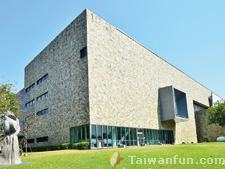 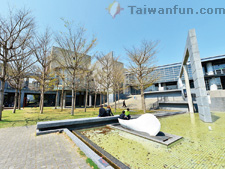
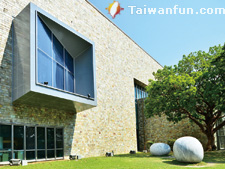
Left: National Taiwan Museum of Fine Arts has a sculpture like-architectural design.
Right: A sunken plaza
Transformed building configuration
Architect Kyle Yang (Arctangent Architecture and Design), successively followed the footsteps of original architect Guo Ji Yi (Taiyue Architectural Firm) in his architectural work to further integrate the design, bringing together two distinct styles and two different perspectives. It is like observing a conversation between two generations as the museum promotes art and culture to the public through the spirit of its design.
This building resembles a sculpture, standing as a sturdy structure on a vast green park lawn, with its simple square design using natural stone as its main material to blend in and become one with nature. Interior exhibition areas are divided among three floors, with the ceiling height as high as 24.5 meters, roughly eight floors, plus a basement area with a height of 7.5 meters.
In addition, the building underlines the integration of both indoor and outdoor spaces. It faces the curving YingCai Road on its northeastern side and forms a rounded plaza with walls on the northwestern side of the city cultural center. On the south side is a quiet, small forested park where people go for walks and an abundance of green space and running streams create an interesting scenic expanse as one gazes upon it from different angles. There are also service facilities in the museum's basement with space for dining and for children to play and draw, featuring a sunken plaza and Digital Arts Creativity and Resource Center designed to attract visitors.
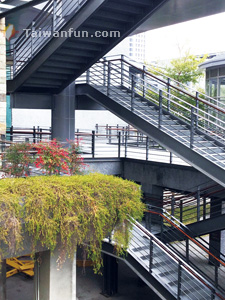 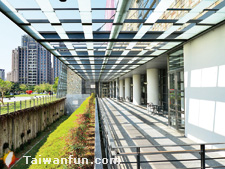
Left: Open spaces and free-flowing circulation
Right: Interesting shapes are created by shadows.
Flexible, extensible organization of space
The museum's entire footprint covers over 102,000 square meters and its floor space is around 37,953 square meters, leading to a claim of being among Asia's largest art museums. The land that it sits on was originally put aside for a municipal park so there is plenty of green space and even flowing waterways, all providing the museum with the added bonus of an open plaza area.
The curved walkway in the east leads to the basement and the central pedestrian bridge distinguishes the exterior from the special-exhibit display areas on the first and second floors, while the third-floor area is used to display regular art exhibits. Using corridors to separate art displays allows visitors to enjoy and experience different artistic themes as they walk through the premises.
Active use of public space
The covered entrance walkway, the open space in the corridors, and the sunken plaza design with a pedestrian bridge connecting to the outside are among the architectural features designed to welcome visitors to enjoy art from different angles and provide them with ample spaces for resting.
An art center without walls is an ideal that is achieved through the use of the courtyard and basement spaces so that visitors can enjoy various art displays, even from the stairs. The pedestrian bridge that connects the southern and northern areas is a special design that allows people to view exhibits from the outside or inside, and when visitors cross the bridge, they may be viewed as part of an art display by onlookers, exhibiting interesting moving lines and shapes from various angles and showing off art from different perspectives.
 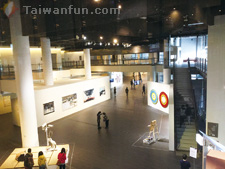 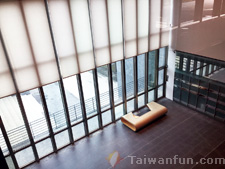
Left: The architecture uses bright, vivid colors to reflect its
moods.
Medium: Various art-display areas are connected by central corridors.
Right: Comfortable corners are available for resting and relaxation.
Architectural expression in bright colors
A delicate balance of art and science is found in this architectural creation as one can witness the fine designs that allow fine art to co-exist with engineering principles throughout the building. While the original structure was gloomy and more closed, its reopened version added the space of the courtyard with its stone outer walls, glass-covered space and pedestrian bridge, all combining to add color and to create an open space at the museum.
The shadow effects of the glass-covered space and stone walls create an interesting backdrop that resembles the various moods of life, and the varying ceiling-height levels showcase the display areas' lively dimensions. Over the years, the art museum has evolved to promote open space via its architecture and revise previously-held perspectives regarding the seriousness of traditional art museums. This new inviting mood matches the theme of an exhibit by artist Tsai Guo Qiang back in 1998. Since then, the Taiwan National Museum of Fine Arts has continued to employ a creative usage of space to attract more visitors to come and experience art, all part of a mission to be an example to other museums and future generations.
Terminology
Circulation: Refers to the continuous way people move through and interact with the space of a building.
National Taiwan Museum of Fine Arts
2, WuQuan West Rd, Sec. 1, West Dist.
Opened June 26, 1988
Architects: Taiyue Architect & Associates and Arctangent Architecture & Design
Architecture Specialty: Resemblance of a sculpture and use of dimensions to forge creative utilization of space between the courtyards and blend the buildings with natural scenic surroundings.
 Writer's profile:Chen Chia Yun Writer's profile:Chen Chia Yun
Writer Chen Chia Yun majored in Architecture for her bachelor's degree and earned two master's degrees in Urban Design and Construction Management in London. She is used to applying both the left and right sides of her brain via creative design and business management, and practice as an architect while teaching and pursuing excellence in her architectural work. She applies passion and energy to both her life and profession, with the belief that beautiful architecture can bring comfort, and that the value of urban public space lies in resource sharing.
R.O.C. Ministry of Examination Architect License Test Committee Member
Owner at Point Architects and Planners
Part-time lecturer at the Department of Architecture, National Cheng Kung University
|

 June 2015
