Poetic ponderings from a lively city: Xie Wen Tai and his Taichung Literature Museum
Words and photos by Xie Wen Tai
Translated by S. Ying
The future Taichung Literature Museum will be situated in buildings that once served as police dormitories during the
Japanese colonial era. The challenge for the architect will be preserving original architectural features while creating a
literature showcase for the future. Other goals include the creation of a landmark that will contribute to Taichung city's
urban landscape while keeping in mind that the beauty and origins of this site hold special memories for many local
residents. This venue has now been beautified in anticipation of it becoming Taichung's most scenic literature-related
destination and serving a key role in preserving the city's literary works.
Morning dawn by the market: A meeting of poetry
Author Avian Liu describes a morning at Fifth Market as noisy and filled with traffic and crowds. My daughter and I ordered noodles and fresh, pan-fried pork buns and sat at a square table in a corner, savoring the flavors that have remained unchanged over the last couple decades. I cherish such special moments, when my daughter can experience my childhood memories, and these 20 minutes of father-daughter time while eating breakfast will remain frozen in my memory, framed by time, for a century to come.
After we finish breakfast, we quickly cross the street, hand-in-hand, heading towards the Japanese-style rooftops. As we draw near, my daughter excitedly hops over, running towards her classmate and shouting back to me, "Here we are at the Taichung Literature Museum!" She is rushing for the poetry-reading session being led by Grandpa Wu, as she is going to ask for his autograph on a Grandpa Wu poetry collection booklet she brought along. My daughter, Quan-quan, loves poems and Grandpa Wu is her idol. It is a wonderful "Kodak moment" as I watch the room, packed with all of his young fans, listening attentively with the swaying of the trees--scientifically known as phyllostachys bambusoides-- in the background.
  
Left: Baisha 'literature island'
Medium: 'Lan Shang' alludes to a tiny channel of water
only strong enough to support a small wine cup.
Right:Police dormitory windows
Literary roots of an old house
On weekdays, when there are very few people, I like to hide in these serene surroundings and enjoy quiet time for myself. The six buildings contain numerous stories from the past and although the outer walls have been taken down, the original gates and old trees are still there, reminders of my fond memories of climbing the fruit trees to pick mangoes and longan fruits when I was young and visiting my grandmother.
The front yard has all sorts of trees, including mountain cherry, maidenhair, green maple and red maple, representing the four seasons and I can even pick up some fallen red leaves to decorate my window sill. Often I am moved to take snapshots of the shadows of oak trees or the outer walls of the old house with my smartphone. Every time I post these on Facebook, they solicit hundreds of "likes" from many others also mesmerized by the beauty.
The Japanese dormitories were given new life while retaining their original wooden frames and structures. The wisdom of architecture during past times never ceases to amaze me as builders created space between the ground and elevated floors to keep houses ventilated, dry and durable. The building style for walls and frames are also unique to Japanese architecture and I view them as the smartest, breathing walls.
I enjoy standing at the entrance corridor, pondering the architectural styles and observing the beauty of the surroundings, ranging from the way that the sunlight is reflected on the walls to the natural fragrances from the various trees and flowers in the yard.
Literature without words
The walls by the lecture hall have symbolic meaning, as the design represents the struggles of early writers with very limited resources, and the building materials express their determination to continue writing and contributing to the literature of Taiwan despite bitter hardships. A small water channel, springing up from under the shade of oak trees, depicts poets' humble beginnings and the persistence by which they inspired the future flow of Taichung literary development.
The pavilion by the trees is a great gathering place for senior citizens to read newspapers and for young photographers to seek out perfect pictures amid the natural setting. Inside the park, there are no displayed words or poems or characters, with the stories instead hidden within the walls, in the trees, by the well, in the waters, and among the light and shadows. This writer believes that you can see the poems in the falling leaves, behind the small pebbles, in the wind, above the white clouds. When I see the people in the park smile, daydream, stare and talk, I am inspired and write down my literary inspirations.
 
Left: Calligraphy walls
Right: Literature Walkway
A place that inspires writing
By the calligraphy wall sits a middle-aged woman who is daydreaming with an empty gaze towards the empty pond. She has stopped writing since becoming a mother and this is the place where she is able to clear out the clutter in her mind and begin recording her thoughts.
There is a gutter with a small stream behind the calligraphy walls, allowing you to dab your index finger into the water and start writing on the black stone. No lasting traces are left and you can "write your heart out". You can draw or write on this surface and within minutes the marks on the stone evaporate into thin air as the water dries, allowing you to continue creating again.
There is a poem on the wall, titled "Little Grass", by revered author Mr. Zhao Tian Yi, who is also a teacher in Taichung. It is filled with positive energy and encourages me to be as resilient as the little blades of grass, regardless of whether it's a bright sunny day or in the midst of a thundering rainstorm.
Red gate and old walls
The wall on the other side is called "Old Walls Tell Stories", expressing the idea that every angle and frame can show you a different story as you stare out at a different literature center, a different scene and a different perspective. The frames of varying sizes also symbolize the idea that we all have different visions and outlooks. The walls also hold sweet memories for a couple who came here after school to pass love letters to each other when they were young. Now, years later, they bring their daughter for a nice stroll and fun times with "selfie" photos.
 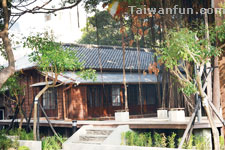
Left: Oak trees and the Early Writers' Walls
Right:
A century-old banyan tree and resting platform.
Eternal hope for Taichung literature
This writer ordered a cup of Yirgacheffe and allowed its steam to drift up to the top of the century-old banyan tree, eight or nine meters wide with roots sunk deep into the ground. The magnificence of the tree is like a waterfall in a huge painting and is the perfect gathering place for story-telling. Often you can hear children's laughter and watch an audience that is unwilling to leave, as it is transported in time by the emotions of stories told. Kids will sometimes happily proclaim that this tree is the home of animation character Totoro, with a bicycle being swallowed by this tree, just like the story goes.
My daughter finds me under the large century-old tree as I silently look on, and her pleased smile shows her satisfaction from getting Grandpa Wu's autograph.
"Dad, I love it here! I pray that the big tree will keep guarding this wonderful place."
"Hmm", I nod and respond softly. I also pray that the future and past of Taichung's literature will be guarded here, so that the essence of this cultural city will remain. One can always hope.
Taichung Literature Museum
48, LeQun St, West Dist, Taichung
Opened on mid-2016
Designer: ARIA Architect & Planners & S.D. Atelier
Features: Once a police dormitory, these six wooden buildings, situated among century-old banyan trees, create a scenic setting that resembles a magnificent waterfall falling from the skies.
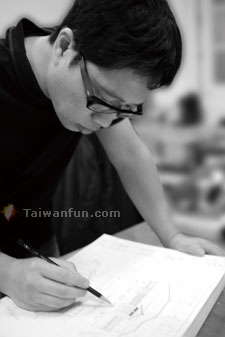 Writer's profile:Xie Wen Tai Writer's profile:Xie Wen Tai
A long-time resident of Taichung, this romantic architect believes that wonderful stories will emerge from beautifully-designed spaces. Although his foolish love for the old parts of Taichung compel him to do what others view as stupid, some of his silly deeds somehow have slowly become wonderful stories, one by one.
He holds a master's degree from the Department of Architecture at National Chengchi University, and now is a lecturer there in addition to Tunghai University and Chaoyang University of Technology's Department of Landscape and Urban Design. Mr. Xie has dedicated himself to projects related to community building, school landscape improvement, revival and preservation of cultural assets in the city, and renewal of city spaces.
|

 April 2015
