Dancing hand-in-hand:
Using light rays and shadows
Architect Tadao Ando's Asia Museum of Modern Art
Words and photos by Chen Jia Yun
Translated by S. Ying
How would one define an excellent architectural design? Perhaps it would be modern, timeless, engaging,
and elicit emotions or feelings of empathy. The architect's temperament may also be revealed in a project,
from the time a design is first committed to paper to final completion of the building. Such is the case with
the Asia Museum of Modern Art, which enables visitors to feel the heart and soul of architect Tadao Ando
and all who played a part in creating this structure.
Irresistible attraction of a triangle
When you walk onto Asia University's campus, you will be drawn to the varied shapes and special angles of the Asia Museum of Modern Art. Ando is an expert at utilizing geometric shapes in his architectural designs to arouse emotions. Visitors are often amazed at how this architect was able to rise to the challenge of using circles and triangles to successfully design an attractive project. There is also the question about why he opted for the difficult design task of using geometric shapes. Was it the need to avoid an electrical tower, does it adhere to the natural landscape of the surroundings, is it meant to reflect a perfect sunset, or is it perhaps a reflection of this world-famous architect's determination and stubbornness?
Generally speaking, most architects prefer regular squares and shapes to design their projects and there are tens of thousands of architectural projects that simply follow basic architectural designs, meant to meet daily-need purposes. However, in every era there may be an architect who is curious about finding new creative designs and enjoys exploring the unknown. Mr. Ando's Asia Museum of Modern Art is one such example. This unique, unprecedented architectural design, offering dramatic effects created by three overlapping equilateral triangles, was selected from numerous proposals in the preliminary design-competition rounds, and topped nine candidates during the final round.
Ando uses an equilateral triangle as the basic construction element to represent three symbolic objects--men, the environment, and spirit of connecting men to the environment via an architectural spirit. His design concept illustrates the importance of merging all three by skillfully incorporating a repeated motif to form the three floors of the equilateral triangle-shaped building. An atrium space is created with a crisscrossing arrangement of concrete beams. Another interesting aspect to using an equilateral triangle is the effect of a 60-degree angle, allowing visitors to expect a surprise each time they turn, not knowing what lies around the corner. Outdoor terraces contain sculpture displays and allow an extension of interior space, connecting to the exterior landscapes, the greenery and the blue skies.
  
Left: Blending outdoor spaces with the environment.
Medium: Sunset captured in between the wall.
Right: place of meditation.
Telling a compelling story with space
The museum uses poles and walls to outline its space and provide dramatic and creative effects. While the ground floor contains a cafe shop and lecture hall, the first and second floors both have art galleries, with one floor being the reverse mirror image of the other. On the first floor, the perimeter hallways are wide enough to be used for artwork displays on movable walls, while the third floor has much narrower hallways surrounding a set of inner galleries. The staircases are even used as a design element for art displays, serving as a metaphorical "scenic ride" to the higher floors. The lower-floor galleries receive a lot of daylight from one side while the upper-floor galleries depend on artificial lighting for illumination. The third floor executes a perfect blend of architectural design and the surrounding environment.
 
Left: A stage with no curtains, filled with dramatic effects.
Right: Spiraling-upward stairs are a design element.
An art show of light rays and shadows
Most architects would place stairs and storage rooms in the center or corner of a building in order to preserve a more complete space for important rooms. Asia Museum of Modern Art is designed to create interesting spaces via the use of three triangles; therefore, within the middle area of the three stacked triangular structures a courtyard is created, allowing rain to fall directly into the building while providing visitors with a glimpse of blue sky from within the museum. From the building's exterior, a large amount of glass and V-shaped structural units are used in the design, offering comfortable shelter from Taiwan's strong sunlight and hot weather. Thus, visitors are able to enjoy the museum and experience the beauty of the seasons as they appreciate this thoughtful architectural design philosophy.
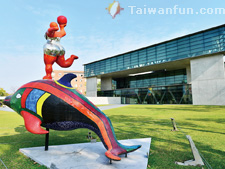 
Left: A symphony of nature, art and architecture.
Right: The gate to inner peace and the soul.
Simple elegance and solemn ambiance
Some architecture creates a quiet air within its walls by having lots of empty space and exhibits, a cold stern feeling that may resemble a jail cell or even a burial crypt. Asia Museum of Modern Art is able to exude a solemn ambiance by using various shapes and angles, using a repeated motif to illustrate the central design theme and philosophy.
he attention to detail is immaculate, as is evident in the building materials, the dimensions and the way that angles merge. To cope with the realities of this seismically-active environment, no vertical pillars are used. Behind the glass curtain wall are V-shaped columns, used for compression. The exterior of this architectural design creates a peaceful and serene ambiance and is executed with careful precision. It is the intention of Tadao Ando to allow visitors, art, and nature to meet and have a dialog here. If one asks how life is bestowed to architecture, fully utilizing it and allowing its design concept to be understood is an ideal means of maintaining a living, thriving legacy.
Note: Asia Museum of Modern Art is an architectural work that has been widely reported on and critiqued by many experts. The dedication to completing this project by Asia University's owner and architectural team is impressive. Even if there may be mixed reviews regarding any architectural design, one must still pay the highest tribute to their pursuit of excellence and commitment to completing it according to their design philosophy and ideals.
Asia University, Asia Museum of Modern Art
500, LiuFeng Rd., Wufeng District, Taichung
Opened on Oct. 24, 2013
Designer: Tadao Ando Architect & Associates and Kris Yao | ARTECH
Features: Built on a rigid triangular geometry, a sophisticated beauty is created, showcasing the architectural philosophy of Mr. Ando. Asia Museum of Modern Art is a landmark building in Taichung with its unique design of the exterior terraces and use of interior space.
 Writer's profile: Writer's profile:
Writer Chen Jia Yun majored in Architecture for her bachelor's degree and earned a master's degree in Urban City Planning in London, before obtaining an MSc. She is used to applying both the left and right sides of her brain via creative design and business management, and maintains her license certifications while teaching and pursuing excellence in her architectural work. She applies passion and energy to both her life and profession, with the belief that beautiful architecture can bring comfort, and that the value of urban planning lies in public resource sharing.
R.O.C. Ministry of Examination Architect License Test Committee Member
Owner at Point Architects and Planners
Part-time lecturer at the Department of Architecture, National Cheng Kung University
|

 March 2015
