The beauty of characters
realized: Ya Wen Chai represents
three generations of professional
stamp carving
Words by Ye Jia-hui
Translated by Alicia Yu
Photography by You Jia-huan
"Ya Wen Chai was named by my father, who always believed that one day the store would be worth
inheriting and that someone would certainly pass down the stamp-carving skills," says Lu Tzu-kuo,
standing next to his daughter, Lu Ya-wen, as he watches her cut and carve. He is determined to pass
down all off the fine skills and deep knowledge that he has acquired throughout his life to a
third-generation successor.
Working with a machine on a small square table, sitting to the back and left of Ya Wen Chai's entrance, Lu Ya-wen is carving on-order stamps with her full attention. A incandescent light bulb blazes down and the heat makes the user's eyes burn, to the point where her cheeks would have been sweaty were it not for the cold December weather. I ask Ya-wen, "Do you feel tired or find this task very dull?" She pauses and answers, "All techniques can be learned and patience needs to be cultivated over time in order to master."
Her insights show wisdom beyond her age and are hardly the words of a girl who only graduated from university last year. Having learned stamp carving as an apprentice to her father and aunt for many years, she has matured, at the young age of 23, to depict a manner suitable to the successor of a family-run business.
  
Left: Lu Ya-wen and Lu Tzu-kuo are not only father and
daughter but also master and apprentice, thanks
to an inheritance of craftsmanship.
Medium:
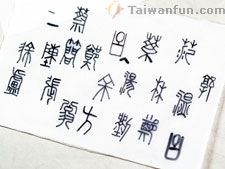
The graceful ancient script of handmade
stamp carving is a very exclusive skill that
Ya Wen Chai takes pride in.
Right: Ya Wen Chai was Taiwan's first-ever
store to produce eco-friendly ink,
which is certified by the government
and protected by patent.
Inheriting a Japanese master's craftsmanship since 1932
Ya-wen's father also acknowledges, "This profession does require much labor. [Ya-wen] has to sit for long periods and must take extreme care as she makes each delicate cut. Thanks to her willingness to learn and her identification with the brand value of Ya Wen Chai, she is able to endure the loneliness of this job" . His daughter's hard-work ethic also reminds Tzu-kuo of his father, who learned his skills as an apprentice to a Japanese master at age 13. Two years later, following Japan's defeat in World War II and departure from Taiwan, his father formally took over the Ya Wen Chai business. This takeover not only made the Japanese master's exclusive skills for creating handmade stamps with "Chinese bronze inscriptions" (known as "Bronze script") exceptional but also led Tzu-kuo and his sister Lu Pin-ying into the world of stamp carving.
Today, Lu Pin-ying is the most important stamp carver at Ya Wen Chai and Ya-wen's current master. When Pin-ying was young, she was struck by polio. Her father worried about her future living and encouraged her to become a stamp carver after her graduation from senior high school. This decision helped to add resilience to a challenging life. Starting from stamp rubbing, writing in reverse and carving characters on stamps, Pin-ying's close attention and years of experience have formed a database of character scripts in her brain. Thus, she doesn't need to sketch a design first or arrange a script on a stamp surface beforehand, and has mastered Ya Wen Chai's most difficult and exclusive "Bronze script" techniques.
  
Left: Regardless of the size and extent of sophistication,
Ya Wen Chai offers tailor-made stamp-carving services
by customer request.
Medium:
The strokes of Chinese characters are complex, making it
more difficult to carve the reverse-written characters into the
stamp's surface.
Right:
Traditional ink contains eight heavy metals, but Ya
Wen Chai has successfully developed a non-toxic,
harmless and eco-friendly inkpad.
Exclusive Bronze script reveals pictograms' beauty
Bronze and stone inscriptions as well as calligraphy symbolize and demonstrate the beauty of Chinese characters. The most drastic change in the evolutionary history of Chinese characters occurred during the Qing and Han dynasties, when the Small Seal and Clerical scripts came into being, paving the way for Regular script. Today, although the Regular and Small Seal scripts are the most identifiable, the Oracle Bone script and Bronze script--generally called the Great Seal script--are considered second to none for anyone wanting to present the beauty of pictograms.
Ya-wen explains that after the Spring and Autumn Period and Warring States Period, Emperor Qin Shi Huang united all the states and put unification-promotion policies into action, such as unifying standards for carriage wheels and the writing system. His chancellor, Li Si, improved the Great Seal script and developed Small Seal script, reducing learning difficulties and increasing the compatibility of Chinese characters. This enormous impact has continued into present times, being made in particular on the profession of stamp carving where Regular, Clerical and Small Seal scripts are still most commonly seen in both handmade and computer-aided stamp carving.
Most carvers of handmade stamps have never heard of Bronze script, let alone undertaken its creation. It was because Ya-wen's grandfather learned inscriptions as an apprentice to the Japanese master that he had the chance to explore the demanding stamp-carving skills required by the Bronze script. In retrospect, this unique skill is the main reason Ya Wen Chai has survived the lower-costing competition of its computer-aided carving rivals, and has remained consistently well-known to the public.
Holding up two stamps and comparing them in the light, Tzu-kuo explains, "The script of the handmade stamp is beautiful, as both the thickness and arrangement of lines reflect the carver's expertise and aesthetics. By contrast, the script of computer-aided stamps is rigid and motionless, unable to present the vivid soul of the characters." Once the stamp marks paper with red ink, the beauty of its Chinese characters immediately convinces viewers. So it's no wonder that despite the relatively high prices at Ya Wen Chai, orders continue to flow in. For customers wanting a more significant, important official stamp, temple stamp, corporate stamp or personal stamp, this business stands out. The senior handmade stamp-carving expert's mastery in and experience with scripts is undoubtedly a world apart from makers who just select characters from a computer, tap the keyboard and move a mouse.
  
Medium: Lu Ya-wen has inherited stamp-carving skills from
her grandfather, aunt and father to become the
third-generation successor of Ya Wen Chai.
Right:
Though it's routine to face blazing, close-up light
and dust on a daily basis, Lu Ya-wen is still self-
composed and completes every stamp.
Developing non-toxic, environmentally-friendly products
Because his sister Pin-ying and daughter Ya-wen are engaged in the work of stamp carving, the tasks of sales and product development are under Tzu-kuo's command. Certified by the government, various Ya Wen Chai products--such as a non-toxic, eco-friendly stamp ink pad and stamp ink, plus anti-counterfeiting stamps--have gained popularity among public institutions. "Every time we send our products for chemical inspections, workers in the chemical engineering company question our efforts to spend so much money on inspecting such a small item like stamp ink. But our thinking is, "Should we stop doing what we know is right?" said Tzu-kuo.
At first, Ya Wen Chai's attempts to develop non-toxic, eco-friendly stamp ink were mocked by many people. But Tzu-kuo thinks that, given the fact that traditional ink does contain heavy metals, it would be better if the product could be improved to become less unhealthy and more environmentally friendly. Today, the market has provided positive feedback to this insightful insistence, as many companies designate Ya Wen Chai to make stamps as gifts for their clients, and the business has even developed a small wedding present for newlyweds as a symbol of a happy marriage with a stamped guarantee.
Left: Ya Wen Chai offers all kinds of customized stamps and related products.
Medium: Writing in a reverse manner is the most essential
basic skill for a stamp carver.
Right: The highly-recognized stamps of many well-known companies and
individuals in Taiwan were made by Ya Wen Chai.
Neither surrendering to the market, or the common stereotype that stamp carving and key making go hand-in-hand, Ya Wen Chai succeeded in becoming a leader for the artistic handmade stamp-making profession, maintaining the loyalty of its clients with good taste, and opening the window to a new world for this traditional industry by pioneering non-toxic ink. Three generations earn a living via this store and are proud of its name. In the digital era, when characters gradually become a standardized product on a computer screen, Ya Wen Chai still holds onto its belief in the beauty of the handmade stamp with ancient scripts, performing one cut after another at its original pace, and reinterpreting the irreplaceable elegance of Chinese characters.
Ya Wen Chai
Address:
178, ZhongShan Rd, Central District, Taichung
Tel: (04) 2222-2293
www.yawins.com.tw |

 January 2015
