Theatrical scenery master
brightens a dream-like life
Hou Shou-feng travels from ancient to modern times;
painting through Eastern and Western worlds
Words by Ye Jia-hui Translated by Angela Cheng
Photography by You Jia-huan
The slowly-rising curtain reveals the well-mannered Jiaqing Emperor, dressed
with Qing Gonryongpo (the everyday dress of the king and crown prince in the
Joseon Dynasty period). Squinting at the hand-drawn theatrical scenery,
Hou Shou-feng never think that the "aesthetic" will leave him...
In earlier times, before the full development of the film industry and before a TV occupied every family's living room, simplicity reigned in Taiwan's world of entertainment, which relied solely on Taiwanese opera and glove puppetry at folk festivals to spice up everyday life. However, a successful puppet or play required that actors and puppets, their scripts, clothing and music all be vividly expressive. Furthermore, the designs for theatrical scenery were key, leading audiences in following plots and precisely switching between various times and locations. Towards this end, Hou Shou-feng uses graphics to convey a variety of three-dimensional scenes, creating stunning, magical stage effects and making this master a behind-the-scenes hero, taking audience members on a boundless journey of the imagination across time and space.
  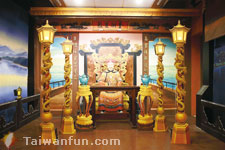
Left: "Riding the Imperial Dragon Boat to Travel the World" was carefully created over three years by this theatrical
scene master. From the age of 13, Yang Zhen-kun has worked in welding for over 60 years.
Medium: Hou Shou-feng's skillful painting vividly recreates the canals of Venice.
Right: Hou Shou-feng created the Jiaqing Emperor in the 4D theatrical scenes
to portray the historical story "Jiaqing Emperor Tours in Taiwan".
An apprentice persists in career growth without any regrets
"There was nothing else, just 'interest'," says Hou when asked about his reason for pursuing stage art as a career. Starting as a 15-year-old apprentice drawing glass plaques, he then switched into temple paintings and sculpture. In 1953, after much perseverance and waiting, Hou finally had the chance to join the most prestigious Tainan-based "star theatrical scenery art research painting club" and became a student under teacher Huang Liang-xiong.
"If I don't draw, I will die!" expresses Hou's passion, which helped him get through the menial tasks, such as washing dishes, cleaning and grinding nails, that he was given at the club until his talent was revealed and he was promoted. He worked overtime every day in the first four years, especially during the lunar new year, which was the busiest time, not only working day and night but traveling with troupes like a nomad wandering around the island.
Hou didn't miss any opportunities to present his almost-obsessive passion for "beauty", even when he was very busy, in order to ensure that each finished product was the best. Therefore, during his apprenticeship, he not only secretly completed senior artists' unfinished works at night but also took the time to copy famous paintings back home and purchased paper and pencils at his own expense, leading his master and master's wife to jokingly refer to him as a "a waste of electricity". "Tomorrow, do not paint the theatrical scenery without energy," they would remind him. Recalling the past difficulties of his apprenticeship, Hou said he had little concern for the tough physical and mental training and today there is no sign of complaint or self-pity in this master's 70-year-old face.
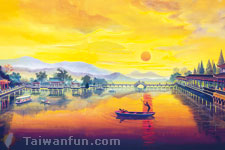 
Left: Painting the West Lake is one of Hou's latest endeavors.
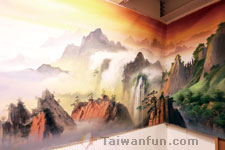
Right: Huangshan is one of the master's proudest creations in recent years.
20 years of theatrical scenery-making: Passing through a millennium
In 1958, Hou returned home, did his military service and then lived on his own. Because of his outstanding work at the "star theatrical scenery art research painting club", his master, Huang Liang-xiong, decided introduce Hou to an important client--the Guon-Le Troupe--as the painting club's business became more focused on drama troupes. However, when Hou first joined them, the Guon-Le Troupe only had two teams, although it later went on to manage eight Taiwanese opera troupes, a drama troupe, a song and dance troupe and even shot the first locally-made Taiwanese film. Thus, Hou joined this group at an opportune moment as it began to take off and he worked hard with the Guon-Le Troupe, creating all of its performing ensembles' theatrical scenery and stage work. He even worked in a separate business as designer of six performing halls' theatrical scenery for the Taipei "Today's World Recreation Center".
A low-level painter who is a primary school graduate without a prominent family background may find himself only helping his master with the laundry and errand running. However, Hou Shou-feng took the difficult path and strove to develop and display his talent through a variety of challenges and frustrations, in time becoming an extraordinary theatrical scenery designer--one of the best in Taiwan--who earned a living traveling around the island on various jobs.
A behind-the-scenes hero consistently creates amazing scenes
Stage scenery varies according to the nature of a performance. For example, besides having "soft" and "hard" stage scenery, Taiwanese opera stages usually include three parts such as appearance scene like horizontal inscriptions, a big tent, the "Chu-jiang" and "Ru-xiang" doors, railings, interior scenes of buildings, assembly halls, study rooms, palaces and prisons, and outside scenes mostly consisting of mountains, gardens, sea views, temples and cities. When following the story line, there will be additional equipment used to change scenes, like the "Jinshan Temple Flooded by Water" scene from "Legend of the White Snake", "Yingtai Crying Over the Tomb" and "To the Heaven" from "Butterfly Lovers" and other scenes that raise the plot and performances to the highest level and inspire amazed audiences to prolonged applause.
Besides theater performances drawn from Chinese legends and myths, Hou also oversaw stage scenery for the dance drama "Story of the Bridge on the River Kwai". For this, the stage design needed to imitate the foreign film "The Bridge on the River Kwai", and recreating the scenes of a moving train and bridge explosion not only required the use of special cotton, gasoline, and lighting and sound effects but also close cooperation between all crew members to precisely coordinate of all these. Thus, when the drama troupe toured Southeast Asia, they created quite a sensation wherever they went, especially when they arrived in Thailand--the story's real-life setting. When the bridge on the River Kwai was blown up with great explosions, audiences were impressed and surprised by the creation of such a spectacle on a small stage. To achieve the seemingly impossible and bring such incredible scenes to life is the theatrical scenery designer's job, a magician who makes miracle. In all this, master Hou is the man controlling everything behind the scenes.
Following the end of Taiwan's Japanese colonial era, entertainment began moving from Taiwanese opera towards television and movies. This had a significant negative impact on traditional theater and the ebbing of this industry's environment became a turning point in Hou's creative life. After dedicating half of his life to stage design, he finally got the chance to embrace the finer arts, using watercolors and Japanese-style painting to portray various countries in Taiwan and taking eight years to complete hundreds of paintings recording aboriginal life and culture. Out of a sense of compassion in the wake of Taiwan's 921 Earthquake in 1999, the artist also took four years to create over 60 works in the hope of inspiring everyone to cherish this island through the sincere eyes of an artist.
Scholars tend to look down on themselves and although Hou previously showed such excellence and won recognition after switching to painting and fine arts, he deliberately avoided talking about the stage art he once created. However, in 1997 Deputy Cultural Minister Lin Jin-hui suggested that Taiwanese opera scholar Ms. Liu Nan-fang invite Hou to publish papers and participate in a cross-Strait conference. Hou was also invited to design and paint 12 theatrical scenes for three "Return to the Indoor Stage" dramas.
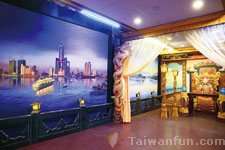 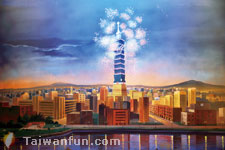
Right:
In the painting master's work, a dragon boat travels from ancient
to modern times after meeting the Jiaqing Emperor and arriving at
Taipei 101, bringing famous old and new scenes together.
Artistic heritage preserves prosperous stage era
The affirmation of countless people and mind-boggling theatrical scenes created throughout the years are symbolic of Hou's key mission of preserving an artistic heritage via his Taiwanese theatrical scenery, using skills taught by a master from Shanghai and Fuzhou, where these techniques have already ceased to exist. This means that the disappearance of such skills in Taiwan would create a void in the future development of traditional Chinese stage design.
Therefore, Hou spent three years designing a set of theatrical scenes for the "Riding the Imperial Dragon Boat to Travel the World" exhibition showing at his personal art museum. This uses symbolic designs in four lower decks and a fifth upper deck, inviting guests to enter the real indoor theater stage for Taiwanese opera "Jiaqing Emperor Tours in Taiwan". They first encounter the Jiaqing Emperor, traveling on a dragon boat from Kunming Lake of the Summer Palace to Hangzhou's West Lake before arriving at Taipei 101, Taichung Park, Sun Moon Lake and Kaohsiung's Love River.
isitors will also enjoy great scenes from four countries while standing on the "deck", including the Eiffel Tower, London's Tower Bridge, Cologne Cathedral in Germany, and the canals of Venice. Hou even uses the Seine, Thames and Rhine rivers and Venetian canals to connect all these global landmarks and adds fluorescent glue and lights to present night scenes and create contrasting ambiances of day, sunset and late night.
Standing up high on some scaffolding, Hou totally forgets he's 76 years old, picks up a pen and begins drawing, adding some extra color and lines to the unfinished London Tower. When asked whether he is tired of a lifetime's work as an artist, he remains completely immersed in his work, not distracted by other people's conversations. Rather, he unquestioningly listens to his heart and lets it guide him on his unending quest to find and create beauty.
|

 July 2014
