A brilliant manipulator
of fire: Welding craftsman
Yang Zhen-kun
Words by Ye Jia-hui Translated by Angela Cheng
Photography by You Jia-huan
Walking up Lane 183, the raucous rattling and noise leaves one's ears ringing, making it difficult to
imagine the kind of determination that has kept Yang Zhen-kun, better known as "Uncle A-kun",
enduring the torment of this hot, noisy, dirty and crowded working environment and committed to
his welding craft for over 60 years.
"Do you want the sparks to be more obvious? It's very easy! When it burns, magnesium alloy is the best looking," says Yang Zhen-kun as he begins a simple introduction to his job. He is initially very awkward and hard to understand but, when the photographer asks which metal combustion is the most beautiful, the 74-year-old grandfather immediately goes back into the house and brings back some magnesium alloy with a blowtorch. The glittering, fun and amazing sparks scatter everywhere instantly, more brilliant than a sparkler. The spectacle also seems to have a soothing effect on Yang, who lost of both his parents during childhood but seems to have combined fire and light to forge himself a new life out of the flames of difficult times.
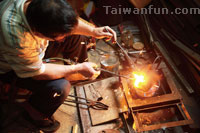 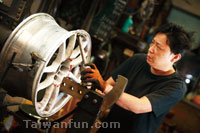
Left: When welding at high temperatures, Yang needs to use a welding rod to
slowly clean off metal impurities, working under an annoying glare.
Right: Yang Zhen-kun's son, Yang Zong-xian, has inherited his father's skills,
with wheel rim repairs being his main focus.
No surrender: Humble origins turned into the power of progress
Regardless of how wealthy a society is or any era, there are ordinary people who will face difficult lives. Welding craftsman "Uncle A-kun" is a good example of perseverance, even in a hard situation.
"It's not a big deal! Doing ironwork is just like being a craftsman. There are no special conditions required for us to pick our work--we do any job when we get a chance and must do everything!" says Yang Zhen-kun. His cheeks are scorched by the high-temperature furnace but are wrinkle-free, as his face is smooth and even a bit rosy. Yang began welding when he was 13 and has never faced any serious physical problems, despite the high temperatures and heavy work. Instead, he always welcomes "emergency patient" cases from all over Taiwan with a warm smile. The "sickness" this "doctor" cures is welding work related to any kind of metal, from car engines and exhaust pipes to Japanese iron pots that the literati admire. After passing through his skilled, blackened hands, all of these items experience a rebirth and renewed love from their owners.
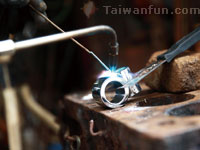 
Left: 凡生活用品到工業焊接,只要與金屬相關的,幾乎都難不倒楊振崑。
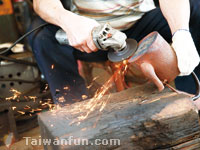
Right:
The broken bottom of the teapot needs to be repaired with pig iron,
with the the base smoothed with a grinding machine.
"My father and mother died when I was 7, making me an orphan. Fortunately, my uncle kindly adopted me, though one needs to be mature and not cause too many troubles for others. From childhood, I did everything, from selling 'tang hulu' (a traditional Chinese candied fruit snack), ice cream and popcorn, to cleaning shoes before finally getting some direction at 13 and becoming an apprentice," he recalls. Soldering, welding, ironwork and craftsmanship all look like very hard work to the outside observer, but Yang rarely complains about any of this. If it's heavy work, he will take responsibility and do everything on his own; if the tooling equipment is dirty, he will just wash and wipe it clean; if the blowtorch is hard on the eyes, he advises one to just "squint your eyes a little bit". Yang simply smiles at all this and says that he is already used to high temperatures, while also absently patting his knees; since becoming a master welder, he doesn't know how many times his knees have been blistered and burned. Each time, it has happened because he has been so focused on his work that he has forgotten to move his feet. Only later has he felt his skin burning during a shower afterwards and discovered blisters.
 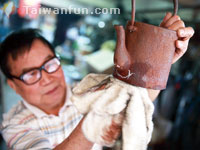
Left: 十Starting from the age of 13, Yang Zhen-kun
has worked in welding for over 60 years.
Right:
When a customer begged him to fix a Japanese iron
teapot, Yang Zhen-kun accidentally became a master in
this field and discovered a whole new line of business.
Don't give up: An unfamiliar material requires learning from scratch
Yang says that welding work is much like being back-up reinforcements for the military; although he isn't involved in the work of creation from beginning to end, he's an expert in dealing with things afterwards and repairs. The previously-inexperienced welding master originally did not know much about every kind of metal, temperature control, and techniques and effects of welding. Understanding a metal's weight, strength, ease of processing, malleability, pressure resistance, vibration and melting-point temperatures required an accumulation of experience. An example of this is the magnesium alloy commonly used in aircraft frames. In the past, this material was alien to Yang, although its lightweight nature made it common in imported cars, large motorcycles and gearbox casings. So, when customers came in for help with their cars, Yang initially wasn't quite sure about how to work with it. However, thanks to his dedication and focus, he studied magnesium alloy's melting-point temperature and malleability on a daily basis, learning how to make welds that were attractive and strong through repeated experimentation that helped him gradually understand these alloys. Today, auto buffs with discerning eyes refer any questions relating to equipment and metals to Yang's business, Zhen-kun Welding, because they know that as long as Yang Zhen-kun is in charge "the task will be finished", as this business guarantees.
 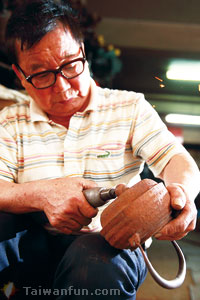 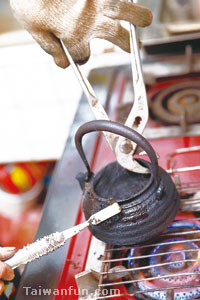
Left: Yang Zhen-kun's excellent Japanese iron teapot repairing skills means that items
awaiting fixes now need to wait until the next year to be returned to owners.
Medium:
Tapping and grinding, Yang repairs the iron to give
it a vintage appearance and lines consistent with
the original teapot.
Right:
After an iron pot is repaired, tea must be
boiled inside as it is brushed at the same
time to put color on it and create luster.
Yang originally thought welding work would probably be industrial and equipment related, Thus, when he received a package from a postman one day, he didn't realize that it would reveal the focus of his work during all these years--patches for iron pots. He recalls, "This black iron teapot seemed like nothing, but some expensive ones could cost up to two or three hundred thousand NT dollars!" Accustomed to the simple life, Yang at first couldn't understand why such a high price could be offered for a teapot. However, because customers were asking if it was possible to repair rusty, damaged Japanese teapots, Yang inadvertently began studying ways to repair these items. Most of this education was self-taught, as he carefully studied the features of the pot material and the repairing process, mastering the melting point, linking, methods for creating rust iron lines via point-like tapping and, following repairs, the need to boil tea in the teapot to color over the newly-repaired iron and create a perfectly "seamless" fix.
Unexpected teapot-repair skills despite an ignorance of tea
Yang notes that it is easy for iron teapots to rust, especially around the easily-damaged, thin teapot mouth and at the teapot's frequently-burned bottom. However, collectors are often ignorant of where their teapots are damaged. Therefore, Yang created a "water drop measurement" technique of putting clean water into a teapot and observing it under light. As the water seeps out of the pot, it will permeate the iron, which will then change color. Following with this thin water mark carefully will reveal the damaged area, which is marked with chalk. Then a cut piece of iron is placed on a high-temperature gas forge, and a welding rod is used for detailing, able to create extremely realistic antique-like effects. Such brilliant, specialized skills bring Yang all kinds of business. Iron teapots sent in by customers for repairs normally require a wait of three months for completion. Yang has also had customers who were dissatisfied after sending their iron teapots to Japan for repair, before finally discovering the value of Taiwanese iron work from master craftsman Yang Zhen-kun's hand."I don't make tea and don't understand tea, but I understand iron and that's enough!" declares the craftsman.
 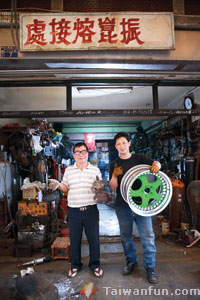
Left: Various grinders are Yang's tools for
making a living.
Right:「"Zhen-kun Welding" is currently a
father-and-son joint venture.
With his down-to-earth approach, Yang utilizes the most simple environment and materials to overcome challenges at work, never complaining about unfortunate life experiences from the past. Rather, he has chosen to seize the opportunities that have been presented to him to become an excellent welder and craftsman, working with fire and other basic elements in a brilliant display of grassroots glory.
Zhen-kun Welding
Address:
7, Lane 183, SanMin Rd., Sec.2, Central Dist., Taichung City
Tel: (04) 2224-6519
Hours: 9 a.m.-9 p.m.
|

 June 2014
