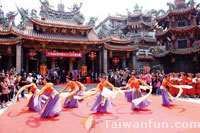
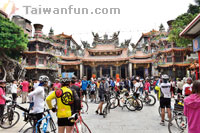
The bicycle activity combines
local industry, culture
and
religion.

Youthful designs bring out a
new culture of Zhentou
(traditional Eastern Asian skills)
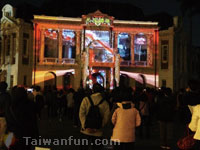
The 'Light Up Taichung' 3D
Projection Mapping Light Show
from
old Taichung City Hall
uses lights and three-
dimensional images to create
new Mazu culture.
|
The Taiwanese have an old saying, "Crazy for Mazu in March" and, once again, the time has arrived for the Dajia Mazu pilgrimage procession, regarded as one of the world's three biggest religious activities, together with the Vatican Christmas Mass and Muslim pilgrimage to Mecca.
Since 2011, following the Taichung city-county merger, the Taichung Mazu International Tourism Cultural Festival has helped transform the Dajia Mazu pilgrimage into an international "must-do" event.
A pilgrimage of 9 days, 8 nights
The birthday of the goddess Mazu falls on the 23rd day of the third lunar month, when enormous numbers of participants join this traditional religious and cultural event--Taiwan's largest. A variety of important rituals are part of the pilgrimage, including a series of 10 main ceremonies that all have to be carried out in a specific order, place and time--including poe divination, raising of vertical flags, prayers, seating on the sedan chair, starting off, resting, blessings, and birthday congratulations. The pilgrimage route heads from Taichung to Changhua, Yunlin and Chiayi, and passes through 21 towns and stops at nearly 100 temples. Witnessing devotees' joy and gratitude along this route allows one to experience a true taste of Taiwanese culture and religion.
A "poe divination" ceremony--carried out at 6 p.m. on Lantern Festival day--to consult Mazu at the Dajia Zhen-lan Temple has determined that this year's Dajia Mazu pilgrimage procession will start out at 11 p.m. on April 6 (eighth day of the third lunar month) and return on April 15. The entire pilgrimage will last nine days and eight nights. The procession will spend the first night at Changhua's Nanyao Temple, the second night at Xiluo's Fuxing Temple, the third and the fourth nights at Xingang's Fengtian Temple, the fifth night at Xiluo's Fuxing Temple, the sixth night at Beidou's Dian-an Temple, the seventh night at Changhua's Tianhou Temple, and the eighth night at Qingshui's Chaoxing Temple. The ninth day will see the procession return to Dajia Zhen-lan Temple
Centuries-old temples shine again
This year Taichung Mazu International Tourism Cultural Festival will also include a series of variety shows and Taiwanese opera nights at participating century-old temples. This starts with a Lan Yang Theater performance of a "Starting-Off Play" from the "Poseidon Queen" at Dajia Zhen-lan Temple on April 1 as pilgrimage warm-up activity. On April 6, a "Viewing Stage" is coordinated with the Mazu pilgrimage and a series of performances to introduce the Mazu pilgrimage. All are welcome to come and gain a greater understanding of Mazu-related culture. In addition, the famous Taiwan Ming Hua Yuan has been invited to perform a play on "Taiwanese Opera Night" at Wuqi's Chaoyuan Temple on April 13. On April 24, Shengang's Shekou Wanxing Temple will invite East Art Group, Huang Band, Wu Shu-min, Hsu Fu-kai and other celebrities and teams to perform and wish everyone best wishes and peace for the new year. Mazu "lucky money bags", which extend Mazu's blessings for the year ahead, will also be distributed at 7 p.m. at the temple's service information desk, with a limited quantity of 300.
To make participation in the Mazu Culture Festival more convenient, Taichung City Government is organizing festival shuttle buses every Saturday and Sunday between April 19 and May 4. Four routes stop at eight centuries-old temples, including Dajia Zhen-lan Temple, Taichung's Lecheng Temple, Nantun Wanho Temple, Dazhuang Haotian Temple, Dadu Wanxing Temple, Wuqi Chaoyuan Temple, Shengang Shekou Wanxing Temple, and Fengyuan Tzuchi Temple. A 3D Projection Mapping Light Show has also been taking place at the former Taichung City Hall every Saturday night since this year, in a special effects spectacle that allows spectators to experience Mazu culture with lights and three-dimensional images.
Cultural heritage goes creative
The 2014 Taichung Mazu International Tourism Cultural Festival will continue with "The Elegance of Centuries-Old Temples" and "The Starting-Off Play and Viewing Stage" series of activities. Static activities will include a "2014 Color Painting Mazu" drawing contest, accepting works from June 3 to 16, and "Drawing With Mazu" contest held by Dajia Zhen-lan Temple. This uses the Dajia Mazu Tourism Culture and pilgrimage procession as themes to show culture religious traditions and the innovative heritage of Zhen-lan Temple activities. All high school, junior high school and elementary school (grades 4-6) students who enjoy drawing are welcome to join this activity.
In addition, fresh themes are selected each year as part of the festival to express the universal, inclusive nature of Mazu culture. This year's design competition seeks "five-theme creative works", including LINE stickers, animation, short films, comics and picture books, to encourage people to focus on the features and history of Mazu Temples in Taichung as a theme, combining creativity and tradition to communicate cultural heritage across generations. The total value of the prizes is NT$9.8 million and all are welcome to participate, with contest entry works being accepted since Feb. 17. For more contest information, visit the Taichung City Government Cultural Affairs Bureau website. All this is designed to encourage fresh talent and generate all-new creative works related to Mazu culture that will help promote it to a broader audience.
ction of a brand-new "Daan Port Mazu Theme Park" covering up to five hectares is expected to commence this year. This is designed to promote local business and industry together with traditional Dajia Mazu culture. In addition to developing Daan coastal park into a "Mazu theme park" and "beach park", plans also call for a Mazu statue up to about 70 meters in height. This future central Taiwan coastal landmark--rivaling Rio de Janeiro's famous "Christ the Redeemer" statue or the giant Buddha at Eastern Great Temple in Nara, Japan--will bless this land and its people from generation to generation.
|

 April 2014

