The shoe doctor is in: Shoe repairman Chiang Po-hui
Words by Ye Jia-hui
Translated by Angel Pu
Photography by You Jia-huan
"I used to be a shoemaker but, nowadays, shoes made in factories are
so cheap that we can't compete with them," says Chiang with a smile. "They, however, are not as durable and comfortable as handmade shoes,
so now I only repair shoes." It feels like Chiang has spent almost an entire
lifetime in shoe-related businesses.
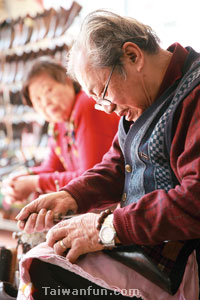
While the cold, gusty winds discourage the average person from leaving home, Yongxin Shoes owner Chiang Po-hui sits outside the entrance of his store, repairing shoes with a variety of problems. Under the warm winter sun, he skillfully, carefully ensures that every shoe is fully repaired. Both selling and repairing shoes, Yongxin shoe store has been in doing business in Taichung for 44 years.
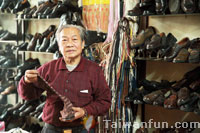 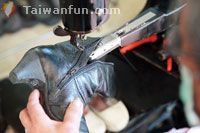 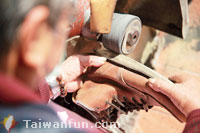
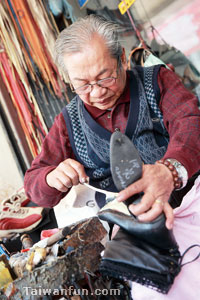
Left: Whether they are leather shoes, canvas shoes, mountain climbing shoes,
men's and ladies' shoes, Chiang can fix them all.
Medium: A detached zipper requires a professional
sewing machine to repairs.
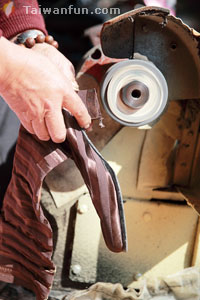
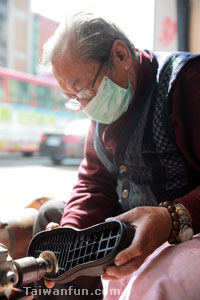
Right: When attaching a new rubber sole, the bottom of the shoe needs to be
polished first so that the sole will adhere to it.
Building a stable life via shoe-making
Like most Taiwanese born in the 1940s and '50s, Chiang decided to learn a skill as soon as he graduated from primary school. Without a specific reason, he choose the job of a shoemaker. After three years as an unpaid apprentice, he finally began his career at the age of 18 and would travel anywhere--Taipei, Keelung, Tainan-as long as there was a job opportunity for him. In 1970, Chiang finally had the chance to rent a shop on Sanmin Road--Taichung's busiest street at that time--and opened his own shoe store, Yongxin Leather Shoes. Business thrived, thanks to the shop's beautifully-designed, exquisitely-made shoes, allowing Chiang to buy the shop he had been renting. Progressing from a trainee to a business owner, Chiang slowly, but surely, moved forward, also improving his skills day by day.
According to Chiang, the procedure for making a leather shoe includes measuring the foot, making a shoe last, making a draft, cutting the leather, attaching embellishments and shoelace holes, sewing the leather pieces, assembling every part, and final touch-ups. Just the one step of measuring an individual's foot and arch requires not only skill but also experience, as it is critical to determining whether the new shoes will fit and be comfortable.
Chiang notes that it once cost NT$40 (per pair) to hire a shoemaker for a pair of shoes, and he could only make one pair per day. The only time he needed to work overtime was just before the Chinese New Year, when most Taiwanese usually buy new clothes and shoes. Being a shoemaker doesn't mean one would earn a big fortune, although you could enjoy a stable life. However, between 1986 and 1991, mass-produced shoes gradually took over the market, triggering the declining sales of handmade shoes. And, despite the fact that handmade shoes are comfortable and unique, it seemed that many people still preferred cheaper, mass-produced footwear. From making customized leather shoe to a high-end leather shoe store, Chiang now had to follow the times and transform himself into a shoe-repair professional.
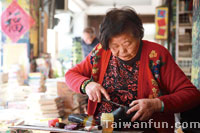 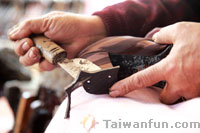 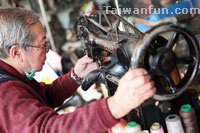
Left: Chiang's wife is his best help as he works.
Medium: The knife for peeling off the rubber sole must be as sharp as possible,
and each blade is handmade.
Right: The machines Chiang uses are all very old, but these "antiques" are still in
good condition.
No shoe problem stumps Chiang
"These are changing times and we have to follow them. All I could do was to make the best of it and move on without regret," says Chiang, who doesn't mind having to now work next to a pile of old shoes in air always filled with flying dust and particles. The very fact that he understands every step of making a shoe allows him to fix any kind of problem, keeping shoes with their owners longer. Most of his clients send their footwear here because they really love their shoes or have some special memories connected to them. Thus, they are always very thankful when they see their shoes "brought back to life".
According to the shoe repairman, despite the fact that shoe factories produce a variety of shoe types for different uses and occasions, the most important factor is whether they are comfortable, fit well and are durable. The most common problem is the shoe sole falling off. This happens when soles are glued to shoes, which isn't as strong and lasting as a hand-sewed sole. Also, because mass-produced shoes are assembled in seconds, there is no way to spread the glue evenly. Therefore, when he fixes shoes, he needs to clean the old glue off first and polish the bottom of the shoe in order to increase friction when attaching a new sole. If a new sole is needed or a worn heel needs fixing, Chiang will polish the bottom first, using a wooden stick section to fill the holes in the heel and ensure the shoe nails fit perfectly into the heel as he's re-attaching it. The final step is tightly pressing the shoe and sole together.
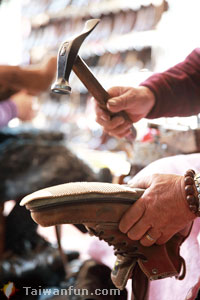  
Left: When gluing the sole, the shoemaker
needs to bang the sole from the center
towards the edge in order to push the
air out.
Medium: Chiang can most certainly fix any
heel-related problems.
Right: Even in his seventies, Chiang is still
skillful and efficient.
Reborn old store wins clients from around Taiwan
Although he was initially simply following market trends when he transformed his store into a shoe-repair shop, Chiang unexpectedly rediscovered the worth of an old shoe store. The morning alone sees 20-30 customers visiting to either drop off shoes or take repaired shoes home. Only three people work here--Chiang, his wife and daughter-in-law--and they continue nonstop from opening time onward. Surprisingly, not only local residents know Yongxin. According to Chiang, his clients are from all over Taiwan, from nearby counties like Changhua or Nantou to more distant cities and counties. Most of clients in the second category usually find the store via online recommendations and ship their shoes to the store. As Chinese New Year approaches, people are starting to clean house and sort through shoes that need to be fixed. It reminds Chiang of a time when handmade shoes were still popular and everyone had to work overtime before the lunar new year arrived.
Left: Chiang decided to become a
shoemaker at the age of 15.
Right: The procedure for polishing the edge of
a rubber sole not only removes the dirt,
but also ensures that the new sole fits
perfectly.
Instead of following many who have moved to China to enter the mass-produced shoe industry there, Chiang has chosen to remain in his little shop and repair shoes. The results have proven that he was correct. "I may not have a big fortune, but I make sure every pair of shoes sent here lasts as long as possible. This is the best service a shoemaker can offer," he notes. Standing in front of his shoe store, Chiang expresses the pride and persistence of a life-long shoemaker with these simple, but sincere, words.
Yongxin Leather Shoes
Address: 7, SanMin Rd, Sec 2, Central Dist., Taichung City
Tel:(04) 2221-0048
Hours:9 am-10 pm |

 February 2014
