Indispensable
bamboo: Chen Chun-ming's
world of bamboo
sculpting
Words by Ye Jia-hui
Translated by Angel Pu
Photography by You Jia-huan
"Are you willing to choose a career that's 10 times harder than the others?" asks Chen Chun-ming,
who has dedicated himself to bamboo sculpting for over six decades. Compared to wood sculpting,
the creation of bamboo sculpture require 10 times the effort from artists. Although the rewards may
seem small for so much hard work, Chen has relied on willpower to overcome every difficulty he has
faced in his career as a bamboo sculptor.
It's almost 1 p.m. and Chen Chun-ming, a slightly-built man with a long braided hair, opens the door for us with a cup of tea in hand. After dozens of years as an artist, he stays up late and wakes up late, not caring about the old adage that its best to sleep and rise early. For Chen, "being free" is what keeps him healthy and his attitude toward life is also reflected in his artistic style. He does the best he can when it's his time to shine, while also recognizing when it's best to remain quiet and focus on the sculpting that he has dedicated almost his entire life to.
  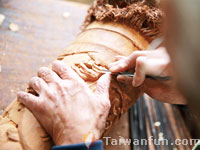
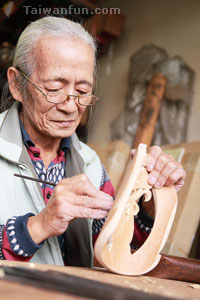
Medium: Chen Chun-Ming, 74, has only done one job in his entire life, in a career spanning over 60 years.
Right: A hint of Japanese artistic styles can be seen in Chen's creations, especially in
the way he carves waves. He learned this from his father, who studied in Japan.
A lifelong job passed down from father to son
Chen is an excellent example of the common saying, "no pain, no gain". Numbered today among Taiwan's rare bamboo sculptors, he worked with and learned from his father Chen Cheng-chi--one of this country's four most famous wood sculptors--from the time he was very young.
As the son of a master wood sculptor, Chen had the advantage of a better art education, but also needed to live up to the elder Chen's expectations. However, for as long as he can remember, no matter how hard he and his father worked, the family was never rich and sometimes landlords evicted them from their home. Nevertheless, Chen's father chose to do the same job and do it to the best of his ability, seeing it as a personal responsibility and right way for living.
Touching a bamboo tube that had just been cut open, Chen, a recipient of the National Literature and Art Achievement Award in 1981, reminisced about what his father had taught him, noting, "It's never a matter of money or wealth. It's just that a person should assume his responsibilities and do the right thing right." It's quite obvious that this artist possesses a stubborn, persistent spirit.
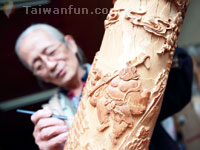 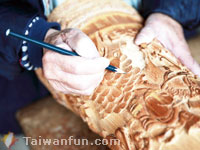 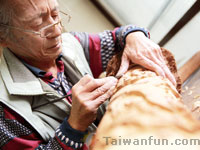
Left: Characters from Chinese literature classics have often been subjects for
Chen's works.
Medium: Although an artist makes a draft with a pencil in advance, they may also
use their judgment to make some slight alterations during carving.
Right: Bamboo has a firm, solid texture, so Chen needs to use his shoulder to
stabilize the end of the carving knife for a better grip.
Taiwan's 1960s wood-sculpting heyday
To support his family, Chen's father considered a way that he could keep his children fed while continuing his favorite job. As wood sculptures were being replaced by works made with concrete molds, both father and son thought it was time to develop some new products, lest they be forced to look for a new line of work like other wood sculptors. During this time, many American soldiers were stationed in Taiwan and before returning to the United States they often purchased local items as gifts for friends and relatives. Therefore, Chen selected locally-grown camphor and cypress wood, trimmed it into the shape of Taiwan, and decorated it with typical Taiwanese rural themes, such as a farm boy and farmhouse, or a woman in a bamboo-leaf rain hat in front of a banana tree.
These vividly-illustrated wooden decorative works were very popular and became best-sellers at major tourist spots around the island. However, unsurprisingly, other sculptors began competing with cheaper, less-elaborate products. Not wanting to do the same thing, the elder Chen proclaimed to his son that they were going to stop making wood sculptures and, instead, would begin using bamboo as a material.
"Do you know how different sculpting wood and bamboo is? Every bamboo-sculpted pen pot we tried to make broke during our first attempts," said Chen, recalling their failures. Initially, they didn't understand the character of bamboo, nor had anyone told them how to treat it before sculpting. They were also unaware of how humidity could affect bamboo materials. Without a professional to help, they were almost defeated in their struggles with bamboo . Finally, with the help of a bamboo-materials dealer, they learned useful techniques such as mothproofing and humidity control that allowed them to move on to the next stage.
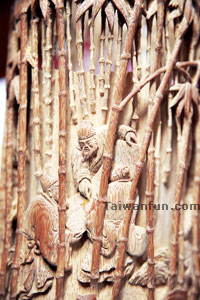  
Left: A good bamboo work portrays not only the vivid,
lively faces of characters, but also a depth
between each object.
Medium: The thickness of a bamboo slice is only
about a centimeter, so sculptors need to
demonstrate their creativity within this
small area.
Right: The texture of Mengtzeng bamboo is hard and firm,
requiring skill and experience from the artist to
hollow it out.
Understanding bamboo's character to overcome its hardness
After experimenting with all kinds of bamboo, father and son found that Mengtzeng bamboo was the best for making sculptures, possessing an ideal thin texture, flexible fiber, and thickness. Nevertheless, sculpting with this material was still very different from wood, particularly because bamboo is much harder. This means that it takes 10 times the effort to etch a line on bamboo than it does with wood. And, if an artist is too rushed and uses too much strength, the bamboo piece will simply crack, leaving the artist with no other solution.
Sculpting bamboo cannot be hurried; one has to do one thing at a time. Which is also why Chen sleeps by day and works at night. He only feels calm when it's dark outside and everything is quiet, as the peacefulness helps him to evaluate the strength he should use when sculpting.
Holding a bamboo root, Chen explains that there are two kinds of bamboo sculptures--stem carving and root carving. A sculpture carved above one-inch of bamboo tube's head is stem carving. Most landscape carving and calligraphy art carving is stem carving. Root carving, by contrast, is work done beyond one inch below the bamboo tube's head. This often creates a very different vibe because there are many lumps and curly roots that all add different features to the finished work. Many of Chen's sculptures, including characters from "Journey to the West" (Xi You Ji) and Hollywood alien E.T., are root carvings.
In other ways, the bamboo-sculpting process is very much like wood sculpting. The artist needs to make a draft with chalk and a final draft with a pencil. After carving, emery paper is used for polishing before the application of oil and pigment. There is no set order and method for the latter two processes, which are up to the artist. This is part of how an artist showcases their individual creativity, techniques and talent.
Chen begins drawing as early as he starts carving, making this indispensable to the process. First, he skillfully drafts the design on the bamboo stem, then lays out various carving knives, ranging from big to small, flat to curved. As he notes, "I've used them for so many years; some of them are from my father."
The carving knife can be considered an extension and reflection of the sculptor. Chen always sharpens his knives himself, so that he knows the curve and flatness of every blade he uses by heart. He even knows which side of the sharpening stone is best for honing a specific knife. But even with the sharpest knife, he still needs carefully measure his strength when carving. Chen points at a red mark on his right shoulder created by the end of a carving knife after dozens of years of work.
Dedicating all strength to bamboo sculpting
Instead of making bamboo carving a lifelong career, most people would rather do it as a hobby because it's too difficult and tiresome. However, it is the only profession that 74-year-old Chen Chun-ming has had his entire life. He always recalls that his father told him that an untrained observer will not be able to discern how much strength a sculptor is exerting, and that artists must themselves carefully determine the proper amount, or else risk just muddling through their work.
However, Chen never witnessed his father "muddling through" or being negligent, and that has made an impact on his own attitude towards life. Although he sometimes feels it's a bit silly to do a job that will never make him a rich man, it's this very "silliness" that allows him to see life in a different way, just like the perspective from the top of a bamboo stem, stretching high into the air.
Chen Chun-ming
Address:
9, Lane 20, DaLian W Rd, Beitun Dist., Taichung City
Tel:(04) 2292-6949
|

 January 2014
