A lifelong love for
handicrafts: Lacquer art master
Wang Ching-shuang
Words by Ye Jia-hui Translated by Angel Pu
Photography by You Jia-huan
Photos provided by Wang Ching-shuang
It's 4 a.m. on a windy morning and 92-year-old Wang Ching-shuang leaves his house for a walk,
as he does every day. His stride completely echoes his personality--firm, steady and constant--the
precise reasons that have made him into Taiwan's master of Japanese "Maki-e" lacquer over the
course of several decades.
Watercolor, oil painting, pastel painting, gouache and Chinese water ink painting are all artistic mediums well-known around the world, to the point where many affiliated masters can be named without much thought. By contrast, "lacquer art" is less familiar to most people. Few professional books discuss lacquer art and its appreciation and even fewer "lacquer masters" are known to the public.
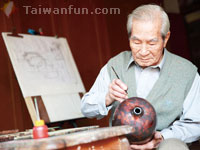  
Left: Wang Ching-shuang is not only one of Taiwan's best lacquer masters,
but also one of the remaining artists from the first generation.
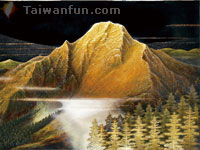
Medium: The Maki-e technique can be considered the soul of Japanese lacquer art, which Wang has fully inherited and perfectly presents via his work "Jade Mountain".
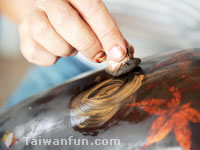
Right; Before completion, lacquerware must be polished
to give it a unique shine.
Taiwan's first lacquer master dedicates himself to education
Wang Ching-shuang, 92, can be considered one of Taiwan's first lacquer masters and, together with Lai Kao-shang and Chen Huo-ching, is considered one of the "three Taiwan lacquer masters". Moreover, both he and Lai studied in the Taichung Handicraft School's lacquer department in 1937 and 1938. This school, opened by Japanese Mr. Yamanaka, enforced strict discipline, meaning that lazy students weren't allowed to finish their studies. Moreover, those entering the lacquer department needed to be prepared to suffer more than other students, thanks to the fact that this art form features 66 basic procedures, it takes over six months to finish a common work, and artists have to endure the trials of handling tree lacquer paint by hand.
In addition to the steady, stable personality that allowed him to endure the lacquer art-learning process, Wang in 1940 also had the opportunity to perfect his skills at Tokyo Art School, where he received even stricter training. After the very skilled young artist returned from Japan, he decided to dedicate his life to Taiwanese lacquer art education. In 1952, at the invitation of the Nantou County commissioner, Wang and famous painter Yen Shui-lung established the Nantou Handicrafts Research Institute, which later became the present-day National Taiwan Craft Research and Development Institute. Under the constant influence of their father during childhood, Wang's two sons, Hsien-min and Hsien-chih, are now involved in the creation and teaching of lacquer art, in a great example of a father's transmission of his legacy to his offspring.
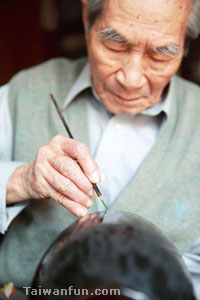 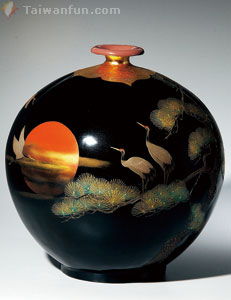
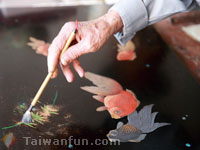
Left: The brush for painting
Maki-e lacquer must be
flexible, allowing the artist
to carefully control his
pressure on it.
Right:
"Song He Yan Nian" a Maki-e lacquer paint
artwork by Wang.
Father and sons creating timeless beauty together
Although Wang is still in good health, his hearing is no longer very good, meaning that his sons had to "interpret" interview questions for this article, help their father take photos and mix lacquer paint. Their humble and respectful attitude served as a reminder that this is more than a father-son relationship, but also a teacher-student one.
Besides lacquer art, Wang is also capable of creating gouache and sculpture and sketching. Although Wang dedicated his career in his younger years to applying expensive lacquerware to the creation of common daily-life items such as meal boxes, candy boxes, jewelry boxes and letter openers that most people could afford, he also worked to support his family and make ends meet. However, in his later years, with his children running their own businesses, he has finally been free to make the lacquerware that he's always wanted to create. After a life filled with challenges and hardships, Wang is now able to express his perspectives on life.
 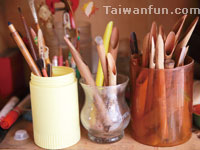
Left: The Japanese Maki-e technique that Wang is famous for is actually a gold-sprinkling
method.
Right: The container for the gold or silver powder
can be made from reeds, bamboo tubes or
huge pieces of straw. Each container is
specified by the size of the mesh.
Challenging Jade Mountain and experiencing a second highpoint in life
Holding a charcoal crayon almost two inches in length, Wang's hand does not shake one bit as he sketches scenery. "My father lives a very disciplined and regular life, so he's pretty healthy for someone in their nineties," said son Wang Hsien-chih with respect. "He doesn't even need glasses when reading a newspaper." The elder Wang has been involved with judo, tennis and golf since his younger years and even swam across Sun Moon Lake in his eighties. At the age of 82, against the advice of everyone, he decided to climb Jade Mountain in order to make a sketch to base a lacquer creation on. This work, titled "Jade Mountain", has become one of the best, most highly-praised lacquer-art pieces around, vividly presenting not only breathtaking beauty but also fully portraying a distant, aerial perspective of an alpine forest with different kinds of gold lacquer paint, using traditional "Maki-e" techniques he learned from the Japanese.
Although lacquer art has been Wang's sole profession in life and he is already a master in his field, he didn't hold his first solo exhibition until he was 80. According to his sons, this is perhaps because of his very careful personality. Today, he still loves creating and draws his inspiration from daily life; even just a flower on a balcony can provide endless inspiration. When creating a lacquer piece, he does everything himself, from mixing paints and polishing to other numerous heavy and complicated procedures. For Wang, each step of polishing a work is like polishing his own spirit, representing artists of his own generation, which helps him create even more classic works.
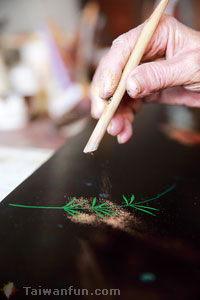 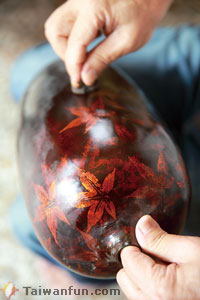
Left: Wang taps a powder container with his
finger, sprinkling gold powder on the work
like fine snow.
Right: Wang rubs lacquerware repeatedly with
yellow wax-tipped cotton until it's glossy
and shiny.
Reviving lacquer art and promoting it to a younger generation
Through the Japanese colonial era, 228 Incident, Taiwan's economic miracle and more recent history, Wang has faced all changes with a calm, steady attitude, unaffected by even this current age of the Internet. For him, all the big and small awards and prizes displayed in his living room, including a "Cultural Asset Certification" presented by the Council for Cultural Affairs, are like the gold powder used to create Maki-e lacquer paint—they look beautiful and splendid but don't help much when it comes to reviving lacquer art. Rather than focus on his own achievements, Wang hopes that the lacquer art that he has dedicated his entire life to can once again gain more attention. Taiwan's environment, weather and resources are very suitable for developing lacquer art, meaning that it would be even more of a pity if it was allowed to disappear with time. |

 December 2013
