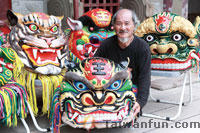
Chen is one of Dajia's only lion
head-making experts.
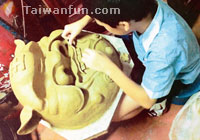
Through the lion head making
process, community children
also learns
about local culture.
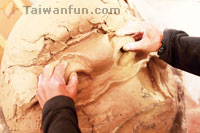
When sculpting lion head
features, the nose is the most
crucial part.
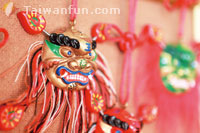
Dajia's lion head culture
originates with traditional
martial arts.
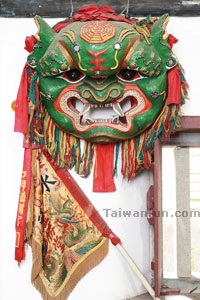
A green lion head indicates a
battle between the
studio and
a rival house.
|
Martial Artist, Lion Head Maker
Chen Ming-hong dances with lions
Words and photos by Chen Yu-hsiu
Translated by Erica Lin
"I loved playing with mud in the fields ever since I was a kid. Who knew that
sculpting mud from the rice paddies would lead to 'kneading mud on the earth god',
as I unexpectedly started kneading heads for the king of all beings--the lion,"
Chen Ming-hong says with a smile while stroking his small beard, as this so-called "Lion Head Dharma Master" talks about his past....
Mention Taichung's Dajia and what do most people think of? Perhaps its Mazu temple, straw mats or specialty, cripsy butter cakes. While various things will come to mind for different people, for master Chen Ming-hong--born and raised in Dajia--"martial arts" is most definitely his first answer.
Dajia 53 Village: The birthplace of Taiwanese martial arts
Taichung's Dajia district was once home to the famous "Dajia 53 Village", spread between the four coastal districts of Dajia, Da-an, Waipu and Houli, and known for its worshipful attitude toward traditional Chinese martial arts. For local residents, the study of martial arts was undertaken for self-defense. However, the excellence of their kung fu skills, a lack of leisurely entertainment in the agricultural era, and the annual Dajia Mazu Pilgrimage--regarded as Taiwan's most celebrated religious event--meant that martial arts turned into not-to-be-missed performances incorporated into traditional folk festivities. This earned Dajia 53 Village nicknames such as the "Home of Punches" and "Home of Martial Arts".
Since Chen's parents were preoccupied with working to feed a very large household, their children were free to choose whatever future vocation they wanted and expand on their individual interests. In such a way, Chen Ming-hong, who enjoyed kneading and sculpting since he was little and liked to dig mud out of fields and sculpt it into shapes, started his martial arts studies by joining the most popular local martial arts studio, affiliated with the famous Yulin Studio. Chen recalls his apprenticeship as being very difficult, as the hardest tasks were distributed among the apprentices. This meant that, although there were dozens of apprentices in the beginning, the hardship and gradual replacement of martial arts with Western-style entertainment led to the decline of this art form and the number of apprentices to only two or three. Chen certainly stood out among these because instead of merely practicing martial arts as his sole reason for staying at the studio, he had a strong interest in something his fellow apprentices were the least interested in--making lion heads.
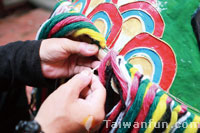 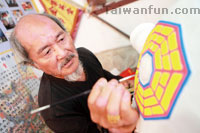
Left: Every step in the process to make a lion head is
planned and executed by Chen.
Right: The eight divine trigrams on top of a lion head is meant to protect
people from getting hurt by the lion's animal instincts.
Loving art from a young age, crafting with kung fu
When one truly loves something, there's no way of hiding it. A passion for art from the time he was young made it easy for Chen to make lion heads for the martial arts studio, despite the fact that he never had the opportunity to receive a proper art education. When he took over the lion head maker's job, instead of regarding it as a hardship, he took pleasure in his work and was innately good at it. He also let his imagination flow freely. As a result, although he was limited by religious guidelines while making the lion heads, he challenged himself to make them in a different, more artistic fashion.
Due to the lack of supplies in a more agrarian era, many lion heads were made of everyday objects. For example, the base of the head was made from rice sifters and dustpans, and painting a lion's face was as simple as drawing a nose, eyes and mouth to the point that it was recognizable as a lion head. Moreover, because lions weren't indigenous to China, having spread to China from western regions of India, no one had seen a real lion. Under these circumstances, lion head makers could only rely on their masters' and apprentices' word of mouth to inspire a lion-like appearance. Later on, as the role lion heads in various activities became increasingly important, all martial arts studios began to make them a central idea and representation. This meant that the making of lion heads was no longer simple or easy, as more and more variations began to emerge.
Slowly sticking, freely polishing to sculpt powerful lion heads
Chen takes some earthy yellow clay and makes a small pile on a wooden board. "The clay's pattern is the most important foundation when making a proper lion head. Similar to a human's facial features, it will look strange if there's a dent somewhere or it's flat somewhere," Chen explains, noting that the making of a clay model looks easy and the techniques involved aren't too complicated, either.
The hard part is getting the right proportions and exact measurements. He usually starts by deciding the location of the lion's nose; as long as the the placement and proportion of the nose are correct, there won't be a problem with the placement of the forehead and chin. However, due to the large scale of the lion head, it is easy to get eye fatigue if one works on it for too long, which leads to mistakes when adjusting proportions. As a result, while he is excited to see a new creation being made, he also reminds himself to leave work at appropriate times, allowing his perceptions to temporarily fade and enabling him to fix any potential mistakes or deviations immediately when he returns to examine the work later on.
If the process to make a clay model goes smoothly, a lion head can be completed in about a month and a half. But it is also normal to drag the completion time to three or even four months due to the lack of inspiration. After the model is finished, one can continue to the process of pasting paper. Back in earlier days, the most common paper the rural population had in households was a gold paper used for making offerings to gods. Thus, masters collected their materials accordingly, gluing gold papers, one by one, onto the clay model with starch paste. Pasting a total of four layers, they took approximately one working day to to do each layer, from making it to allowing it to completely dry.
Once the paper version is completed, the clay model has to be dug out. The remaining paper likeness itself represents the lion head's appearance without "make-up". As everyday objects became readily available, the custom of pasting gold paper was modified to the use of waterproof cement packaging bags. Today, drafting paper is used in this process. Both cement bags and the drafting papers are damp-proof, making it unlikely the heads will be ruined, even by light rain. Earlier versions which used gold paper and pastes made of flour or sticky rice were very likely to be destroyed by moisture or rats and insects. Thus, the longest-surviving lion heads made by Chen only have a history of approximately 30 years; anything older faces preservation difficulties caused by the above reasons.
Dignifying and amusing, breaking away from conventions to create new directions
In the past, lion head designs and colors conveyed specific symbols and did not vary much. White, blue, black, red and yellow represented the five elements of gold, wood, water, fire and earth. Furthermore, significance was given by characters from the "Romance of the Three Kingdoms", with red representing Guan Gong (who played a significant role in the civil war that led to the collapse of the Han dynasty), blue or black for Zhang Fei (who was a military general serving under warlord Liu Bei in the late Eastern Han dynasty), gold for Liu Bei (a warlord in the late Eastern Han dynasty who founded the state of Shu Han in the Three Kingdoms period and became its first ruler), and silver being Zhao Zi-long (who served Liu Bei and accompanied him on most of his exploits). Therefore, a martial arts studio that shows up with a silver lion head is expressing the fact that the studio members have lots of guts. With green or black lion head, as everyone knows that Zhang Fei is very determined, this indicates a battle between the studio and a rival house. In a very special sight, a martial artist who shows up with a white lion head is indicating that a master has passed away in the studio. The apprentices are mourning and honoring their master with the highest respect, sending him off on life's last journey with a white lion.
As Chen Ming-hong focuses on drawing the eight divine trigrams on a lion head, he says that Dajia martial arts aren't as celebrated as they once were. However, he still hopes that young people won't reject traditions, which will change with time. Just like the lion head he is creating right now, although he insists on leaving the eight divine trigrams on the head, which protects people from getting hurt by a lion's animal instincts, he presents an abundance of more lively changes to the colors, decorations and expressions. If the younger generation can understand that traditional culture is a foundation for increased human social relationships, more people will be drawn to the crafting of lion heads, thus passing this cultural heritage down to generations to come.
53 Village Traditional Martial Arts Cultural Museum Chen Ming-hong
Address:
116, WenWu Rd, Dajia Dist., Taichung City
Tel:0927-515-754
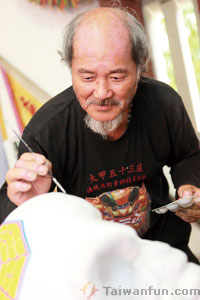 
Left: Without any rough drafts, Chen likes to
think of ideas and put them into action
as he makes lion heads.
Right:
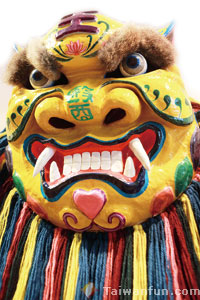
Right: Although they feature personalized,
aesthetically-pleasing touches,
Chen Ming-hong's lion-head
creations also preserve traditional
elements.
|

 July 2013
