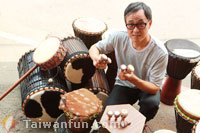
Although Hsu has gone
through tough times
making drums, he is also lucky
that he can
persist in doing
what he loves the most.
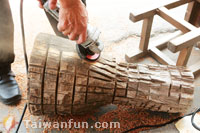
Breaking wood fibers allows
the striking sounds to transmit
through the drum.
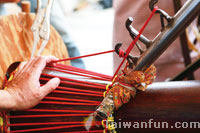
Hsu designs his own unique
tools to assist in drum-making.
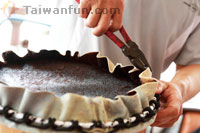
Framing and tightening the
soaked-until-soft cowhide onto
metal rings to craft the
drumhead.
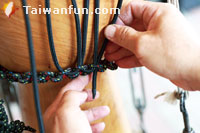
After trying many threads, Hsu
discovered
that Tetoron had
the best pulling tension and
worked the best.
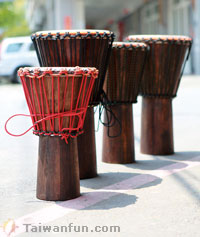
With a wide shape on top and
narrow one at the bottom, the
djembe creates a broad range
of pitches and tempos.
|
Pioneer of Taiwan's
African Drums
Hsu Chih-ping's
Unstoppable Rhythms
Words and photos by Chen Yu-hsiu
Translated by Erica Lin
"The manufacturing cost of a drumhead can be either inexpensive or high-priced. But,
regardless of its cost, a struck rhythm is the single universal, easy-to-understand,
easy-to-learn language, transferring emotions by bridging human personalities and
different countries," says Taichung expert African drum maker Hsu Chih-ping.
Sometimes, to be helplessly in love with something--being infatuated and falling for something--is unexplainable to others because it has no specific point of origin. For Hsu Chih-ping, falling in love with drums and drumming is something that has yet to be completely explained.
African drums and the sudden start of an inner dream
"When I was a professional military serviceman at the Air Force Academy, my teacher said to me, 'A soldier's career is built on the battlefield; if there's no war, there's no way to climb upwards.' I knew I didn't have the background or the connections to get promoted, so I left the air force." Stepping away from this stable occupation, Hsu went into the booming securities industry, using his skilled writing to teach others how to make big money via swing trading.
However, this kind of lifestyle didn't touch Hsu at his inner core as he felt a tedium and emptiness in his heart, watching financial and transaction numbers rise here and there. Then one day he accepted a friend's invitation to a performance of an African drum group from a friendly nation performing in Taiwan. Starting with this epiphany, he threw himself into the African drumming world. "As soon as I heard the drumming tempo, I completely woke up, from my hair to my toes; every single cell in me couldn't help but to be happy!" he recalls of his first contact and bond with the African drum.
In 1990, the Taiwanese stock market crashed, leaving investors everywhere in anguish. Without a doubt, Hsu's days weren't any better in the securities industry but, seeing the crisis as a turn for the better, he found a reason to detach himself from that profession. Having decided to heed his inner calling, in 1993 he stepped into the very unfamiliar, yet most desirable, field of African drum making.
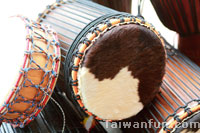 
Left: Hsu knows how to make all kinds of African drums, including the conga
and doun doun.
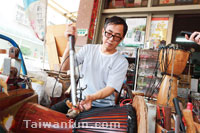
Right: Hsu taught himself by disassembling and feeling around drums, eventually
becoming Taiwan's best African drum maker.
Self-taught and learning from the very beginning
At that time, there were no local drum-making masters who specialized in African drums and the ones that were being made and sold here were imported, semi-manufactured products completed in Taiwan. These items didn't match Hsu's expectations for African drums, as he not only believed that these instruments had to provide good tempos, but also that every note and every resonance should have a unique character and original expression.
When the cheaply-manufactured available drums didn't seem to meet his high expectations, Hsu decided to start with raw materials. Having searched all over Taiwan and practiced with all suitable woods, from Chinese juniper, camphor wood and beech to pheasant wood and many other varieties, he tried everything. He even accidentally used the most expensive, most valuable "stout camphor" to make his first drum. By trial and error, Hsu discovered that the most expensive wood didn't make the best drums. Rather, the most suitable wood for African drums had to have the right density of pores in order to conduct drumbeats properly.
However, despite having located the most suitable wood, the engravement of the drum body, or sound box, was another difficult task. Hsu had never visited Africa before, nor studied music but, in order to make African drums, he finally devised his own manufacturing process after breaking more than 20 drums. This included the six major steps of shell sewing, body engraving, barrel fixing, counterhoop welding, animal skin mounting and roping. In the beginning, Hsu's amateur spirit led him to try using two alternating electric drills to bore holes, but these kept breaking and smoking. He persisted boldly, using a chain saw, which wrecked the wood fibers of the drum body. After such adventures, he finally hit upon the idea of asking a factory to help the processing with lathes. "Although everyone likes to advertise things as being 'purely handmade', hoping to sell them at a better price, we know from actual experience that using machines to assist in cutting actually produces a more perfect arch and cutting line, resulting in a more accurate expression in a drum's sound and emotion," explains Hsu.
After deciding on and fixing the drum's appearance, the next step is to stretch an animal skin over the body. Hsu dries a soaked-until-soft cowhide under the sun for a bit, then spreads it flat on the body and secures it with metal rings. He has tried drum-making with many different hide textures, including sambar, sika deer and pig leather, but none of these were ideal. At the end, cow leather and goat leather were the best choices, of which cowhide produces the best sound and is the most durable for the humid Taiwanese weather.
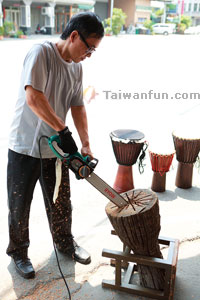 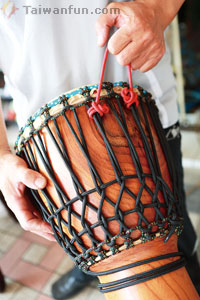
Left: Carving out big and small prototypes of sound
boxes by cutting wood with a chain saw.
Right: Although it is time-consuming, the "two strings, one weave" method
allows more precise tuning.
Made in Taiwan: The best threading material
After securing the drumhead, Hsu puts the entire African drum on a self-invented assisting machine, which helps stabilize the drum body while he rope-tunes it. The first African drums were tuned with either animal tendons or vines but, nowadays, all drums in Africa are tuned with "MIT" (Made in Taiwan) ropes. Notes Hsu, "The Taiwanese textile industry is really something else. Changhua is a big textile county and a lot of world class threads are from Taiwan!"
Although Hsu's mind is focused on African drums and his hands make them, he also can't help but speak well of his home country. He's experimented with so many different textures and different weaving ropes through his drum-making trials but, after all his comparisons and trials, he's found that the most durable and tension-resistant is the Tetoron thread he currently adopts. This type of thread not only has gone through a 300-kilogram tension pull test, but because of its durability also permits the appropriate tightening on the drum surface. Furthermore, with special roping it achieves a tuning affect.
The heads for the Chinese bass drums used in Taiwan today are fixed on the barrel with nails. As he weaves, Hsu explains that this method not only prevents tightness adjustments, but also means you have to take off the entire drum head and exchange it for a new one after using it for a while, which is expensive and not eco-friendly. The perks of roping is that you can adjust the tightness by yourself, it lasts for a long time, and it doesn't go out of tune. That's why all the drums he makes for U Theater, a well-known Taiwanese performance group, are all treated with the roping method. This provides not only variations in appearance but, most importantly, is economical and eco-friendly.
Recycling desks, making good sounds
Hsu often finds ways to apply his love of African drum-making. He often visits educational institutions to promote African drums, which was when he accidentally discovered that, due to school-renewal efforts, there were many schools with piles of old desks and chairs sitting around, often waiting to be burned or recycled. Upon closer examination, Hsu found that these items were actually made of decent-quality Taiwan hemlock. Moreover, they were not damaged by moths or worms after over 20, even 40, years of usage, meaning that their tannin-acid content was sufficient. He reasoned that, if this wood was used to make instruments, there wouldn't be any problems with termites or rot. In addition, current laws on logging trees are very strict, making it hard to obtain wood. If these old desks and chairs were burned, wouldn't it be extremely wasteful?
A bright idea suddenly occurred to the drum maker, who decided to do an exchange with the school: He would collect the desks, make the desktops into African drums, and then gift them back to the schools for students and teachers to use. This would save the schools money spent to discard the abandoned desks and chairs, while allowing more people to discover the fun of drumming.
Unlike wind and string instruments, which require time to learn and become familiar with in order to be appreciated at a deeper level, the beat of a drum is a primitive sound unrivalled in its impact on the listeners, familiar with thumping rhythms since hearing their mother's heartbeat in the womb. Hsu notes that drumming is not only easy to learn, but also stimulates more than 200 peripheral nerves in one's palms while drumming. At the same time, it also trains one's memory and brain power. Thus, many medical organizations in Taiwan such as the Tsaotun Sanitarium, Spinocerebellar Ataxia Association, and Taiwan Autism Association (Autism Society Taiwan) purchase African drums for patients to practice on. Some schools even let kids with autism or ADD learn on drums after finding that through drumming these students show remarkable improvements in mood stability.
With no sleek or impressive studio, Hsu hides himself in the self-operated Jitai Grocery Store. He has come on a long journey to the point where he is today, supporting his dreams and entire family by making African drums, becoming Taiwan's best-known African drum-making expert along the way. Not only has he proved that "dreaming is the most beautiful thing", but he has also made his rhythmic life into a wonderful reality.
Guyo Instruments Hsu Chih-ping
Address: 1005, ShuangWen Rd, Dali Dist., Taichung City
Tel: (04) 2406-5221
|

 June 2013
