HOME  TAICHUNG ARTICLES TAICHUNG ARTICLES
COMPASS
MAGAZINE  June 2013 June 2013
|
Low-Budget Travel in Taichung:
A Backpacker's Perspective
By Javier Siles and Uvia Chang
Translated by Erica Lin
With Taiwan's third-largest population and exactly 2,214.8968 square kilometers of space to explore, Greater Taichung offers a tremendous variety of attractions for visitors to enjoy. While the public focus is usually on traditional tourists--regularly seen shuttling around the city in tour buses--Taichung is also a significant destination for foreign low-budget travelers. These travelers, commonly lumped together as "backpackers", hop from one country to the next, often for months at a time, with a backpack as their only luggage.
To better understand these visitors, Compass Magazine surveyed a handful of backpackers to learn more about their Taichung experiences and impressions, noted below. In general, those scheduling visits to Taiwan were mostly either ESL teachers working around Asia, or students who plan around school holidays. Typically, Asian travelers tended to carefully plan out their trips, often with stricter deadlines, while Westerners were more flexible.
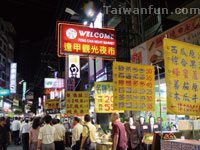
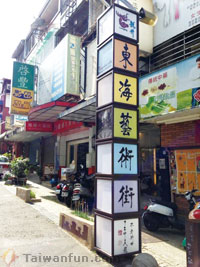
Among the must-visit destinations noted were the Tunghai University campus and nearby areas. After seeing the school's I. M. Pei-designed Luce Chapel and strolling around its grassy lawns, visitors like to walk to the Donghai Night Market and Art Street. On the opposite side of the city, Taichung Park, with its Japanese lake pavilion, colorful flowers and tall, magnificent trees, was considered another scenic site. Both Yizhong Night Market, near Chung Yo Department Store, and the famous Fengjia Night Market, are two more backpacker favorites for dinner and shopping. The National Museum of Natural Science in North district was also on this list.
|
|
|
Sisi Chang, 28, Hong Kong
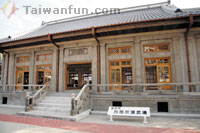
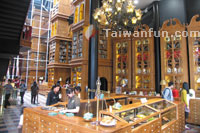
With a strong interest in foreign cultures, Sisi decided to stay four days in Taichung while traveling around Taiwan with a friend. Next to the train station, she visited the "Gong Yuan Yen Ke" Dawncake bakery branch, a vintage Japanese-era structure with modern interior facilities that resemble an elegant library, where cakes, candies and other pastries are sold. In the West district, she also admired the Martial Arts Compound of the Taichung Criminal Law Enforcement Office, another classic wooden Japanese colonial-era complex consisting of a main building and outbuildings with large tatami mats where martial arts were practiced by policemen, plus historical pictures and artifacts.
|
|
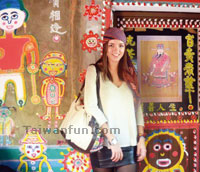 |
Estefania, 23, Honduras
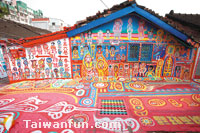
After visiting some friends in southern Taiwan, Estefania decided to come by herself to Taichung for two days before heading to the Philippines, Hong Kong and China. Her favorite places included the Rainbow Village on ChunAn Road. This small former military residential community has now become a major tourism spot, where all the walls have been joyfully painted by Huang Yung-fu, an elderly resident who continues to live there. She also praised the relaxing, beautiful environment in and around the National Taiwan Museum of Fine Arts on WuQuan Road, including the adjacent Art Museum Parkway with its theme restaurants, wide variety of cuisine, different styles of houses, and many picture-taking strollers.
|
|
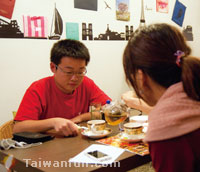 |
Mr.Tsao, 25, Shanghai, China
Having traveled in many countries such as Germany, Hungary and Nepal at a young age, Mr. Tsao now works in the Shanghai travel industry and is a professional photographer, capturing exotic scenery and cultural beauty. While his primary purpose for this particular trip to Taiwan was shooting a good friend's wedding photos, he stopped by Taichung for two days. He noted that mornings in Taichung had a certain poetic, peaceful feeling, adding "the air here is much fresher than Shanghai, and I really feel the friendliness of locals here when I take the bus out in the morning". The eight-kilometer public-bus Free Ride program and various bus routes made it easy for Tsao to visit famous city tourist spots. With an expressed interest in buildings from the Japanese-colonial era, Tsao also visited the Changhua Railroad Roundhouse, a fan-like semicircular train roundhouse that is a historic landmark from the Japanese period.
|
|
 |
Cai, 27, Beijing, China
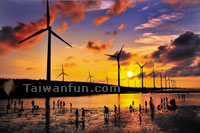
Cai traveled solo around Taiwan by bus and spent a couple days in Taichung. For her the top attractions included the Gao Mei Wetlands in the Qingshui district, with its beautiful landscape, where visitors enjoy walking in the wet sand before admiring the sunset. Her itinerary included a key cultural spot for today's young people, Ching Chen High School in neighboring Changhua city. Used as a filming location for the famous Taiwanese romantic movie, "You Are the Apple of My Eye", based on Jiu Ba Dao's novel and directed by the author himself, the school is now a popular destination for fans. She also stopped by the 921 Earthquake Museum of Taiwan in the Wufeng district, where the government preserves memories of the large Sept. 21, 1999 central Taiwan quake that was one of Taiwan's worst natural disasters in the last century. |
|
 |
Zhang, 23, Shanghai, China
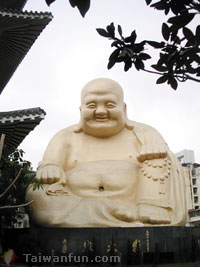
Riding his bike around Taiwan with two classmates, Zhang stayed three nights in Taichung city, which functioned as the group's base for travel to nearby areas. They went to Nantou county's Sun Moon Lake where, Zhang notes, "the beauty of the lake, and the temples around the area, all of it surrounded by mountains, gave me a deep sensation of peace and calm." In Changhua county, they went to the Mazu Temple in Lukang, where they admired the architecture and enjoyed the traditional Taiwanese snacks that the local vendors were selling outside the temple. Back in Taichung, they paid a visit to the Bao Jue Buddhist Temple, a Japanese structure in the North district well-known for its giant, almost 30-meter-tall, smiling Buddha--one of the biggest in the world. The building contains thousands of cremation urns, which is why this temple's environment is quieter than other temples. |
|
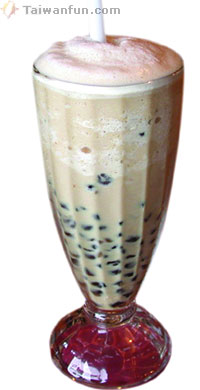 |
All of these travelers agreed that Taichung residents were very friendly, making the city feel nicer, as they mixed with the locals at hot spots like the crowded night markets. However, some of them had bad experiences when cab drivers tried to trick them, with Cai advising that "it's better to let the meter run". Regarding food, Chinese visitors especially enjoyed spicy hot pots, while the rest of the Asian backpackers tended to try tropical fruit like Chinese plums and starfruit. Westerners were more willing to try exotic things such as snake, and most of them fell in love with bubble tea.
The general consensus was that, despite the incentive offered by traveling up to eight kilometers for free via bus, a less-than-convenient public transportation system limited their movements in Taichung. For example, Estefania noted that it took her over 90 minutes to get to the Rainbow Village from the city center. It is also a noticeable fact that not many backpackers are found in downtown areas. Asked about this, travelers immediately responded that this was due to a lack of low-budget accomodations where they could spend the night in Taichung.
However, all this being said, these backpackers said that they enjoyed their days in Taichung, not only because of the various attractions around town, but also because of its people, which they said would lead them to recommend this city to their friends.
Special thanks to iTC Angela Eve for
her assistance with this article.
|
|

