
Lin thinks the difficulty of the
violin-making process
comes
from the importance of "doing
it with your own
hands".

William Violin Workshop has
been transformed
from an
empty garage into an artistic
violin
palace.

Lin uses professional hand
tools to
slowly shave out the
perfect outline of
a violin's
back plate.

Carving the scroll requires 3D
vision and full
attention,
resembling both a test and
religious
ritual.

The order and logic of staining
determines the
quality of a
finished violin. It is also the
most
mysterious part of violin
making, in which
violin
craftsmen take the most pride.

Linings are made not only for
a decorative
purposes but also
to minimize damage
caused
when a violin is accidentally
dropped.
They also help create
perfect resonance in
closed
spaces.
|
No Pain No Gain: Lin Dian-wei's solo
violin-making journey
Words by Ye Jia-hui
Translated by Edward Lin
Photography by You Jia-huan
"Shadows only appear when there is light; where there are shadows,
defects can be identified. So there's only a chance for perfection
when defects are seen," says Lin Dian-wei, as he raises the pristinely-sanded back plate of a violin toward the light, looking for
defects and seeking perfection.
The violin is known as the "queen of all music instruments" and often plays a lead role in symphonic performances, highlighting its magnificent sound and elegant shape. In a solo, a violin can manifest mad, humble, sentimental or joyful emotions. Demanding a skillful technique and producing a powerful voice, the violin's charm has conquered the whole of Europe since its northern Italian origins in the 16th century. For over 500 years, the violin has even spanned oriental and occidental cultures, generating creative collaborations throughout a significant portion of musical history.
A music-loving family: A taste cultivated since childhood
Born into a music-loving family, Lin as a child fell in love with classical music and felt the unique charm of the violin's voice as well as an attraction to its exquisite silhouette and graceful character. He was also impressed with violinists' dedication and obsessive manner. However, in the 1970s, when civil servants' monthly salaries averaged just a few thousand NT dollars, violin playing was considered a lavish hobby, as these instruments cost a few hundred thousand NT dollars. "My parents would have had to sell our house if I had insisted they let me learn to play the violin then!" he says with a wry smile.
Although learning to play the violin remained a distant dream, Lin's passion for classical music never waned. He continued to listen to a variety of classical works, nourishing his own tastes for musical theory, tone, composition and instruments, which in turn cultivated his own unique perspectives. Nonetheless, influenced by practical considerations and social stereotypes, Lin opted not to pursue a career as a professional music educator, instead plunging into the fields of biochemistry and medical research after graduating from National Chung Hsing University's Institute of Biochemistry.
With an attractive degree and an enviable career, Lin's future looked promising, but his father's poor health awakened a question in his heart and mind. Since the start of his career, he realized that every industry in Taiwan had stagnated in a "second hand" stage that relied upon accepting foreign R&D and buying foreign intellectual property rather than developing local industries. Lin disagreed with this myopic approach. Out of consideration of his family's company as his father's life-long masterpiece and, to the disbelief of many people, Lin took over his father's wood-products manufacturing company in 2002 and soon began to develop new product lines. While pushing forward into new markets, he re-embraced his violin dreams. Crafting fine violins has become much more than a stress-relieving activity for Lin, who has also received many honors, including that of being the first Taiwanese luthier, or violin maker, nominated at an international violin-crafting competition.
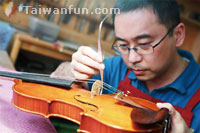 
Left: Without anyone's guidance, Lin successfully made internationally-renowned violins through self-study.
Right: Lin uses instruments to precisely measure the thickness of a violin's
back plate; the slightest difference leads to a completely different result.
Behind closed doors: The rigorous, lonely journey of violin crafting
"In 2005, I bought a manual about professional violin making. As an after-work pastime, I researched violin-crafting techniques. It helped me relax," recalls Lin. Perhaps driven by personal interests heightened by a spirit of scientific research cultivated during his studies, Lin couldn't restrain himself and bought a set of violin-making tools in 2007. He locked himself inside a small garage and, on top of a cheap card table, began his independent safari into violin making.
With a family background in the wood-products manufacturing business, Lin grew up surrounded by various types of lumber and had developed a deeper understanding of wood varieties than most people. Because of his engineering background, he also had a knowledge of mechanics, physics and chemistry. The combination of all these factors played a vital role in helping him become a violin craftsman. Lin ordered the finest violin-making wood, Italian spruce, for the top plate and Balkan maple for the back plate from a timber trader. From the very beginning, he imposed world-class standards and techniques on his handmade violin craftsmanship.
"The violin is the world's most expensive wooden product and music instrument after the Chinese 'guqin. Nevertheless, the violin has greater popularity and renown. It is at the apex of wood crafting," Lin says. Although there are quite a few violin repairers in Taiwan, few of them know the complete process for violin crafting and can hardly be called luthiers. In the West, "luthier" is a title endowed only on someone who understands and is able to execute every step of the violin-crafting process. Thus, violin making is a revered profession with high social status.
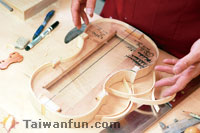 
Left: 不Instead of using mechanical tools, Lin uses the interior molding method to
make violins by hand.
Right: No secrets and no reservations--Lin generously shows his violin-making
workshop to others.
Invaluable experience: The devil is in the details
Looking solely at a violin's silhouette, it is obvious that the process for making one is extremely complicated and difficult. Lin notes, "In all cases, practice makes perfect. Anyone can find the violin-making process and its methods online or in books. Although to me there are no unspoken secrets, experience is still the most important ingredient and can only be obtained through hands-on practice; there are 'un-teachable' elements such as judgment, touch and intuition."
In general the violin-making process can be broken up into 12 steps: molding, carving the scroll, shaving the wood for the back plates, attaching the ribbing, attaching the bouts, carving the bridge, staining, stringing, fixing the bridge, tuning, attaching the chin rest, and so on. During each step there are details that need to be attended to correctly.
However, Lin believes that staining is the most difficult step in the process because different stains must be applied to many layers in a logical order. Different stain combinations yield different results, making this the secret step and pride of every violin craftsman. For an unfinished violin, the first layer of stain uses a specific ratio of clear egg whites thinned with water. This seals the porous wood and enables the violin's chamber to resonate louder and more richly. Lin learned these steps and materials from books, although it was only through time after time of selecting and mixing egg-white solutions that he obtained a satisfactory result. Lin also jokes that he was lucky to have studied bio-chemistry, so that he could intuitively understand these chemical reactions. Now he uses them in fine craftsmanship rather than in a laboratory.
At first, Lin made violins only for his personal entertainment. He also blogged about his experiences, sharing them with other violin lovers. Surprisingly, because of his increased celebrity, he enrolled two apprentices at his workshop and, after that, began contemplating his responsibilities as a technical instructor. He realized that only by helping his students to advance and be recognized could his social status be strengthened.
Honors and achievements: World-class violin-crafting techniques
Lin signed up for a global violin-crafting competition, the Italian Triennale Competition of Violin Making, which is held every three years and represents the highest glory for violin makers. In fact, the world's most famous violins are the works of Antonio Stradivari, whose name is used as a title for this semi-governmental, global competition. For the competition, all of the world's top violins are presented by their makers, striving for the championship crown. To prepare for the contest, Lin used the connections of his father's friends to visit Chi Mei Museum founder Wen Long Xu and see his personal violin collection. "That day was like a dream to me. I felt like talking to all the master violin makers in person in the collection room," he remembers. After the tour, Lin felt that his mind had been cleansed and was able to put all this inspiration into the violin he made for the competition. In the end, his violin won a nomination, the highest mark of approval outside of the top three places. For an Asian luthier with zero previous background knowledge or advantages, this result symbolized not only a success but also the highest credit to himself.
By contrast to making violins by himself in a garage, Lin has now transformed his original work place into "William Violin Workshop", which is open to the public. He also has rented a historical building that used to be a police dormitory from Yunlin county, changing it into a weekend violin classroom where violin-crafting tools and processes are displayed and explained. He says that he did not know that he would make so many changes in his life, just for violins. Still, regarding all the investments he has made for this instrument, he is willing to go even farther to nourish Taiwan's violin culture and help add more variety to Taiwan's musical culture. For this Taiwanese luthier, this is the best way to live out a life as a music lover and pay tribute to instrument he loves so much.
|

 April 2013
