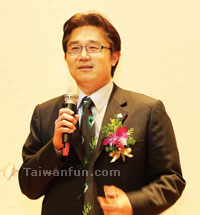
Current chair of the Art
Garden Parkway
Management Committee
Dr. DJ Chen
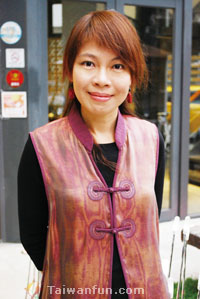
Debbie Lo
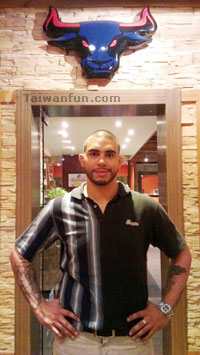
Demitri Telfair (BBQ House)
|
Embodying the best of Taichung:
The Art Museum Parkway
continues to shine
Words by Niang Chen
Translated by Angel Pu
For Taichung residents, it can be easy to lose sight of the fact that this city is home to some extraordinary neighborhoods that have long stood uniquely apart from almost anywhere else in Taiwan. Even as the public eye is often mesmerized by the glittering new highrises of the "Chi-Chi" 7th Redevelopment Zone or much talked-about plans to develop new urban attractions, there quietly remain older areas that in many ways have much more history, charm and appeal.
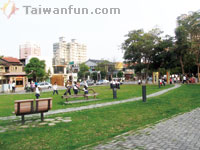
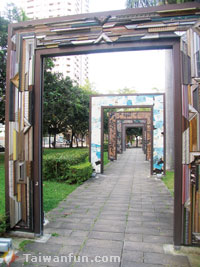
A list of possible candidates might include the city's Art Street or the YiZhong Street Night Market area. However, when it comes to a single place that captures the best of what urban Taichung stands for in a natural, largely unplanned, non-artificial way, it is hard to think of anywhere that tops the Art Museum Parkway. This area--also known as the Art Garden or Art Parkway--is the neighborhood on and around a green belt between WuQuan West 3rd and 4th streets that runs for about three blocks south from the entrance of the National Taiwan Museum of Fine Arts on WuQuan West Road, Section 1 (see Compass Art Museum Parkway Map). Some might also include adjacent areas, like a parallel green belt between WuQuan West 1st and 2nd streets, MeiCun Road, and even the CunZhong Street green belt that originates from the west side of the museum grounds.
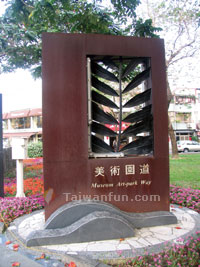 
The Taichung lifestyle in its truest form
Taichung often touts itself as "Taiwan's lifestyle capital" with open green spaces, attractive architecture, a slower more leisurely pace of life and, of course, plenty of culture and creativity. To observe this in its truest form, head over to the Art Museum Parkway on any late afternoon. The wide sidewalks, winding paths and grass lawns here are frequented by playing children, strolling couples, residents walking dogs, relaxing senior citizens, joggers and other passers-by, perhaps going to or from an exhibition or event at the museum.
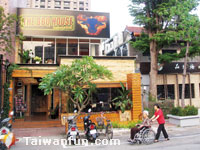
The landscaped greenery and colorful, quaint and eclectic mix of restaurants, cafes and shops occupying remodeled old houses on all sides also means that there are many cameras in sight, in the hands of visitors and ever-present wedding photographers. In fact, in a March, 2001 cover article about the Parkway, this magazine noted that the location ranked near the top of the scale according to the "Wedding Photo Rule", which graded the beauty and appeal of a place based on the number of couples getting their wedding photos taken there.
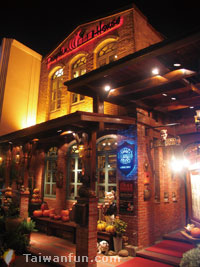
Nightfall gives the Parkway a new, more romantic cast as restaurant and shop lights come on, warmly illuminating exteriors and interiors, filled with customers sitting at tables over meals and drinks. Such places remain the area's best-known draw, with establishments serving Western, Japanese, Shanghai, Beijing, Turkish, Italian, Greek, French, Korean, Taiwanese aboriginal and other kinds of cuisine. A variety of popular cafes are also scattered about, run by owners who are near-obsessive in their commitment to the art of coffee-making.
Given the Parkway's proximity to the Art Museum, it is also very appropriate that recent years have seen a growing influx of artistic and culturally oriented businesses, from art galleries to imported home-decorations stores. National Veterinarian Hospital Chairman Dr. DJ Chen, current chair of the Art Garden Parkway Management Committee, notes that his organization's business members--now numbering about 90--are about 60 percent restaurants, 30 percent art/culture-related, and 10 percent miscellaneous businesses.
Roots in a rich history
According to Chen, the Parkway's roots date back to the Japanese colonial era, when city planners laid out a city plan based on the model of the ancient Japanese capital of Kyoto. Later post-colonial officials belatedly began implementing original Japanese plans that called for numerous green belts between roads. What today is the Art Museum Parkway's green belt was once actually a waterway that was covered over about a quarter of century ago, says Chen.
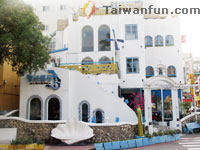
The next era in this neighborhood's development was largely responsible for the Western-style, stand-alone homes that house many of today's restaurants and other businesses. During the 1960s and 1970s, a large swath of this area was part of a sprawling U.S. military housing complex commonly known as the "New Compound" that included restaurants/clubs, a baseball field and swimming pool (still in existence as the Amvets Pool). While most of this is long gone, road names such as MeiCun ("American Village") are still testament to this history.
An inspiration for 'dream restaurants'
The construction of the Art Museum triggered the start of a new phase, as artists began to cluster in this area. This included a number of enterprising individuals who began opening their "dream businesses" here. One of the first was interior designer Debbie Lo who in 1995 opened Garden at Giverny, followed by 1924 Shanghai in 2000. Today, she has five restaurants on the Parkway, including Moment in Peking, Santorini, and Bava modern Taiwanese cuisine.
"I'm the kind of consumer who likes to spend my time searching for great restaurants...and thought that maybe one day I could open my own beautiful place. So I chose this Art Museum boulevard," says Lo, noting that she was drawn to the Parkway's open spaces and lack of heavy traffic.
Chen points out that Lo and a number of other Parkway restaurateurs who own multiple business in this neighborhood (Walnut House, La Bretagne and Pumpkin House, for example, are all "sisters") were actually early local pioneers for this cost-effective strategy. And new restaurants continue to be drawn to the exceptional environment here. This includes The BBQ House, a foreign-owned steakhouse that opened in December, 2011. Manager Demitri Telfair says that he and his business partners decided on this location after hearing from friends that was a very lively area, especially on weekends, with lots of restaurants in the same price/quality range, adding that he especially likes the Parkway's special events.
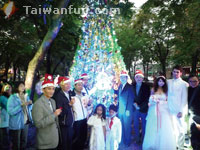
Chen says that a number of events help pull crowds to the area, with May's annual Compass Taichung International Food & Music Festival (organized by this magazine) being the Parkway's "hallmark event". Other events range from a Christmas Festival and community residents' music/dance recital to a military "cosplay" and equipment gathering taking place this summer. On April 7, the Parkway committee will hold a student artists' art contest, too.
New challenges and directions
As Chen, Lo and other resident business owners readily note, the Art Museum Parkway has struggled in the past couple years to attract visitors, who have been drawn to newer developments like the Calligraphy Greenway area. Chen says that various strategies are needed to deal with this "crisis", including promoting the Parkway as a local family-friendly destination with something for all ages and, longer-term, working with the city government to highlight it to international tourists as a representative Taichung destination.
"The mayor says that Taichung is like a graceful woman, like Audrey Hepburn. We are the essence of Taichung city, not a night market," he says. "Here, you can enjoy wonderful buildings and good people. You can talk to artists and find lots of discoveries and surprises."
"We can't copy other streets, but instead need to think about what is special about this place. People need different kinds of places for different functions. I think [the Parkway] is very elegant and beautiful, with lots of tree and old beautiful houses that can be restored," says Debbie Lo, adding that she hopes to see more non-restaurants like design studios, furniture and art stores, and bookstores for art, music and architecture opening. She also notes that she is encouraged by a growing number of little businesses opening on adjacent quiet alleys and streets, such as WuQuan West 2nd Street.
Representative of this new wave of business owners is Miss Chuang and her husband, who three years ago were among the first to open a restaurant on WuQuan West 2nd Street, which offered cheaper and smaller locations than West 3rd and 4th streets. Today, they continue selling curry and other entrees, macarons and cupcakes from their cute Ge Bie Wu eatery.
"We like the clean, comfortable environment here, with no vehicles rushing by outside," Chuang remarks. "After three years, we still enjoy this area."
As the Art Museum Parkway continues to evolve and grow in new directions, there is little doubt that it will remain one of the most appealing, representative symbols of everything that makes Taichung City Taiwan's undisputed "lifestyle capital".
For information about business and events on the Art Museum Parkway, visit the management committee's official website at www.artgarden.tw
|

 April 2013
