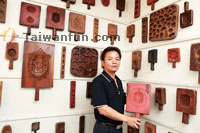
Cheng has collected almost
1,000 molds.
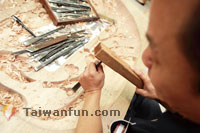
When carving a mold, lines
must be defined so that it's
easier for pastry chefs to
de-mold.。
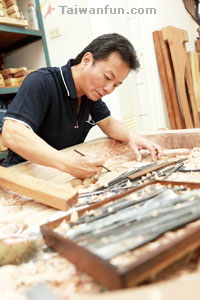
Cheng carves a 120-kilogram
mold ordered by the
Hakka
Culture Committee.
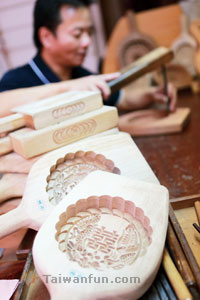
The busiest season every year
for Chinese
bakeries and mold
makers is just before the
lunar
new year because it's a opular
time
for weddings.
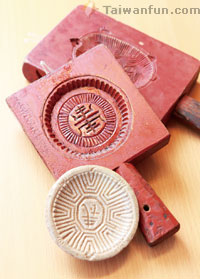
Common words and patterns
on Chinese
pastries include
"shou" (longevity), "fu" (luck)
and a turtle (fortune).
|
From paper to
product: Huang Fang-liang
reveals endless possibilities
at Carton King
Words by Ye Jia-hui
Translated by Angel Pu
Photography by You Jia-huan
An opened bright-red, metal wedding cookie box contains dozens of cut-out
paper molds for Chinese glutinous rice-flour cakes, known as "kueh". "I left
for Kaohsiung to learn carpentry when I was only 18," recalls Cheng Yung-ping
as he shares a life story connected to these old, yellowing paper molds.
"I knew I would not do well at school and I have polio; I had to have a skill in order to make a living," says Chung Yung-ping, one of the best "kueh" mold makers in Taiwan. Although he already understood his physical limitations at a young age, he still used every resource he could find to learn new things.
Walking along a small alley in Taiping district, you can hear a variety of machinery noise, as this neighborhood is known for small family factories. In addition, most of Taiwan's exquisite, professional molds for traditional cakes are made by businesses here, including Cheng's factory.
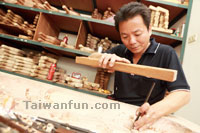 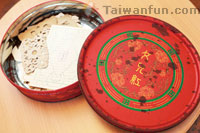
Left: For Cheng, the secret of remaining enthusiastic about molds is that there are always new
things to learn.
Right: Cheng Yung-bin still keeps the paper cut-outs for molds
from his first job.
Leaving home early to study wood carving
"I went to school later than anyone else my age because of polio so, by the time I graduated from Shuang Shi Junior High School, I was already 18," says Cheng of his background. Although he was born in Taichung and all his family members lived in the city, he still decided to head to Kaohsiung to study wood carving from a famous carpenter. Cheng recalls the tough times he encounted while starting out. For beginners, the most important job is sharpening one's knife and there's an old Chinese saying--to do a good job, one must first sharpen one's tools--so the quality of the tools determines the results. Also, as he sharpened knives, he became familiar with their quality and features so that it would be easy for him to make knives by himself in the future.
Cheng has always loved arts and crafts, so he never felt tired or wanted to quit as an apprentice. From the boring task of knife-sharpening and being showering with wood flakes the entire day, to tiresome nighttime work, he was never tempted to give up. In fact, he was so enamoured with this work that after finishing his apprenticeship, he immediately went to Miaoli to become a wood-carving artist. After that, he ended up in Taoyuan making carvings for temples.
Cheng says that for a wood-carving artist the most challenging and satisfying job is remodeling for temples. However, it's not a stable job and one ends up going anywhere there is work, like a nomad. A worker may stay in a place for three months to a couple of years, depending on the scale of the job. Seeking more stability, Cheng decided to return his hometown of Taichung and became a wooden mold maker by chance. After really taking to this job, he created his own business, Yuen Feng Food Mold Shop, when he was only 26.
Creating 'kueh' molds is like creating an artwork
From carving wooden doors, tables, statues and temple decorations to food molds, Cheng was able to master the necessary skills in a very short time, because the techniques each of these requires are actually very similar. Cheng is not only skillful, but also very strict with his work and himself. He considers mold-making to be the same as creating a work of art. Therefore, the lines must be precise and the patterns have to be artistic. In addition to replicating molds, he can also customize these items for clients.
Molds used by Chinese bakeries are for "kueh" glutinous rice-flour cakes as well as other pastries and candies. "Kueh" molds are mostly for "Ang Ku Kueh" (glutinous rice steamed cakes with sweet filling) while cake and pastry molds are mostly purchased by bakeries for cakes and cookies. Candy molds, on the other hand, are rather rare on the market because these sweets are no longer handmade. This means that you'll only find candy molds in some craft stores or craft lovers' personal collections.
Mold-making materials include Formosana michelia, camphor wood and Chinese cypress. Michelia is a hardwood, so it's suitable for molds that need to be banged to de-mold, such as those for "kueh" and some cakes. The softer camphor wood and Chinese cypress are bendable and normally used to make molds for pastries. Some molds can even be made of porcelain. Cheng began collecting culinary molds in 1989 and now owns over 1,000. From examining his collection, you'll discover that, besides wood and porcelain, molds can also be made of stone, brick and metal, with every material having unique features. Although Cheng's work focuses on wooden molds, he's also interested in all varieties of these unique items, which have become a focus of his life.
Being picky achieves excellent results
The procedure for making a mold includes design, sampling, wood shaving and carving. There are specific patterns for molds to be followed. For example, common patterns seen on traditional Chinese wedding cakes include the dragon and phoenix, and male and female mandarin ducks. On the other hand, chicken patterns signify good luck for families; stacks of circles represent luck in making money or having many descendants; shrimp stand for good academic results; and productive carp patterns are used to wish that people will have offspring.
When explaining the meaning behind different patterns, Cheng doesn't forget to fix the positions of the molds he has hanging on the wall, showing a bit of his exacting attention to detail. "Pickiness is what I am," he responds after spending a long time making adjustments so that the photographer will have a good angle. He also says that his meticulous personality causes him to push himself to the limit in whatever he does.
His personality and outstanding works have made him one of the best and best-known mold makers in Taiwan. His big clients often introduce other bakeries to Cheng, giving him many opportunities to try different kinds of patterns, even including the White House, Hello Kitty and Pokemon. Cheng's creations are so delicate and detailed that it's hard to believe they are carved.
Firm base guarantee a bright future
"A great-quality mold can be used forever," says Cheng, adding that he believes mold makers should follow the old ways and honor the beauty of traditional wood carving. "Every generation has a different story, so all we have to do is simply make sure we do our best," he responds when asked about the future of the mold-making industry. It's already quite clear that Cheng will never stop doing what he loves as long as there are still people who love traditional Chinese pastries.
Profile
Yuen Feng Food Mold Shop—Cheng Yung-bin
Address:
22, DaXing 15th St., Taiping Dist., Taichung City
Tel:(04) 2393-5857
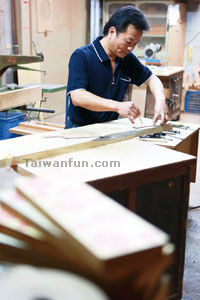 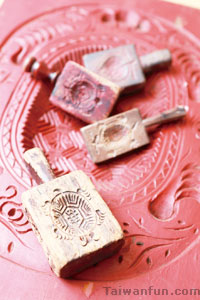
Left: Cheng samples wood materials.
Right: The common patterns for "kueh" cake molds
include the turtles, dragon and phoenix, flowers
and fruit.
|

 January 2013
