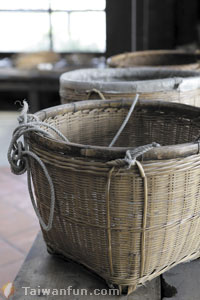
Old baskets provide a glimpse
into the day-to-day lives of
earlier ancestors.
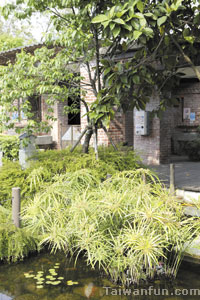
Dongshi Hakka Cultural Park,
almost hidden behind greenery,
is a very important center for
promoting Hakka culture.

The Dong Fong Bicycle Path
route is lush with vegetation,
making it very comfortable for
taking your time and bicycling
there.
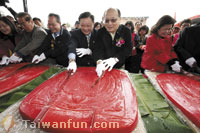
The Xin Din Ban Festival, held
during Lantern Festival every
year, is one of Dongshi's most
important festivals and attracts
many tourists.
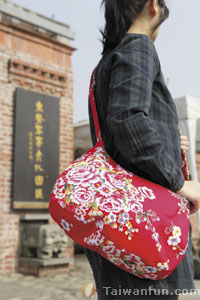
Beautiful Hakka cotton prints
can be very fashionable with
modern designs.
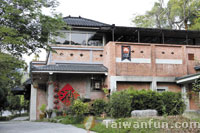
The Sweet Charm Farm Winery
has become a famous Dongshi
destination, where visitors are
welcomed to enjoy some wine
and relax.
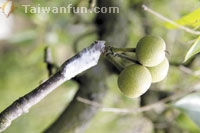
Thanks to the grafting of
Japanese pears, the rough,
sour pears originally grown
here have been transformed
into sweet, juicy fruit.
|
Entering a Hall of History: Stories from the Past and PresentThe Hakka People in Dongshi
Words and photos by Taichung City Government
Translated by Angel Pu
Dongshi is central Taiwan's largest Hakka town and is also famed as the "kingdom of Asian pears". Although it was devastated by the 921 earthquake in 1999, the strong, resolute spirit of its Hakka residents has helped it rebuild and maintain this mountain town's lasting appeal and developed it into an even more mature destination.
Mountain tranquility and fresh, clean air
As you travel along the Dongfeng Bicycle Path ("Dongfeng green passage"), you can view waves of mountains as soft breezes gently caress your face. Close your eyes for a moment and it's possible to sense the tranquil, laid-back atmosphere of this area. Taking the time to explore and gain a deeper understanding of Dongshi's history and culture will leave a strong impression of the town's vitality, which has remained unchanged from its very beginnings.
Dongshi, which marks the starting point for the Central Cross-Island Highway, is the key center for the Hakka people living in central Taiwan and is notable for producing sweet, juicy Asian pears that are top sellers around the country. The town was also devastated during the 921 earthquake but yet survived, and the strong and tough spirit of Hakka people can be sensed everywhere.
Taiwan's sole home of Tabuyin Hakka culture
Flipping back through the chapters of history, Dongshi was originally known as Dongshi Jiao (Dongshi Corner). It was a wilderness area belonging to the Taiwanese Atayal and Pazeh aboriginal tribes, and had few visitors or residents. However, in the 10th year of Emperor Qianlong's reign (1745 A.D.), Guangdong immigrants of the Young, Chang, Xiao and Zhao families came from mainland China to begin farming here. Today, the largest groups of Hakka descendents belong to the Liu, Zhang, Chen, Huang and Lin families. Among these, the Liu group has is the largest population, which explains why there are many small temples dedicated to Liu ancestors even now.
During the Japanese occupation period, Dongshi Jiao became a part of Taichung district, with Dongshi city including Dongshi Street, Shihgang, Shinshe and other nearby areas. In 1945, after the Japanese colonial period ended, Dongshi Street became Dongshi town and the local Japanese government office became the town office.
On Dec. 25, 2010, Taichung city and Taichung county officially merged to become a single special municipality. At this time, Dongshi town was redesignated as Dongshi district and the town office was transformed into a district office.
The early Hakka pioneers in Dongshi hailed from Gaopi town, Dabu county in mainland China's Guangdong province. This is why Dongshi is the only place in Taiwan where Dabuyin Hakka culture has been preserved, and where the most complete traditional Hakka customs are maintained. Dongshi Hakka Cultural Park, located at the end of the Dongfong Bicycle Path, was remodeled out of Dongshi's old train station. Inside the park are displayed cultural items pertaining to Hakka weddings, festivals, clothing and other traditions.
Temple of the Lords of the Three Mountains religious center
When the Hakka ancestors first came to Dongshi, they lived near local indigenous tribes. For safety reasons, they built their villages by rivers and used sharpened bamboo to construct fortified structures like The Temple of the Lords of the Three Mountains, located in the center, and the four "General Huts" (Jiang Liao) set up as guard posts on four corners. The Baoan Temple near Zhong Ke Elementary School in Dongshi is where the residents worship the Lords of the Three Mountains, and it remains the key religious center for Dongshi residents. A "three offerings ceremony" is held every year as an important festival that attracts large numbers of tourists.
'Xin Ding Ban' thanks the gods for blessings and new sons
In early agricultural society, patriarchal thinking prevailed. Families were expected to have baby boys and valued them over girls. Therefore, there was a custom known as "Chu Ding", with "ding" having the connotation of a son. Families who gave birth to baby boys would make a "xin ding ban"--a newborn baby cake made of rice and tinted red--to thank the gods and Earth God for blessing them with a son. After worshiping, the cake would be shared with the villagers. Such customs are still kept in Dongshi. A newborn baby cake competition has been held annually during Lantern Festival for the past century and has become a special local tradition famed around Taiwan. The word "ban" in Hakkanese is in fact the same word as "guai" in Taiwanese. The wooden carved cake mold for the turtle impression on these red cakes is another feature that draws attention
Qiao Sheng Xian Shi Temple and Jiang-Liao Lane
Dongshi has another feature that is famous around Taiwan. The Qiao Sheng Xian Shi Temple, where wood workers' patron saint Lu Ban is worshipped, is the biggest Lu Ban temple in Taiwan. It is rare to find any temple exclusively dedicated to Lu Ban in other places and the Qiao Sheng Xian Shi Temple has quite a long history. It was built in the 40th year of Qianlong Emperor's reign (1775 A.D.), making it one of the oldest temples in Dongshi.
Moreover, Jiang-Liao Lane in Dongshi is said to be the first spot that Han Chinese people started farming cultivation. Residents who first gathered here mainly consisted of people who made a living in the lumber business. Accordingly, the Qiao Sheng Xian Shi Temple was originally established by lumber workers to worship their patron deity.
Blessings from the Carp Earth God
There is another story that pertains to Dongshi's "feng shui". It is said that at the end of the Qianlong Emperor's reign, the area near the present-day Jiang-Liao Lane and Li-Yu Lane was a network of busy city streets. The ramps built beside the streets were found to resemble a big carp ("li yu") after construction due to the wavy landforms, especially as it was found that the arrranged stonework resembled the scales of a carp, which caused much amazement.
Some residents thus came up with the idea of worshiping the Earth God at the carp's "head". A temple was then built and has played an important role in locals' religious practices ever since. Although the nearby Dajia River has often overflowed, causing floods that have destroyed many houses, the neighborhood around the Li Yu Earth God Temple has been unaffected. To show their gratitude, residents renamed the structure Yong An Temple and upgraded it to a larger temple that now has a 200-year-old history.
Stone walls become a winery
The Sweet Charm Farm Winery is another must-see attraction in Dongshi. When you type key words pertaining to a "private winery" on local web search engines, you will come across results for this winery, located on DongLan Road of Provincial Highway No. 3 in a red-brick house decorated with lanterns hanging under the roof.
From a historical point of view, the Sweet Charm Farm Winery embodies a meaningful story. According to the local elders, stone walls were built in the past alongside the river for protection where ShiCheng Street is currently located. In the town's early years, Atayal aboriginal tribesmen often attacked and women and the elderly who had no time to run away would hide behind these walls and wait until the fighting was over. It is said those who hid behind the walls would immediately light incense and place it along the walls to give the impression that there were a lot of people inside and scare the attackers away. However, the original walls that saved many people's lives no longer exist and the ones we see today by the highway were built later.
This area has always been the main location for producing wide-brimmed rain hats made of bamboo and in the past almost every family in this village made a living this way, selling tens of thousands of hats every year around the nation. Nowadays, fewer and fewer residents have these skills, even as the remarkable history behind the stone walls has gradually faded. However, thanks to the unyielding Hakka character, this area is flourishing once again, thanks to the private winery.
The story of pears unveiled at the Pear Cultural Museum
The Pear Cultural Museum is the first thing you'll see in Chung Ke Li town, about a half-hour's drive from Dongshi town. The simple whitewashed building comes into view among mountain slopes filled with pear tree orchards as you gradually climb up the road. One then sees a balcony where visitors can sit outdoor and appreciate the wonderful scenery.
Dongshi is famous for its fresh, sweet and juicy Asian pears. However, the pears produced here originally were so rough and sour that despite very fertile orchards they sold badly. In 1973, retired elementary school teacher Chang Rung-seng led a team introducing techniques that allowed local pear trees to grow Japanese pears via grafting. The selling price of the pears grown in Dongshi then doubled several times. This impressive sharing of know-how with local farmers transformed Dongshi's pears into top-sellers in Taiwan.
The Pear Cultural Museum has an "organic building" style that uses local stones, red bricks, whitewashed walls, metal and wood. It is elegant and simple without being extravagant in the use of various materials, thus embodying the Hakka people's thrifty image.
Why do Hakka people believe in the Lords of the
Three Mountains?
How did the Lords of the Three Mountains originally become the focus of Hakka people's religious worship? Opinions vary widely but one theory says that in 819 A.D. the scholar Han Yu was demoted to governor of Chao Zhou. At that time there was heavy rain in Chao Zhou, so Han Yu prayed to the lords of Du Mountain, Ming Mountain and Jin Mountain for blessings. Subsequently, the weather that year was so favorable that the Lords of the Three Mountains became the local people's main gods. The majority of residents in the Chao Zhou area are Hakka and when these immigrants arrived in Taiwan they brought their original gods with them. At first, most of the Hakka people lived near the mountains, which helped deepen their belief in the Lords of the Three Mountains even further. Thus, for generation after generation, the Lords of the Three Mountains have become the Hakka people's primary dieties.
|

 April 2011
