
Taichung county has rich
natural resources and
landscapes.
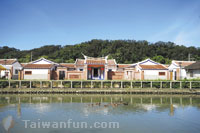
The Hakka Culture Museum in
Shigang is a precious cultural
heritage site, preserving the
beauty of gardening.
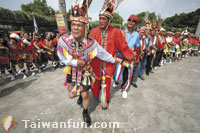
Indigneous culture is a part of
Taichung county's valuable
heritage
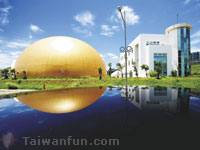
Central Taiwan Science Park is
driving economical development
forward. (photo by Hou Jia-
zhang)
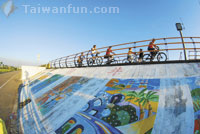
The bikeway next to Lishui Fishing Por in Longjing is an ideal option for those looking for some exercise.
|
A look at Taichung's mountains, coastal areas, outlying districts and developing villages and towns
Text and photos by Taichung County Government and Iv Ke-xi
Translated by Angel Pu
The merger of Taichung city and county on Dec. 25 marked the beginning of the Taichung Special Municipality. This means that not only has the city's territory and population been greatly enlarged but, more importantly, that the new metropolis now includes the former Taichung county's mountains, coastline and outlying districts, which are all distinctive in their own ways. Combining all this with the metropolitan downtown areas of what used to be Taichung city means that one plus one truly equals more than two.
In 1885, during the Qing dynasty, Taiwan officially became a Chinese province and, at first, "Taiwan County" and the provincial capital were located in central Taiwan. During the subsequent Japanese colonial period, in 1896, Taichung State was created, which is how Taichung first got its name. Modern-day, pre-merger Taichung City had eight city districts with a total area of 163.4 square kilometers and a population of 1,081,487 (according to statistics up to October, 2010).
A livable city in the Heart of Taiwan
As a century-old city, Taichung has always been the central Taiwan's main city economically, politically and culturally. Its citizens have gained a reputation for being friendly and tolerant, and the weather is renowned for being unusually sunny and beautiful. In recent years, the city government has implemented a variety of policies and initiatives promoting cultural and economic development and globalization, including a wide variety of cultural promotions, art exhibitions and performances. The Central Taiwan Science Park, Taichung Precision Machinery Technological Park and Taichung Industrial Park have all stimulated economic development and the city's service industry continues to thrive. International restaurants, banking, department stores and hotels are continuously setting up in Taichung, making it a leading choice for new residents. Notably, Taichung city is also Taiwan's second-largest home for foreigners.
In the meantime, Taichung county boasts a vast, geographically diverse area that includes coastline, plains and mountains, with each of these different regions developing different natural resources. The merger with Taichung city means that Taichung's total land area will exceed 220,000 hectares, with a natural environmental richness and diversity offering tremendous tourism industry development potential.
Respecting distinctive features of different areas
In planning a new vision for the Taichung Special Municipality, Mayor Jason Hu is promoting the "respect for distinctive features in different areas", tailor-making a bright, attractive future for each individual district. Prior to the merger, Taichung county had an area of about 2,052 square kilometers, and a population of around 1,564,994 (statistics up to October, 2010). The county's 21 townships and cities have now relabeled as districts post-merger, giving the new Taichung Special Municipality a total of 29 districts and 625 villages, with a population of over 2.64 million. This offers even greater anticipation for Taichung's future, as the potential development of each district is considered.
For example, Fengyuan district (ex-city) boasts a great amount of political, business, cultural and educational resources, was the county government seat, and is a transportation hub, where agricultural and wholesale products from surrounding townships are gathered and consolidated. In recent years, it has also been home to companies developing and manufacturing precision industrial machinery and tools--bringing together a wide range of downstream industries and contractors--and IC chips. Local traditional industries have already moved upscale into high-technology fields. Wufeng, formerly home to the Taiwan Provincial Assembly, also has a rich cultural heritage, and many spots of scenic and historic interest. Among these, the Grade 2 historic site, the Lin Family Mansion and Garden is famous for its beautiful garden landscaping.
Home to indigenous tribes, the mountainous Heping district area offers rolling mountains and forests and the Dajia River, which cuts through this territory. The government is now assisting local farmers in growing high-value subtropical fruits and vegetables, including Chinese pears, peaches and apples, making this area very suitable for developing agricultural tourism.
Beautiful mountain scenery ideal for developing agricultural tourism
Following the merger, all townships and villages are poised to utilize opportunities for a better future. Most residents in the Shigang and Dongshi districts near the mountains are Hakka. To preserve Hakka culture, the locals are planning to build Hakka culture and tourism centers, traditional Hakka round earth buildings, and a driftwood park.
Houli district is not only a global home for musical instrument-making, but also produces an abundance of flowers. In recent years, local residents have actively worked to develop a saxophone museum and musical instrument festivals. In the future, they will combine flowers, instruments and old railways to create considerable tourism opportunities. Shengang district connects with the Dadu Mountain Technology Corridor, helping to develop the Fengzhou Technology Park. Tanzi district has an export processing zone to attract investment and provide job opportunities. Daya district, Taiwan's original location for cultivating wheat with about 70 hectares of wheat currently grown, has earned itself the name "Taiwan's Home of Wheat". Last but not least, Xinshe is known for its seas of flowers and mushrooms. All these attributes mean that there are plenty of economic benefits to be gained with the full development of agricultural tourism.
Good natural resources connected to a tourism artery
Taichung's coastal districts are Shalu, Da-an, Qingshui, Wuqi, and Dajia. Shalu is able to rely on Taichung Airport to develop surrounding industrial and commercial corridors, while Da-an is located in the western coastal region and has eight kilometers of coastline. Quingshui is home to the precious Gaomei Wetlands and both it and Da-an possess natural sources for developing marine ecology water parks.
Wuqi is famous for its tourist fish market and the Taichung Harbor Coastal Recreation Area, drawing many food-lovers from all over Taiwan every weekend. Now this area also offers "Blue Highway" yacht rides to tourists. Just to the north, Dajia district is famous for Jenn Lann Temple's annual Mazu festival and pilgrimage, making it a renowned local and international hub for cultural and religious activities.
Longjing and Dadu districts are located at the intersection of rail and highway networks and the mountain and coastal areas, making transportation here very convenient. Famous products here are watermelons, sweet potatoes and rice. There are also many kinds of wildlife found in riverbeds and inter-tidal zones. Birds are attracted to make rest stops here, so it's designated as a bird sanctuary--a total area of 2,669.73 hectares. Waipu district's soil is ideal for agriculture and rice, flowers and grapes are its main cash crops. When these are growing, the land becomes emerald green, dotted with orderly-looking farmhouses and home to rich farming scenes.
Booming 'Tun' districts: Prospering industries and commerce
Taichung county's so-called "Tun districts" are Wuri, Taiping and Dali. These places have developed so quickly that their total population reached 438,900 (up to October, 2010). Wuri is located in the southern part of the former Taichung county, next to Dali and Dadu. Taiwan Beer is produced at the local Wuri Brewery and has won gold medals. In addition, following completion of the Taiwan High Speed Rail station there, Wuri has become a transportation hub, and local residents are eager to see five-star resort hotels built here. In the future, Wuri can follow the precedent of the Taoyuan Aerotropolis plan and become Taichung's High Speed Rail City. As for Taiping, its manufacturing industry is also very well-developed with main products being machinery, aluminum products and plastic products, helping making this a up-and-coming central Taiwan urban center.
In the past, Dali was one of the most prosperous places in Taiwan, so there is a rich, valuable heritage here. In the future, Dali, Taiping and East districts will form an industrial triangle, concentrating and further strengthening production and marketing synergies generated by developing industries while at the same time boosting employment opportunities.
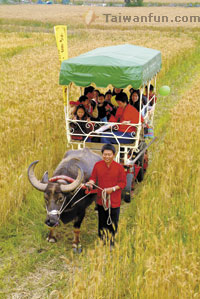 
Left: Riding on an ox-cart in Daya, the "Home of Wheat, is an unforgettable experience
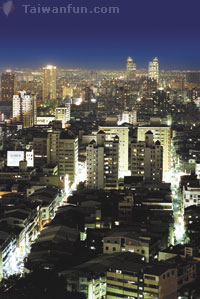
Right: A bustling scene from Taichung city's metropolitan area. (photo by Deng Zun-ren)
|

 January 2011
