
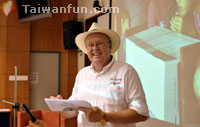
Mike Lockett sharing the stage
with Jason Hu, mayor of
Taichung - one of the largest
cities in Taiwan.


Book signing in a Taipei Library.
|
Adventures of a Normal Storyteller in Asia
Words and photos by Mike Lockett
Translated by Naomi Lai
"The Museletter," Volume 21, No. 3, September, 2009 - Magazine for LANES - League for the Advancement of New England Storytelling
"Don't worry about me being able to follow you," I was told by the Taiwanese translator. He spoke with confidence, and I believed him. "I was once the translator for the President of Taiwan," he said smiling.
I looked at the young woman who was supposed to translate for my program. Her head nodded as she backed off the stage, giving way to the wishes of this man of power who charmed the audience so thoroughly. He not only had been a translator for the President of Taiwan; he also had served as the Minister of Foreign Affairs for Taiwan in the United States. I stood on the stage being served by Jason Hu, the Mayor of Taichung, one of the largest cities in Taiwan. He is one of the most popular politicians in eastern Asia. "Let's tell them a story!" he said. So, I used his services as I would any translator, and put him through his paces.
I told the story in English, just as I would tell it to any audience back in the United States. However, I was in the middle of Taiwan, speaking to an audience that understood only Chinese or very limited English. Mayor Hu translated without hesitation. I admit that the laughter made me suspect that he was adding details to the story that had not come out of my mouth. He matched my tones, and the volume of my voice, and physically copied every gesture. During the telling of the story, we two were one. It was like performing a choreographed dance, or playing a well rehearsed musical duet. But we had never rehearsed together. I laughed and played – and I confess that I sped up my delivery, testing the Mayor's ability to follow me. He anticipated my every word and movement, as together we created a "once upon a time" moment.
The audience clapped and laughed out loud. But this was different. Young audiences often laugh because of the story itself. Older audiences enjoy my both the story and my unusual delivery. This time, the audience laughter and applause sounded louder than ever before. I believe that it was because of the translator's performance, and because the audience was watching a storyteller from America and a loved and respected politician sharing the stage to tell them a story.
The program was one of many in my tour of Asia. I gave programs in South Korea, Taiwan, Shanghai and Hong Kong. This is the fifth time I have traveled to Asia to perform at schools, give workshops for teachers and librarians, and work with publishers to develop storytelling CDs and books. Yet this program at the National Chung Hsing University will be one I will always remember. It started with a storytelling contest. Children and adults took the stage to tell their favorite stories from a number of multicultural books produced by Chung Tang, the Taiwanese publishing company that sponsored the contest and performance. A few contestants read from the books. Braver souls told the stories in their own words, some in Chinese, and some in English.
Special guest, Mayor Hu, was also an observer at this "storytelling contest." He was called to the stage to be introduced and to bring greetings at the event. An astute politician, he stayed on the stage when the main entertainment (yours truly) was introduced. When he heard the phrase,"... and he is called 'The Normal Storyteller', the jovial Mayor could not remain silent. "Are you really Normal?... Good. I think you and I will get along." Somehow, we ended up telling a story together.
"Do you mind if I add to the story now?" the Mayor asked as we finished the story together. How could I possibly turn him down? Our story, 'Why Cats Wash after They Eat,' ended with the mouse getting away.
The Mayor began his story extension, "That same cat went back to the mouse hole to catch the mouse again. This time, he found the mouse was gone. It was a mouse from Taichung, in Taiwan. The people and creatures of Taiwan learn from stories and don't make the same mistakes twice. This is why we bring people here like Dr. Lockett. They tell the stories, and we learn from them."
The honorable Mayor went on to talk in English for my benefit, translating his words into Chinese for the audience. His words were brief, but meaningful. He spoke about Taiwanese families spending time with their children and encouraged children to appreciate their parents. He praised them for coming out on a weekend to share stories and literacy.
I gave my program and received applause, smiles, and flowers for my efforts. This was followed by photos with audience members and autographing of books and CDs. Storytellers are greeted with so much more love and adoration than we are used to receiving at home. I wondered why this was so. What is it that makes stories so popular in Taiwan, and in other Asian countries? With all the wonderful storytellers in Asia, why bring someone to tell stories in English to audiences that primarily speak Chinese?
Oscar Chung, columnist for the Taiwan Journal, wrote an article in the Taiwan Review called 'Learning to Communicate.' (December 1, 2000). He wrote of how the teaching of English was compulsory education in Taiwan, yet after three years, people remained locked in a state of war with the English language. He drew attention to deficiencies in the teaching of English in the Taiwanese educational system. He implied that traditional "rote" learning methods of teaching English were not effective.
The traditional method for teaching English in Taiwan and many other parts of Asia places much emphasis on the development of reading ability and vocabulary building. Memorization, imitation, and repetitive practice are preferred learning strategies in many schools. Because of the need to pass written tests, accuracy is emphasized more than fluency. Students learn to read and write English, but often have trouble speaking it. Many individuals also have problems comprehending spoken English. Chung called attention to an expert who suggested using storytelling as a way to teach English.
Prominent Taiwanese educator Jerome Su, was interviewed in Chung's article. Su, the founder of Bookmans, B.K. Nortons, and a number of other book stores in Taiwan, teaches translation skills to university students. Su recognized that storytelling is one of the best ways to introduce listeners to good books. Storytelling also enables listeners to better understand and speak conversational English. Students who are taught in the traditional manner have more difficulty speaking and translating English than individuals who also have experienced the teaching of English through storytelling.
There is a wealth of research that supports using storytelling to improve reading comprehension, vocabulary, and reading fluency. The book, Story Proof: The Science Behind the Startling Power of Storytelling (Kendell Haven, 2007), discusses the benefits that storytelling brings to learners. It is particularly useful for helping students improve both their ability to understand conversational English, and their speaking skills. Storytelling is a help for students learning English as a foreign Language (EFL). Jerome Su invited me to Taiwan to help teachers learn to use storytelling as a means of teaching English. And that's how I ended up on the stage telling stories with the Mayor of Taichung. Earlier that same day, I gave a storytelling workshop for EFL teachers at the National Taiwan Museum of Fine Arts.
Storytelling is not the only factor in the improvement of education in Taiwan. Another is the wide circulation of books in English. Publishers are paying licensing fees to bring American, Canadian, English and Australian books and publications into the country for use by schools and parents. Part of my work in Taiwan and South Korea consisted of making audio recordings in English to accompany the books.
One of the largest factors influencing student success is the extra time that most students spend learning in cram schools. It is estimated that 90% of Taiwan's students attend cram school at one time or another. Students must pass high stakes tests in Chinese and English in order to enter high school. Similar tests are taken after graduation from high school to determine entry into college. The pressure of passing the tests is so intense that parents pay to enter their children in cram schools at a very early age. Students go to cram school for one to four hours after school on weekdays, and longer on Saturdays. Many students attend cram school during summer vacation, and even on holidays. My work in Taiwan and Shanghai included teaching cram school teachers how to tell stories. In South Korea, I worked with parents and children.
Storytellers who visit Asia for work need to rest before arriving there. Anxious audiences are eager for quality stories in English. Plan to meet happy, loveable people who will become friends in a very short time, like Mayor Hu. Look forward to foods unlike anything you have eaten before. Be prepared for challenges. There will be long hours, unfamiliar bathroom facilities, tons of travel, learning to work with interpreters, and much more. Is it worth it? I already have airline tickets for book releases and storytelling events in Asia next January.
Mike Lockett is a teller of traditional tales in a non-traditional manner. He lives in Normal, Illinois and is often called "The Normal Storyteller." Mike has won eight national awards for his audio products. He is the author of the Basics of Storytelling (2008) and four children's books (2009). mike@mikelockett.com
|

 July 2010
