|
HOME  TAICHUNG ARTICLES TAICHUNG ARTICLES
COMPASS
MAGAZINE  January 2010 January 2010


|
A Tour of Taichung Temples
By Lishea Zheng Translated by Naomi Lai
Photos by Lishea Zheng and Zheng Hong-ru
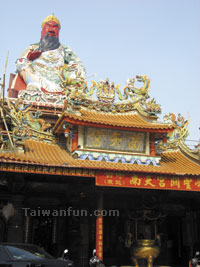
Taichung has plenty of large and small temples that are well worth a visit, standing out as symbols and centers for local religious culture and worship. These include various Tu Di Gong (earth god) temples, protecting local residents; the Temple of Guan Yu (aka Guan Gong), symbolizing justice and brotherhood; the Wenchang Temple, where exam takers can pray for good scores; as well as various historic temples dedicated to different gods and decorated in the most elaborate ways.
The density of temples in Taichung is surprisingly high, especially when it comes to city temples featuring unique architectural styles, such as the Songzhu Temple on Songzhu Road. This temple was built during Daoguang Period of the Qing Dynasty to worship the goddess of mercy Guanyin. Other temples include the Temple of Guan Yu on LianWu Road; the religious center of Shuijuetou; the Yong An Temple, which worships Wang Ye of the Zhu, Lee and Chi families; the Chiao Sheng Shian Shih Temple which worships Lu Ban (god of carpenters), He Yei (god of bricklayers) and Lu Gong (god of forges and coal pits); the Wenchang Temples built in Beitun and Nantun districts during the Daoguang Period; the Taichung Confucius Temple; the Temple of God of Fortune; the Chenghuang Temple and many others. This means that visitors and residents have more than enough options for visiting temples and experiencing the traditional spiritual world of Taichung.
 
|
|

|
Wanchuan Temple
212, ChengGong Rd; (04) 2224-5964
This temple worships the goddess of heaven, Matsu. Built during Yongzheng's rule in 1723, its architecture follows the Min Nan Style with its main entrance facing the busy ChengGong Road. Different from most temples, its incense holder is brightly colored in red and green. Stone lions with circular decorations carved on their backs and white stone dragon pillars carved with delicate details have been a part of the temple since it was first built. There is also an ancient clock. preserved from 1859 (Xiangfeng period). |
|
Wanhe Temple
51, WanHe Rd, Sec 1; (04)2389-3285
Named WanhHe Temple after its completion in 1726, this temple's main hall worships the "Main Matsu" and the "Second Matsu" from Jiaqing period. It is constructed in the three-hall style, with a main hall, a back hall and two smaller chambers to the left and the right (counted as one hall). The most interesting activity held by the temple is the "Surname Show" (Zi Xing Xi). This tradition started during the annual patrols and pilgrimages by the goddesses in the third month of the lunar calendar in 1824 (Daoguang ruling period). When the "Second Matsu" of Wanhe Temple was brought home, her carriage refused to cross the entrance. Following the her wishes, 11 families bearing different family names--with exception of the Chang family--each staged a show worshipping the gods before the goddess was willing to enter the temple. The following year, on March 20 of the lunar calendar, the temple inaugurated a 17-day-long "Surname Show" celebration with a Zhangzhou Play on the 21st, Guangdong Play on the 22nd, Quanzhou Play on the 24th, Tingzhou Play on the 25th and the actual "Zi Xing Xi" by 11 families starting from the 26th date. There is a record of 18 shows being performed on the same day. Following the end of the Japanese colonial period, the number of shows were increased to include 28 families, with performance after performance for over a month. At the same time, the "Second Matsu" also has a parade returning her to her home in Da Yu Chi, Xitun District, every three years. The old wooden incense holder from 1848 in the temple is quite a sight, and there is also a library, cultural center and Jute Art Culture Museum in the Wanhe Cultural Building, constructed in 1993 for the purpose of promoting local culture.
 
|
|


|
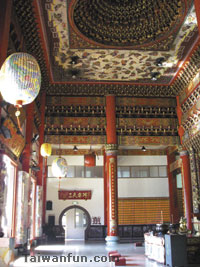
Lecheng Temple
48, HanXi St.; (04)2211-1928
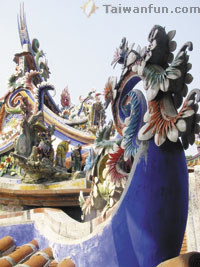
This Class 3 National Historic Site was built in 1753 (Qianlong's rule) with elaborate and extravagant decorations. The temple mainly worships the goddess of heaven Matsu. In the main hall is a delicately-carved wooden worship table from 1827 (Daoguang period). Within this temple there is also the Hall of the Lord Yue Lao, which many worshipers visit to seek blessing for their relationships. Due to the number of worshipers, Lord Yue Lao has been moved to the larger Tiger Hall on the second floor. The second-floor corridor is built close to the ridge of the roof, allowing visitors to admire the elaborate dragon and phoenix decorations. Since 1823 (Daoguang period), there has been a patrol and pilgrimage parade around 18 villages of Datun on March 1 of the lunar calendar. In 2008, Taichung City designated this temple as part of the city's folk cultural heritage.
|
|
 |
Yuanpao Temple
109, MeiChuan W Rd, Sec 3; (04)2205-2123
In the past, when medical practices were not as developed, Taiwan was once known as the "land of malaria". Thus, the people turned to their gods for life insurance and brought the Bao Sheng Da Di (protecting god of life) to Taichung from the Xin Tian Temple in Zhangshou, Fujian province. Seventeen blessed villages around the region then pooled their resources to build this temple. When the construction was finished in 1791, it was named the Yuanpao Temple. However, it is more commonly known as Da Dao Temple. There is a six-day patrol and pilgrimage parade that starts here on March 10 of the lunar calendar every year.
 
|
|
 |
Paochueh Temple
140, JianXing Rd; (04) 2233-5179
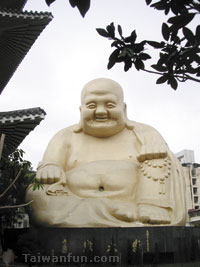
Built in 1927, during the Japanese Showa Period, this old towering temple mainly worships the Gautama Buddha, the Bhaisajyaguru and the Amitabha. There is the Friendly Bell Tower, Seven Treasure Tower, and a Taichung landmark--the seven-story-tall smiling Maitreya buddha on the temple. At the end of World War II, many Japanese were buried here and each year their Japanese descendants and surviving friends visit to pray and honor the dead.
|
|

