|
The Taichung City-County Merger Project: Renaming the Art Museum Parkway 'Cao Wu Dao'
Text provided by Taichung Industrial Association (idipc)
Translated by Ann Lee
In Chinese, "Cao Wu Dao" literally describes a pathway that enriches the mind and soul; as one sees the greenery surrounding them, they will see the way and understand the meaning of the universe and its connection to our environment.
The project and planning to rename the Art Museum Parkway as "Cao Wu Dao" is being led by Mayor Jason Hu himself. This new idea was approved and is supported by the Tourism Bureau, Ministry of Transportation and Communications, in a project called "The Competitive International Tourism Destination & Demonstration Project". In this particular case, only five city landmarks were selected and received financial support from the central and local governments, including the reconstruction of the Art Museum Parkway, or "Cao Wu Dao", into an all-new international sightseeing destination within the next two years.
The Taichung City Government has stated that, apart from the financial assistance provided to redevelop this popular tourist sight, the government will also make an effort to bring in an international team from tourist spots that include the Omotesando, Roppongi Hills in Japan, the Shiodome township renovation project, the Meguro Art Boulevard and Les Champs-Elysees in Paris. The city government plans to gather know-how from other countries which have rebuilt their trademark destinations, and incorporate this knowledge into this brand-new Taichung project, which has the goal of making "Cao Wu Dao" Asia's biggest, most creative cultural stage for international-scale performances.
Specifically, "Cao Wu Dao" stretches from the National Museum of Natural Science to the National Taiwan Museum of Fine Arts' Art Museum Parkway and continues on to end in the Liouchuan Street area.
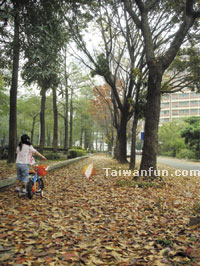
This parkway is also known as Taichung City's "jade necklace" due to the fact that the area is surrounded by shade trees, to the point that one could say that a distinct characteristic of this popular area is the amount of fresh oxygen that can be enjoyed. Mayor Hu once said that the name "Art Museum Parkway" sounded a bit too serious, and suggested a more vivid name, similar to Hong Kong's Lan Kwai Fong or Singapore's China Town, "Niou Che Shuei". The Art Museum Parkway is an ideal location that allows people to enjoy a pleasant time, to relax, listen to music or enjoy a glass of wine. The mayor also notes that every time he has an overseas visitor, he brings them to the Art Museum Parkway because it is truly a breathtakingly beautiful spot within the city.
A cultural face and economic body
Mayor Hu has suggested that a name like "Art Museum Parkway" could limit its potential to serve other purposes, noting that with the simple gesture of a name change, people will understand that this place is not only capable of hosting cultural and artistic events. Those who enjoy visiting the parkway for a stroll are not only limited to arts and culture lovers. Thus, development of the Art Museum Parkway should work towards creating a venue able to host events of different aspects and diversity.
Throughout this period, the government has inquired among local residents, tourists and the media about ideas for a new parkway name. Some said that because it took much effort to build the Art Museum Parkway's good reputation for beauty and because it's a great name, there was no need to change it. Nevertheless, a decision has been made to change the parkway name, in addition to the often confusing WuQuan 3rd, WuQuan West 4th and WuQuan West 3rd street names. An idea has been floated to rename these streets, between MeiCun and WuQuan roads, to MeiShu (Art) 1st, 2nd, 3rd and 4th streets.
In addition, there is a large awareness of the impending Taichung City-Taichung County merger, which has led Mayor Hu to broad insights into the future a "big Taichung city" which, he believes, will definitely be an international metropolis with a broader cultural face and efficient economic body.
Hu also points out that when the city-county merger officially takes place, the combined city population will be close to 2.36 million, which will also boost Taichung's ranking among city planning projects throughout the greater Asian area. Furthermore, the merger will make the expanded Taichung city home to several major international/commercial ports including an airport, a designated High Speed Rail administrative area, dual railroad routes running through mountains and along the coast, four national highways and about 18 institutions of higher education. All this offers Taichung a very competitive edge as one of Asia's large metropolises and serves as a great hub for interactions and exchanges between Taiwan and China.
A high-quality lifestyle in Taichung
The area that stretches from the National Museum of Natural Science to WuQuan 8th Street is, according to tourists and the media, the one tourist destination that best represent Taichung's lifestyle image. Taichung has always boasted a "LOHAS" lifestyle that people adore. Japanese broadcasters NHK and TV Asahi, reporting during the 2007 Asia Cup Baseball tournament; mainland Chinese TV station CCTV; hotelier Stanley Yen'; CTS Channel General Manager Hsu Lu; and well-known Hong Kong chefs Danny Yeh and Liang Wen Tao have all expressed appreciation for the diverse dining culture and the rich metropolitan lifestyle that Taichung offers.
The way a metropolis functions and its image do not only depend on public architecture, but also on the marketing of that city image and quality of life. These things can be viewed as a city's "brand" and work is needed to develop that brand and, more importantly, manage it. Taichung's Art Museum Parkway is known to everyone as a place that not only features innovative architecture, but also has a selection of restaurants offering exotic foreign cuisine and ambiance. This brand value, so to speak, includes the special characteristics of the parkway's products and its unique location adjacent to the National Taiwan Museum of Fine Arts. Thus, the entire redevelopment project will focus on the management of human resources, the functioning and building of its community, and services that show care and concern for humanistic culture.
It is hoped that the Taichung City-County merger in the near future will see more business opportunities and closer business interactions between various communities, as the government provides a more friendly, comfortable "product" to local residents and tourists alike. In this way, we can encourage more out-of-towners to relocate to and reside in Taichung, creating unlimited brand value for Taichung's Art Museum Parkway.
Four 'Golden Brick' areas help create a bright future for Art Museum Parkway
The city-county merger project will not only see the consolidation of central Taiwan jurisdictions but, in the near future, will also be targeted at combining the so-called "Four Golden Brick Areas"--referring to southern China, including Fujian province, Taiwan, Hong Kong and Guangdong province. The entire population of this region exceeds 100 million people, and its Gross Domestic Product (GDP) exceeds US$1.5 trillion. In the near future, it will take less than two hours to fly from Taichung to any of these "Golden Brick Areas". Cooperation between these areas will mean that local citizens will be able to truly enjoy improved lifestyles and the creating of an internationally competitive edge.
The Taichung City-County merger project aims to broaden the city's international perspectives and horizons, by rebuilding the greater Taichung area as a "metropolis with top competitive edge", and through the magnetic effect of these efforts, attract businesses to settle in Taichung and boost economic growth and activity. Taichung city shall thus act as a "locomotive", pulling all central Taiwan cities and counties into a brighter future.
Taichung "Cao Wu Dao" Project
Project completion date: By 2011, the area between National Museum of Natural Science and GongZheng Road will be completed, and the stretch between GongZheng Road and the Liouchuan riverside will be completed by 2013.
The Science & Art Hill: Stretches from National Museum of Natural Science to the cross-over bridge on Taichung Harbor Road.
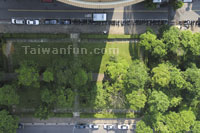
The Art & Culture District: On a grassy plateau, Yong Chuan (waterfall) Square.
The Carbon-Free Boulevard: A Sculpture Forest and Mirror Lake Garden.
The Soho District: Bicycle paths and a weekend art gallery.
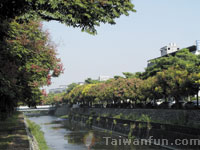
The Romantic Riverside: Displaying public art and a venue showcasing the city's wonderful delicacies.
|

 August 2009
