| 


|
---By
Tai Chin-Chi Translated by Mei Lee Photos by
Shining Group
Anyone regularly following Taiwan's
media lately has probably noticed that there
has been plenty of focus on the grand abodes
of local celebrities and political figures.
A good example is coverage of Taiwan President
Chen Shui-Bien's son-in-law Chao Chien-Ming's
visit to Debao, a luxury villa constructed by
Taiwan's famous industrial construction company,
and famous singer Chang Hui-Mei's purchase of
the "Star of XinYi," located in the
expensive area of XinYi, Taipei, also made headlines.
These magnificent residences are part of this
new public fascination.
Following in the footsteps of
Taipei, grand villas and other residences have
become very popular in Taichung's real estate
market. In September, 2006, land in Taichung
City Government's Seventh Redevelopment Zonelitan
center exceeded NT$1 million per ping (36 square
feet) and reached NT$1,285,000. This was a landmark
towards establishing the new luxury real estate
trend. Looking at this sector of Taichung's
luxury residences more closely, several characteristics
begin to stand out as follows.
1. Excellent, exclusive locations
with large-scale public facilities close by
as an added attraction. In the earlier days
of city development, Taichung's two museums--the
National Museum of Natural Science and the National
Taiwan Museum of Fine Arts--were connected by
the green belt of JingGuo Parkway. Development
in the surrounding areas, such as People's Square,
included the Long Bon Building, An-Lan Home
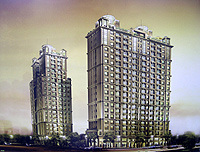
and, later, the "Emperor Twin Tower"
and other high-end buildings, resulting in a
high concentration of luxury residences. Following
the real estate boom of the past couple years,
however, Taichung's business center has gradually
moved to Xitun and Nantun districts. As the
city's new hub for political, commercial and
economical facilities, many large-scale department
stores have also been built or are planned for
these areas.
As a result, the Seventh Redevelopment Zone
has become a competitive "battleground"
for newly-built luxury mansions and apartments.
Within this new 107-hectare metropolitan special
area original landscape designs and public construction
projects have combined to create plenty of open
space and the sites for a planned new city hall
and metropolitan opera house. These new developments
will also contribute to the attractiveness of
this new cluster of grand residences.
2.Luxury residences are often
designed and planned by famous architects or
landscape planners. The average foundation of
every new luxury development in this area measures
400 to 600 pings, with other large-scale mansions
such as Twin Parks, Shining Groups and Regency
Gardens occupy over 1,000 pings. Seventy percent
of these projects have space for only 50 households,
mainly for purposes of superior space control
and management of these high-end apartments.
It is also easier to meet construction quality
standards. The floor area for each residence
ranges from 60 to a maximum of 165 pings, with
an average of 80 to 100 pings for a four bedroom
residence. Two notable exceptions are the Aman
Bobo development, with a total of 172 apartments,
and the "City Symphony" project, with
278 residences, both with smaller-scale floor
plans of 18 to 40 pings.
As for parking space, very few
mechanical parking elevators--popular in so
many local apartments--are found here. Ground-floor
parking spaces are instead offered for sale
with a 2.57:1 average ratio for parking spaces
per household. This is the biggest difference
from regular residential buildings. A lower
density of apartments, residences larger than
80 pings, and double the normal number of parking
spaces available for tennants are all new standards
set by these new Taichung's luxury homes.
3. With the progress of technology, newly-developed
methods and material are used in construction.
Construction of these new high-end residences
abandons traditional reinforced concrete (R.C.)
structures and instead opts for steel reenforced
structures (SRC) to overcome earthquakes worries.
All kinds of anti-earthquake techniques have
been utilized to ensure the sturdiness of buildings.
Other materials include environmentally-friendly,
anti-UV, low-E coatings that have reflective
insulation that allows energy saving, and low-radiation
glass, which is an advanced, quality construction
material. Though expensive, these materials
are used to distinguish the structure's value
from other buildings and to improve living comfort.
Overall, the two most important
attributes of these luxury residences are the
provision of outstanding facilities and flawless
public spaces, together with top-notch security
systems. For public spaces and facilities, most
high-end developments are equipped with swimming
pools, work-out rooms, courts for various sports,
a visitor's reception area, a reading room,
a meeting room, a media room, courtyard landscaping,
water ponds, walking trails, spas, sauna rooms,
steam rooms, and roof-top viewing areas. These
public areas are for the exclusive use by residents
and must be well managed, lest they go to waste.
In the meantime, security systems are designed
to be as secure as possible. Comfortable living
standards and personal privacy are the biggest
concerns. In order to employ high-tech standards
and equipment, management teams undergo extensive
training. Cameras are placed in every corner
and 24-hour surveillance is carried out. Buildings
are also surrounded by infrared sensors which
sound alarms to warn security guards if moving
objects are detected. Air-tight windows also
form an invisible safety net. Passwords, fingerprint
recognition and even eye scans are used to identify
residents and visitors. Video cameras monitor
building entrances, hallways, elevators and
the doors of each residence, providing images
transmitted to residents themselves so that
they can decide whether visitors are welcome
or not.
The job of building management
is not only limited to construction and security
issues. With technology changing daily, the
management of residential buildings also must
keep abreast of the latest developments with
five-star restaurants, taxi services, babysitting,
and delivery, laundry, gift and house-keeping
services.
The real value of luxury homes is in their lasting
value and durability, which does not decrease
with time. Among the most crucial elements are
a good management system and a well-rounded
resident management committee. A well-functioning
management committee will give even an older
building new life and make it a prosperous,
lively residence. As many new buyers and residents
are finding out, owning a luxury residence in
the new metropolitan center of the Seventh Redevelopment
Zone not only to satisfies the need for comfortable
living, but also serves as a lasting symbol
of status and position in society which can
be cherished for many years to come.
Tai Chin-Chi is an Assistant Manager at New
Metropolitan Center Special Zone ChumKen Real
Estate.
|