Blues
Music
By Douglas
R. Rapier Translated by Annie Liu
Sunday, March
13
On Sunday, March 13, Taiwan's first-ever Blues
Music Festival will take place in Taichung.
However, many local residents will no doubt
ask the question, "What is Blues music?"
In the article below, Douglas R. Rapier, chairman
of the Blues Society on Taiwan, answers that
question with a fascinating history of this
influential all-American music form.
The Blues 101: An
Introduction
Willie Dixon, legendary Blues musician, producer
and songwriter, proclaimed, "The Blues
is the roots. Everything else is the fruits."
That's what makes hearing the Blues for the
first time both familiar and novel at the
same time. Nearly every form of popular music
has grown as a stem from roots in the melodies,
harmonies and rhythms of the Blues. Turn on
the radio and chances are the music you're
listening to is resonating with the echoes
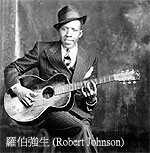
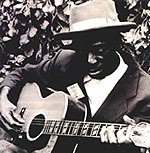
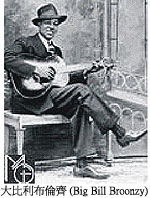
of Bessie Smith, Big Bill Broonzy, Robert
Johnson and countless other Blues artists.
Musically speaking, the Blues is a very simple
form. Most Blues feature a simple repeated
chord progression played over a 12-bar or
16-bar rhythmic structure. The strength and
vitality of the Blues lies in its tradition
and in the form's capacity to provide a context
for a musician to give voice to personal expression
through endless musical and lyrical improvisations.
It is this potential for expansive, expressive
improvisation which led to the Blues giving
birth to Jazz, R&B, Rock & Roll, Country
Western, Heavy Metal, Soul and Pop.
However, despite the fact
that the Blues is the foundation of so much
of modern music, this genre of music suffers
from a severe lack of respect. Many make the
unfortunate mistake of thinking, "Three
chords, 12 bars--what could be easier?"
Rock and Jazz players in particular tend to
think they can knock off some standard Blues
riffs and--presto!--"Look, ma! We're
playing the Blues!" The truth is the
Blues are easy to play--badly--precisely because
it is such a simple musical form. That simplicity
is deceptive: good Blues cannot be played
with bored nonchalance or condescension. As
with any art form, it is passion that drives
the Blues and that passion must be personal
and intimate.
A well-known adage goes, "You've got
to pay your dues to play the Blues."
That is the cardinal rule, with no exceptions.
While playing, you must convey, with honesty
and conviction, your personal experience of
life on this planet. Everyone has a range
of life experiences to be recognized and empathized
and sympathized with by others. That's what
the Blues is about: voicing the shared human
experience of joy, love, sorry, tragedy, life
and death, so that each of us knows we are
not alone. From that fact, we can take comfort.
A commonly held misconception
about the Blues is that the songs are always
dismally melancholy. Nothing could be further
from the truth. While the Blues arose from
the shared experience of African-Americans
suffering the hardships of poverty and socio-political
repression, it was sung as a musical release
at parties and dances. The songs had to be
joyous and hopeful to lift the spirits of
party-goers and get the dancers moving. The
subject of a song's lyrics might be petty
or profound, raucous or reflective, ribald
or tender--of all of these together. Songs
range from expressing soul-sick depression
(such as "Hell-hound on My Trail")
to philosophical reflections on the human
condition ("Mother Earth"), from
quiet hope ("The Sun's Gonna Shine")
to joyful celebration ("Pride & Joy"),
and from macho bravado ("Hootchie-Kootchie
Man") to hard-edged comedy ("Give
Me Back My Wig").
Historically, the Blues grew
out of the music of West Africa. The songs
of the "griot" (traditional minstrels)
became spirituals and work-songs. In the late
1800s, southern African-Americans combined
their music with European-American folk traditions.
Most of the Blues recorded in the early 1900s
were played on guitars and pianos. New regional
hybrids appeared and, in the 1930s and '40s,
the Blues broadened in diversity, instrumentation
and appeal. Some musicians continued to adhere
to acoustic traditions while others took it
to jazzier territory. Most Blues musicians
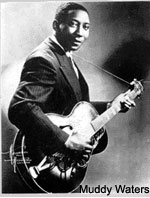
have followed the lead of T-Bone Walker and
Muddy Waters by playing the Blues on electric
instruments.
The main classifications among the many styles
of the Blues are Delta Blues, Piedmont Blues,
Jump Blues, Chicago Blues and Texas Blues.
Delta Blues
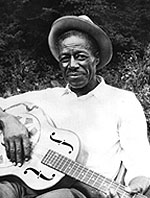
The Delta Blues style comes from a region
along the banks of the Mississippi River that
is romantically referred to as "the land
where the Blues were born." The Delta
Blues form is dominated by fiery slide guitar
and passionate vocals, with the deepest of
feelings being expressed through the music.
Its lyrics are passionate and, in the highest
flowering of blues songwriting, stand as stark
poetry. The form continues to the present
time with new performers working in the older
solo artist traditions and style. It also
embraces the now-familiar string-band/small-combo
format, precursors of the modern-day Blues
band.
Piedmont Blues
Piedmont Blues describes the shared styles
of musicians from Georgia, the Carolinas and
Virginia as well as others from Florida, West
Virginia, Maryland and Delaware. The Piedmont
guitar style is highly syncopated and employs
a complex finger-picking method in which a
regular bass pattern, played with the thumb,
supports a melody on the treble strings. The
Piedmont style is an extension of an earlier
string-band tradition integrating ragtime,
blues and country dance songs.
Jump Blues
Jump Blues is an up-tempo, jazz-tinged style
of Blues that came to prominence in the mid-to-late
1940s. Jump Blues usually featured a vocalist
in front of a large, horn-driven orchestra
or a medium-sized combo with horns. The style
is characterized by a driving rhythm, intensely
shouted vocals, and honking tenor saxophone
solos. The lyrics are almost always celebratory
in nature, full of braggadocio and swagger.
Jump Blues was the bridge between the older,
guitar-based styles and the big band jazz
sound of the 1940s.
Chicago Blues
The "classic Chicago style" was
developed in the late 1940s and early 1950s
by taking Delta Blues, amplifying it and putting
the basic string-band and harmonica group
into a small-band context of drums, bass and
piano and, sometimes, saxophones. This became
the standard Blues band lineup. The form is
flexible enough to accommodate singers, guitarists,
pianists and harmonica players as the featured
performers.
Texas Blues
Texas Blues is characterized by a more relaxed,
swinging feel than other styles of Blues.
Its earliest incarnation occurred in the mid-1920s,
featuring acoustic guitar-work that was almost
an extension of the vocals rather than merely
a strict accompaniment to them. The next stage
of development in the region's sound came
after World War II