|
|
The
world in one city': An interview with Mayor
Jason Hu
By
Douglas Habecker, translated by Dong Xu
Li
To
mark the launch of Taichung's first monthly
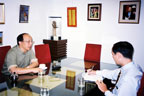
English tourism supplement, COMPASS Co-Publisher
Douglas Habecker interviewed Taichung City
Mayor Jason Hu about the current and future
development of tourism in Central Taiwan.
COMPASS: When it comes to tourism in Taichung,
what are the best things that Taichung has
to offer?
Mayor
Hu: I'll say a leisurely atmosphere is number
one. We often say, "It's the world
in one city." Taichung's very internationalized,
yet very local. I think this leisurely atmosphere
includes good food, good accommodations, and
good places to go out for a cup of coffee or
a glass of beer. For all these, I think Taichung
ranks number one. We are discovering that more
and more expatriates--especially from Taipei,
Taoyuan and Hsinchu--are finding their way
to Taichung for a wonderful weekend, so that
all the hotels are swamped with expatriate
tourists during the weekends. I think this
all shows that Taichung is modern, leisurely
and Taiwanese.
COMPASS: What specific Taichung attractions
really draw people to Taichung?
Mayor Hu: Taichung now hosts the hottest visiting
points in Taiwan, like the Science Museum.
The National Museum of Art, which hosts the
best collection of Taiwanese artwork, also
reopened about a month ago. And there's good
shopping. Actually, Taichung must not limit
its tourism to the city boundaries, but go
beyond the city boundaries to Sun Moon Lake;
Puli's Chung Tai Temple; the flower nurseries
in Changhua; Lukang, with its early Taiwanese
civilization; Sani, the woodcarving capital
of Taiwan; and Miaoli, with its Hakka culture.
Within about a reasonable one-hour radius of
Taichung, you have the whole central area.
This is why Taichung offers much more than
Kaohsiung or Taipei. I want to make Taichung
the hub for Central Taiwan tourist attractions.
You don't find good hotels at some of these
[outlying] areas, but you can always come back
to Taichung at night, have a good dinner here,
enjoy some drinks and spend the night. You
could spend five days and four nights here--a
beautiful holiday.
COMPASS: Are there any future developments
that will boost Taichung even further as a
tourist attraction?
Mayor
Hu: First, we are concentrating on a Culture
Festival. Last year, it combined literature,
art and music and, this year, it also takes
that approach. By about the end of next year,
we will have an amphitheater completed. It's
an open-air theater, like the Hollywood Bowl,
with outdoor seating for 15,000 people and "green" architecture,
located in the seventh redevelopment district.
With that kind of facility and the determination
to organize cultural festivals, one after another,
year after year, we hope that after five to
10 years we will build up the most famous art/cultural
festival in Asia. You've heard of Mardi Gras
or the German Munich Beer Festival, but there's
nothing in Asia, so we're hoping to organize
something. Last year, we had the Jazz Festival
and this year, we'll have a Mardi Gras-style
street carnival. Last year's Rio-style carnival,
with Brazilian dancers and floats, got 100,000
people on the street in one night. The most
successful example was the Lantern Festival
last year, which brought 6.4 million visitors
to Taichung. The average economic spin-off
was NT$5 billion. Even sun cake sales reportedly
reached NT$100 million in 12 days. I don't
think anybody else can create that kind of
record in Taiwan. This is because we are centrally
located, so we must continue to use that advantage
to organize festivals.
That's
the "software" and then there's
the "hardware". We're trying hard
to build the Guggenheim Museum for international
tourism. We're working hard [to cooperate]
with the Science Museum and Art Museum. We're
also building an international baseball stadium,
to be done the year after next, in time for
the 2006 Intercontinental Baseball Games, which
will be held in Taiwan.
Of course, you cannot have tourism without
good publicity. We're organizing an Information
Office, which will spend at least half of its
effort on tourism promotion. We also have built
an Information Center on ZhongZheng Road which
we hope will soon be operating as the information
hub for all Central Taiwan. Other counties
can leave their information there and we want
people come, pick up their information and
drive around. For the Lantern Festival, we
called a meeting of the Central Taiwan tourist
government officials and we worked together.
We need to begin our cooperation in this regard,
which is a win-win situation. Taichung's a
modern city; if you want to attract international
tourists, you have to be a hub for a lot of
other places.
COMPASS: Are there any trends that will affect
Taichung in the future?
Mayor Hu: The high-speed railroad is very important
for Taichung. Taichung will be within 40 minutes
of Taipei, which is within the tolerated limit
for commuting between the two cities. It will
make Taichung even more central in Taiwan,
because we will be within 40 minutes of Taipei
and 45 minutes of Kaohsiung. I think the high-speed
rail will transform Taichung, making it more
pivotal to the daily life of all Taiwanese.
I believe the new amphitheater will become
the new center of performing arts, of rock
or pop concerts, in Taiwan if not all Asia.
Everyone has stadiums, but this will be the
first amphitheater in the Chinese world. Imagine
thousands of kids taking the high-speed rail
for 40 minutes to Taichung, enjoying a concert,
going home, and ringing their doorbells before
midnight. So the high-speed rail will be very
beneficial to Taichung for cultural activites,
daily activities and tourism. |