|
HOME >
CENTRAL TAIWAN > TAICHUNG
> ARTICLES >
COMPASS
MAGAZINE, March 2002.
ABOUT TOWN:

 |
By Chen Ni-Ang Translated by
Matt Godsey and Annie Chen
Beyond
a doubt, Da Ken is one of the most important recreational
and tourist areas in Taichung. This scenic rural area, with
its rolling forested hills and hiking trails, has become a
regular destination for many residents and visitors.
|
The construction of hiking trails, which follow
a creek all the way up the mountain, began in 1981. From left to
right, the trails are numbered one through four, and are called
Cho Shui Ken (#1), Ching Shui Ken (#2), Heng Ken (#3), and Bei Keng
(#4). All four trails eventually connect to trail #5, which exits
at Chung Hsing Lin.
| Each
trail has its own special point of interest at its entrance.
For Trail #1, there is a physical training area; for Trail #2,
it is a hexagonal pavilion; for Trail #3, it is the Chang He
Pavilion; and for Trail #4, it is the Chung Cheng Campground.
All four trails are more than a kilometer in length and, although
they do not reach a very high altitude, are very steep. There
are many places where ropes have been installed to make it easier
for hikers to climb. Around 1985, the Taichung City Government
began running a special bus service on weekends to bring visitors
to Da Ken but the service stopped soon thereafter. |
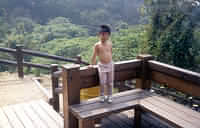 |
Today most people drive to the entrance of Trail
#2 to begin their hike. However, no matter which trail they choose,
hikers should expect to spend at least an hour climbing to the top,
where there¡¦s a big pine tree that greets them at
the end of their hike. The climb might take longer for those unaccustomed
to hiking, and hikers should remember to save some energy for the
hike back to their car.
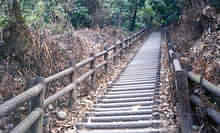 |
Da
Ken was seriously damaged during the September 21, 1999 earthquake.
The entrance to Trail #1 was completely destroyed. Parts of
Trail #2 fell into the creek bed, and the trees that once ran
along and shaded Trail #4 slid to the bottom of the mountain.
At that time, the damage to the Da Ken area was so severe that
the trails had to be sealed off. But, after two years of hard
work, the trails have been restored to their former glory. The
only noticeable differences are that some wooden steps have
been replaced with concrete, and some sections that once had
lush groves of trees are now bare. However, the trails have
been completely rebuilt and reopened. |
It is interesting to note that most visitors to
Da Ken today are in their forties or fifties, middle-aged people
who go for health and leisure. Young people usually only go on weekends
and holidays, mostly in large groups. Carrying their own barbeque
equipment with them, they settle in whatever spot they can find
to cook. As for hiking, most of them lose interest too quickly to
make the one or two hour climb.
|
In the beginning, the trails were created
by local residents. Then, they wore conical bamboo hats with
a scarf tied under their chins, and carried a machete by their
sides. Today¡¦s climbers sport sun hats, backpacks,
towels for wiping away sweat and, sometimes, gloves to protect
their hands from rope-burns.
Despite the fact that you will probably encounter
hikers who carry small radios to listen to their favorite
music or programs while walking, Da Ken's many trails remain
a peaceful, healthy getaway for those interested in a little
fresh air and time away from the city.
|
 |
|

